Session Length Calculator
Estimate total recording studio hours from song count, runtime, takes, overdubs, setup, edit and comp time, break buffer, and tempo changes that stretch or compress the actual pass length.
Load a realistic session profile, then adjust the exact inputs for the band, engineer workflow, and song arrangement. The calculator estimates time only; it avoids cost and booking-rate assumptions.
| Stage | Formula | Minutes | Hours |
|---|---|---|---|
| Setup | Waiting for calculation | 0 | 0.0 |
| Session type | Typical songs | Usual take plan | Planning note |
|---|---|---|---|
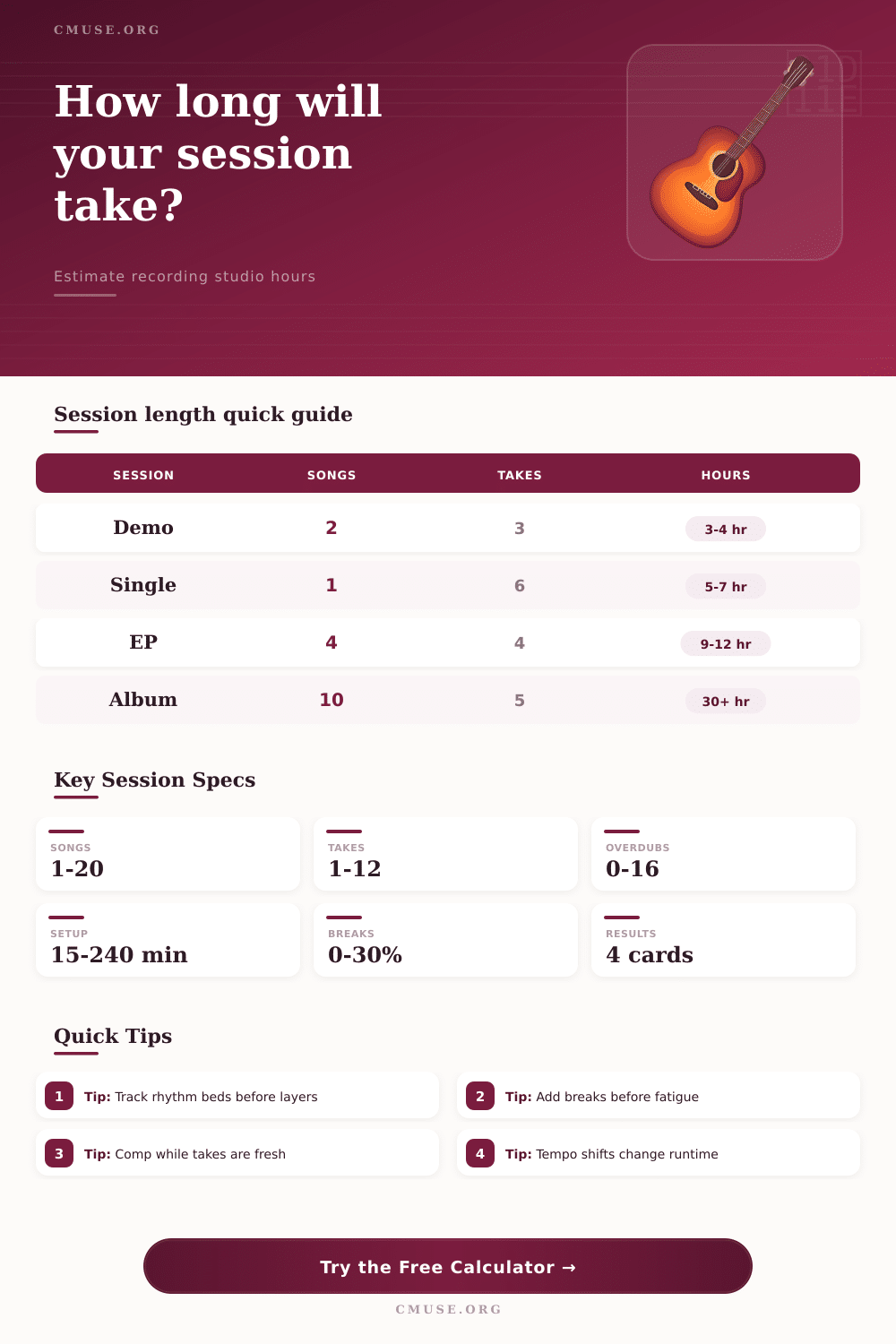
| Scratch demo | 1 to 3 | 2 to 4 takes | Fast decisions matter more than polish. |
| Lead vocal single | 1 | 5 to 10 takes | Comping and punch time often exceed raw runtime. |
| Live band EP | 3 to 5 | 3 to 6 takes | Setup is heavy, but songs move quickly after tones. |
| Layered production | 1 to 4 | 3 to 8 takes | Overdub coverage drives the final block length. |
| Album tracking | 8 to 12 | 3 to 7 takes | Break buffer protects performance quality. |
| Take density | Best for | Time effect | Risk signal |
|---|---|---|---|
| 1 to 2 takes | Live captures and practiced cues | Low pass time | Few alternate edits available. |
| 3 to 5 takes | Most singles and band beds | Balanced pass time | Needs clear keeper notes. |
| 6 to 8 takes | Lead vocals and solos | High pass time | Comping can expand quickly. |
| 9 plus takes | Detailed pop vocals or difficult parts | Very high pass time | Performance fatigue may slow progress. |
| Overdub coverage | Multiplier | Examples | Use when |
|---|---|---|---|
| Short spots | 0.20 x runtime | Tags, hits, small repairs | Only a few bars need work. |
| Section parts | 0.35 x runtime | Verse guitars, chorus stacks | Parts appear in selected sections. |
| Half-song parts | 0.50 x runtime | Backing vocals, percussion | Layers enter for much of the arrangement. |
| Mostly full | 0.75 x runtime | Doubles, synths, strings | Parts support nearly the whole song. |
| Full pass | 1.00 x runtime | Lead vocal, bass, rhythm guitar | The part runs from start to finish. |
| Example project | Core setup | Common total | Watch item |
|---|---|---|---|
| Solo acoustic single | Vocal and instrument mics | 3 to 6 hours | Tuning resets between takes. |
| Hip-hop vocal stack | Lead, ad libs, doubles | 4 to 8 hours | Overdub layers can outgrow the song. |
| Rock rhythm beds | Drums, bass, guitars | 6 to 10 hours | Initial drum tones dominate setup. |
| String cue session | Section mics and score prep | 5 to 9 hours | Page turns and fixes add resets. |
| Full album day | Repeatable live-room template | 10 to 14 hours | Break planning keeps takes usable. |
When an individual enter the recording studio, the time to record often expands. The time to record a song is frequenlty longer than the time that was originally planned due to the fact that there is often small tasks that take up more time than the band members had estimated it would take to complete. For example, a band may have planned a song session to record three songs in one afternoon, but the band may end up recording past the midnight hour due to the need to swap guitars, and to listen to takes of the songs to select which take was going to be the one that was incorporated into the song.
After performing for several hours, each band member will experience ear fatigue, and, therefore, will need to take breaks. These types of tasks and breaks is why a session length calculator is beneficial for the band and recording studio to utilize; it can estimate the amount of time that will be required for the band to perform in the session. A session length calculator will require several different types of inputs from the band to accurately reflect the length of the recording session that is to occur.
How to Estimate Time for a Recording Session
One of the most important variable that will impact the length of the session is the count of the number of songs that will be performed. Other important variables that will impact the length of the session is the take count, the overdub count, and the tempo at which the band will perform the songs. Each of these variable will impact the length of the songs during the session; therefore, it is important to have each of these variables accounted for in the calculation of the length of the session.
These various variables will help to reveal the type of session that will occur. For example, a session consisting of two scratch demo songs with three takes each will take less time than a session that consist of a single lead vocal take that requires eight takes and several doubles. The scratch demo songs will require less time to edit than the lead vocal takes due to the fact that the lead vocal takes require more editing.
The calculator will calculate these variables for the band. Additionally, the calculator will perform the math for the band to determine the length of the session when accounting for percentage requirement for coverage of the songs and takes, as well. The length of the songs will not be consistent during the session.
For example, a three-minute song may expand to three and a half minutes due to the fact that the band may play at a different tempo during the session compared to when they were planning for the band to perform. Time will be required for each band member to change instruments. For example, the drummer will take more time to change instruments than an acoustic band member.
Each of these variables will be accounted for in the session length calculator. Breaks will be required for each band member during the session. However, each band member may not account for the time that will be required for breaks when planning the performance.
Each performer will experience fatigue during the session. For example, it is common for singers to lose their pitch after playing for five hour. If breaks are not accounted for in the planning of the session, the band may not be able to perform at the same level during the session.
This break time can be accounted for in the length calculator. Tables within the session length calculator will reveal the amount of takes for the session and the length of time that will be required for each of those takes. For example, two or three takes may be sufficient for a band performing a well rehearsed song.
However, eight takes may be required for a band that is performing a song that features exposed musical parts. Similarly, a short harmony line will require the band to multiply the length of the song by a small number, but a full instrumental arrangement may require the length of the song to be multiplied by the entire length of the performance. Each of these variables can be accounted for in the length calculator.
A session length calculator will not eliminate the human variables that may impact length of a song session. For example, it is possible that during a long practice session a great take may occur quickly; however, another section of the song may take several takes to be mastered by each band member. Calculating the length of time for the session will provide for a floor for that song session; however, it will also allow for each band member to decide if an extra day is required to learn the song or if the song will be performed in a tighter time frame.
By accounting for time in the plan for the band to record songs, the quality of those takes will be protected. Additionally, by allowing for an early completion date for the mastered session, the audio that is created will be of higher quality than that which would be created if an optimistic date for the session was establish.