Producer Points Calculator
Estimate a producer royalty from record deal points, royalty base, net receipts, producer advance recoupment, artist recoupment gates, and the final split among up to four producers.
Model: Load a named deal structure, then adjust the royalty base, points, recoupment account, producer advance, and producer split table to match the contract or royalty statement.
Enter named producer shares. If the shares do not total 100%, the calculator normalizes the entered split so the payable producer royalty is fully assigned.
| Producer | Role note | Entered split % | Advance allocation % |
|---|---|---|---|
| Producer | Role | Entered split | Normalized split | Advance share | Payable royalty |
|---|
| Base language | Calculator basis | Common use | Watch item |
|---|---|---|---|
| Gross master receipts | All gross income before deductions | Simple indie or direct-to-artist agreements | Usually higher than net receipts |
| Net receipts | Gross less platform, reserves, and approved deductions | Distribution, licensing, and profit-share deals | Define every deductible item clearly |
| PPD or wholesale base | Eligible units multiplied by PPD | Traditional physical and download accounting | Free goods and returns may change eligible units |
| Artist royalty base | Net receipts multiplied by artist royalty rate | Producer paid from artist royalty account | All-in royalty language may reduce artist share |
| Gate selection | Producer advance | Artist recoupment | Payment behavior |
|---|---|---|---|
| No recoupment gate | Ignored for payout | Ignored for payout | Earned producer royalties are payable immediately |
| Recoup producer advance only | Recouped first | Tracked only | Royalty after producer advance becomes payable |
| Advance plus expenses | Advance and expenses recoup | Tracked only | Expenses increase the producer recoupment account |
| Pay only after artist recoupment | Not deducted here | Must be fully recouped | Producer royalty may be held until the artist account clears |
| Advance plus artist gate | Recouped first | Must be fully recouped | Most conservative payment timing estimate |
| Preset | Base | Points | Recoupment emphasis |
|---|---|---|---|
| Indie Net Single | Net receipts | 3.0% | Producer advance only |
| Major Album PPD | PPD units | 4.0% | Advance plus artist recoupment gate |
| Distribution Net Deal | Net receipts | 2.5% | Advance plus approved producer expenses |
| Artist Royalty Gate | Artist royalty | 25.0% | Producer paid from artist-side royalty base |
| Multi Producer Remix | Gross receipts | 1.5% | Four producer split with no advance gate |
| Split setup | Producer 1 | Producer 2 | Best use |
|---|---|---|---|
| Sole producer | 100% | 0% | One producer controls the full points share |
| Main plus co-producer | 70% | 30% | Lead producer with meaningful co-production |
| Track and vocal producer | 60% | 40% | Separate track production and vocal production duties |
| Four-way remix team | 25% | 25% | Use all four rows for equal remix or collective splits |
| Statement line | Calculator field | Formula check | Reason |
|---|---|---|---|
| Gross receipts | Gross master receipts | Starting income line | Sets the top of the royalty waterfall |
| Distribution fee | Distribution or platform fee | Gross multiplied by fee percent | Changes the net receipts base |
| Royalty base | Producer royalty base | Base selected in the contract | Most disputes start with base definition |
| Producer royalty | Producer points | Base multiplied by points percent | Shows earned royalty before recoupment |
| Producer advance | Producer advance | Deducted from earned royalty when selected | Separates earned royalties from cash payable now |
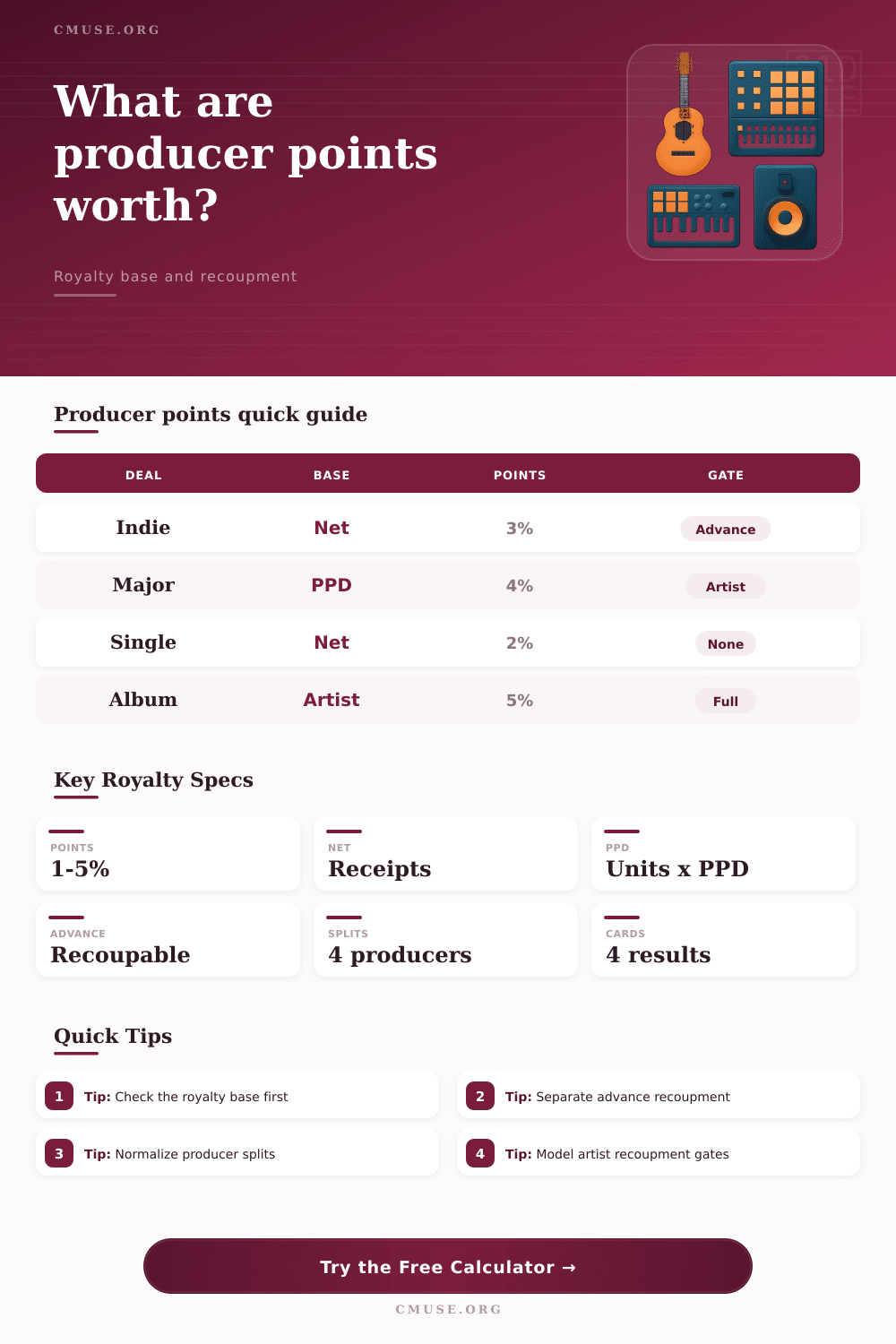
Producer point are a percentage of the money that will go to the producer from the record deal. However, the producer may not understands how the producer points will become actual money for the producer. For example, a record deal may state that the producer will receive three points.
However, the producer may not understands what these three points apply to or how they will be calculated. The royalty bases is where the calculation begins for the producer points. The royalty base will ultimately determine the total amount of money that the producer points will applies to.
What Producer Points Mean and How They Work
For some record deal, the royalty base is set to gross master receipts. Gross master receipts mean that the total amount of money will be counted from the sale of the music before any fee is deducted. However, other deal may state that the royalty base will be net receipts.
Net receipts is the amount of money that will be left over from the sale of the music after the distribution fee, returns, and deductions is made. Some older deal may use the royalty base of published price to dealer multiplied by units sold. However, newer deals might use the producer points to apply to the artist royalty account.
The way that the royalty base is defined will ultimately change the amount of money that the producer will receive. Recoupment rule will dictate when the producer will receive the money from the record deal. There are recoupment rule for the producer’s benefit because producers usually receive advances on their earnings from the record deal.
Producers almost always receive advances on their advance for the record deal. The royalties that a producer earns from a track will be used to pay the producer advance. In some case, the producer expenses will be used to pay the advance.
In others, the artist will have to pay for their advance and recording cost before the artist pays the producer. Understanding the recoupment rules will allow a producer to plan their finances proper for creating new music. If a producer must wait many years for the artist to pay for their advance, it can pose a financial challenge for that producer.
You can use the producer point calculator to see where the money stop and where it starts for a record deal. Producer splits are used for when several individual will produce a single track. The splits will dictate how the producer pool money is divided up among each producer.
For example, if four individuals produce a song, they will not all earn the same percentage from the song. This is because one producer might have produced the beat for the song while another produced the vocals. The percentages for each producer might not always come to 100%.
In this case, there will be a normalization process to allocate all of the producer pool money. The producer point calculator will perform the split for each producer. The calculator will also show each producer the amount of money that each producer will earn.
The advance allocation must equal the producer split. If it do not, there will be dispute between the producers and the artist when the royalty statement is sent. Many mistake are made by producers that have a mismatch between the expectations of the producer points and the actual definition of those points in the contract.
For instance, the producer may work to earn three points on gross sales; however, the company may define the royalty base more narrow. This would cut the producer’s earnings in half. Additionally, producers assume that the producer will earn their advance; however, the contract may state that the artist must earn their advance and cost before the producer will be paid.
These mistake can be avoided by modeling the various producer point input prior to reviewing the royalty statement for the artist. The reference table on this page will help you to map out the language of the record deal to the producer point calculator settings. These table will help you map each clause in the deal memo to the correct setting in the producer point calculator.
There are also preset button for common deal types in the producer point calculator. These include indie net single deals, major label PPD deals, joint ventures, and multi-producer remixes. These buttons can save producers time in setting up the parameter for the deal that they will produce for there artist.
Due to the changing nature of record deals and music in particular, the parameters of the producer point calculator may have to be updated. For instance, a song that was produced as a remix might become a lead single, or the artist might earn their sync placement before the producer will be paid for any advance. These change can all be reflected in the producer point calculator to show producers how the producer pool might change.
The producer point calculator does not replace the record deal contract, but it can remove the guesswork that go along with that contract. The most important step for a producer to take prior to signing a contract is to run the number through the producer point calculator. By understanding how the royalty base, the producer points, the recoupment gate, and the producer splits interact within the record deal, the producer can have leverage when negotiating the terms of the record deal.
The producer can use this knowledge to negotiate a clause that appropriately protect the producers time and contribution to the music that they created.