Performance Royalty Calculator
Estimate music performance royalties from play count, venue or broadcast weight, duration, PRO collection share, territory factor, writer and publisher splits, and per-writer ownership.
🎼 Performance Presets
Presets load practical starting values for live venues, radio, streaming simulcasts, television cue sheets, and territory-weighted performance activity.
⚙ Royalty Inputs
Estimate model: PROs use proprietary surveys, cue sheets, blanket licenses, census logs, and distribution rules. This calculator creates a transparent planning estimate from adjustable factors.
Royalty Estimate
Adjust the inputs to model performance royalty distribution.
📊 Royalty Spec Grid
📝 Per-Writer Allocation
| Writer | Entered Share | Normalized Share | Estimated Writer Royalty |
|---|---|---|---|
| Writer 1 | 40.0% | 40.0% | $0.00 |
| Writer 2 | 30.0% | 30.0% | $0.00 |
| Writer 3 | 20.0% | 20.0% | $0.00 |
| Writer 4 | 10.0% | 10.0% | $0.00 |
🎤 Venue And Broadcast Weights
| Performance Source | Planning Weight | Typical Count Basis | Best Input Use |
|---|---|---|---|
| Open mic or small background music | 0.20x | Venue logs or set lists | Low-reach room estimates |
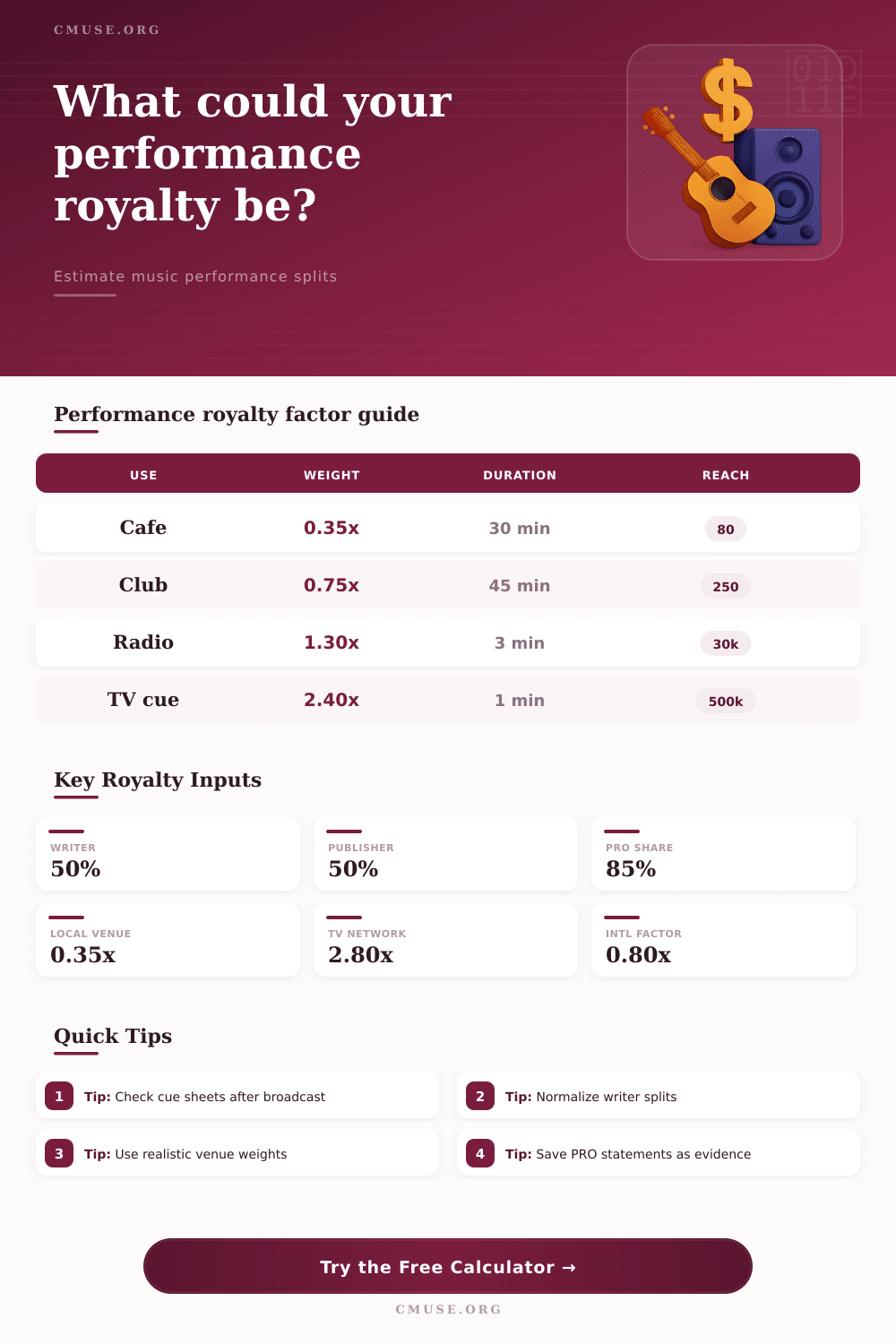
| Coffeehouse or small venue | 0.35x | Live set performances | Original songs in small rooms |
| Club or ticketed local venue | 0.75x | Set lists and attendance | Regional live activity |
| Festival stage or major venue | 1.20x | Reported set performance | Large audience live events |
| College or local radio | 1.30x | Spins and station logs | Noncommercial airplay batches |
| Commercial radio rotation | 1.85x | Airplay monitoring | Repeated broadcast spins |
| Cable or regional TV cue | 2.40x | Cue sheets and airings | Program background music |
| Network television feature cue | 2.80x | Cue sheets, duration, airings | Prime or high-reach broadcasts |
🌍 Territory And Collection Factors
| Territory Scenario | Factor | Collection Timing | Use When |
|---|---|---|---|
| Domestic standard | 1.00x | Normal PRO cycle | Home society domestic performances |
| Foreign reciprocal average | 0.80x | Often delayed | International society collection estimate |
| Delayed reciprocal territory | 0.65x | Longer delay | Less certain overseas reporting |
| High-license major market | 1.15x | Normal to delayed | Large commercial media territory |
| Premium network market | 1.35x | Cue-sheet dependent | High-value network broadcast modeling |
| Unverified or partial data | 0.45x | Uncertain | Missing, sampled, or incomplete reporting |
📐 Split And Registration Examples
| Registration Setup | Writer Pool | Publisher Pool | Allocation Note |
|---|---|---|---|
| Self-published songwriter | 50% | 50% | Writer may control both sides if registered correctly |
| Two equal co-writers | 50% | 50% | Each writer receives 25% of total distributable royalty |
| Band with four writers | 50% | 50% | Writer pool is divided by agreed songwriter splits |
| Publishing administration | 50% | 50% | Admin holdback can reduce net publisher pool |
| Film or TV cue sheet | 50% | 50% | Duration and use type often affect weight heavily |
📋 Common Performance Scenarios
| Scenario | Count | Duration | Suggested Factor Focus |
|---|---|---|---|
| Local original set | 8 to 20 | 25 to 45 min | Venue weight and attendance reach |
| Regional tour batch | 20 to 80 | 30 to 60 min | Consistent set lists and territory |
| Radio campaign | 50 to 2000 | 3 to 4 min | Station class and logged spins |
| Streaming simulcast | 1 to 50 | 15 to 90 min | Verified reach and platform reporting |
| TV background cue | 1 to 500 | 0.25 to 3 min | Cue-sheet duration and market weight |
Performance royalties is provided to songwriters in the following instances: live performances, radio and television broadcasts, and media placements. These royalties are determined by several variables, such as the frequency with which the song is played, in what locations the song is played, how long the song is played, and in what ways the royalties is split between the song writer and the song publisher. Because there are so many different variables that can impact the royalty payments that a songwriter can receive, it is dificult for that songwriter to predict the amount of royalty payments that he or she will earn.
The royalty calculator allow a songwriter to input different data regarding the song and it’s performances to calculate the performance royalties that the songwriter will earn. Variables that must be input include the performance count, the weight of the performance venue, the length of the songs, the reach of the songs, the territory factor, and the splits between the writer and the publisher. The royalty calculator use these variables to apply certain multipliers to those variables in order to arrive at the total royalties that the writer will earn.
How the Performance Royalty Calculator Works
The multipliers allow the songwriter to view the impact that each of those variables can have upon the total number of performance royalties that the songwriter will earn. Each of the performance royalty formulas are based upon surveys of the industry and licenses for certain uses of the songs. Thus, the songwriter can use the royalty calculator to determine whether he or she should focus upon registering new works or upon collecting the set lists of a tour that is to be played.
The venue weight is one factor that can impact the performance royalties of a songwriter. The weight of the venue changes based off the size of the audience that is to attend the performances of the songwriter, as well as the price of the tickets for those performances. For instance, performances at a coffeehouse will have a lower venue weight than performances at a music festival.
Thus, the performance royalties will be less for coffeehouse performances because music collecting societies use the size of the audience to determine the performance royalties of each songwriter. The royalty calculator allows each of these weights to be toggled in order to compare the royalties from performances at different types of venues. The length of the performances is another factor that can impact the performance royalties of a songwriter.
However, the relationship of length and performance royalties is in the opposite direction than that of the relationship of venue weight and performance royalties. Thus, longer performances earn the songwriter more performance royalties. For instance, a three-minute song will earn a songwriter more performance royalties than a thirty-second song.
However, the length of the songs does not change in a straight line; the structure of the system prevents the reach of songs from becoming too large. Territory factors is one other variable that can impact the performance royalties of a songwriter. Domestic performances earn songwriters more performance royalties than foreign performances, though those foreign performances are conducted through reciprocal agreements between countries.
These reciprocal agreements can lead to a reduction of the performance royalties that songwriters earn. The royalty calculator includes preset factors for each of these domestic and foreign territories. Additionally, the PRO collection share can be used to determine the total royalties that will be earned by the songwriter after the removal of administrative fees of organizations like ASCAP.
Finally, performance royalties are split between songwriters and publishers, and split according to percentages that may not necessarily be a fifty-fifty split. Some publishers offer different percentages to co-writers of a song, as well as with the inclusion of holdbacks in publishing agreements. The royalty calculator allows the input of royalties for each writer in order to determine the royalties for each writer after the split between writers and publishers is accounted for.
Although the data that is collected for the various variables may not necessarily be accurate, the performance royalty calculator can indicate whether or not the data is accurate by logging into the royalty calculator and comparing the performance royalties that are calculated to those that are published in royalty statements from administrative organizations for songwriters. Any discrepancy between the projected and actual royalties is likely due to inaccurate data or registration errors. However, many songwriters make mistakes in their calculations of performance royalties for songwriters.
One of the most common mistakes of songwriters is to believe that each performance of a writer’s songs is the same as each of the others. However, each performance may contain variables, such as the venue for the performances, the length of the songs, and the reach of each of those performances. It is also possible for some songwriters to forget about the influence of the length and reach of a writer’s song when calculating performance royalties.
For example, a songwriter may only consider the number of dates on which he or she performs, but a short song with high reaching capabilities may be worth more performance royalties than a long performing of a song that has a limited reach. Finally, many songwriters may not account for the impact of the different territory factors on their performance royalties. For instance, it may appear to be a major success if a songwriter’s song is performed in another country, but the royalties for those performances will be lower due to the influence of the territory factors in calculating those royalties.
As a result of using the royalty calculator, it is important for each songwriter to keep accurate records of the performances of their songs. Such records can include set lists of each performance of the songwriters songs. Furthermore, if the songwriter’s performance is to occur at a festival, for instance, the songwriter is required to have the set list and the stage times for each performance logged in order to prove to royalty collecting organizations that the performances occurred.
The same is true for songs that are played on the radio or television; the songwriter is required to log the length of the song and the name of the program in which the song was played. Over time, each songwriter can begin to recognize the impact that each of these variables has upon the calculation of performance royalties for each writer. For instance, each songwriter that tours can learn of the weights of each of the different performance venues in which they perform.
Each songwriter that places songs within visual media can learn of the importance of the accuracy of cue sheets to determine performance royalties for those songwriters. Thus, the calculator can help these individual songwriters to better understand which variables impact the performance royalties of a songwriter the most. Thus, the calculator allows each writer to understand the relationship between the variables of performance royalties that are calculated for each writer.