Band Revenue Split Calculator
Divide one gig, session, merch night, or streaming payout after venue terms, management, crew, travel, reserve, equal shares, role weights, or custom member percentages.
Load a realistic starting point, then edit the deductions and member table. The calculator treats revenue math as an internal band ledger, not legal or accounting advice.
Use the weight column for bandleader, songwriter, or hired-player agreements. Use custom percent for explicit contracts. In equal mode, active members split evenly.
| Use | Member | Role | Role Weight | Custom % | Advance Paid |
|---|---|---|---|---|---|
| Member | Role | Share Basis | Share % | Gross Payout | Advance | Final Payout |
|---|
Total Deductions
Payout Share Of Gross
Active Members
Split Method
| Model | Best Fit | Typical Share Basis | Watch Point |
|---|---|---|---|
| Equal member split | Democratic band, regular gig | Each active member gets the same percentage | Does not reflect extra writing, driving, or admin labor |
| Role-weighted split | Bandleader plus core players | Lead, MD, or songwriter weights are higher | Weights should be agreed before the gig |
| Custom percentage split | Contract, royalty pool, side-player terms | Named percentage for each active member | Total should equal 100% for a clean ledger |
| Reserve-first split | Touring, gear repair, recording fund | Reserve is removed before member shares | Reserve rules need transparent tracking |
| Step | Calculation | Reason | Included Field |
|---|---|---|---|
| 1. Gross revenue | Start with total received | Door, guarantee, merch, royalties, or session pool | Gross revenue |
| 2. Venue terms | Subtract venue percent and flat house charge | Door splits often remove house terms first | Venue % and flat |
| 3. Representation | Apply manager and agent percentage | Usually based on post-venue band revenue | Manager % and agent % |
| 4. Shared expenses | Subtract crew, tech, travel, and overhead | Keeps player payouts separate from band expenses | Crew and travel fields |
| 5. Reserve and split | Hold reserve, then split the remaining pool | Funds future band needs before take-home pay | Reserve and split method |
| Preset | Gross Revenue | Deductions Emphasis | Default Split |
|---|---|---|---|
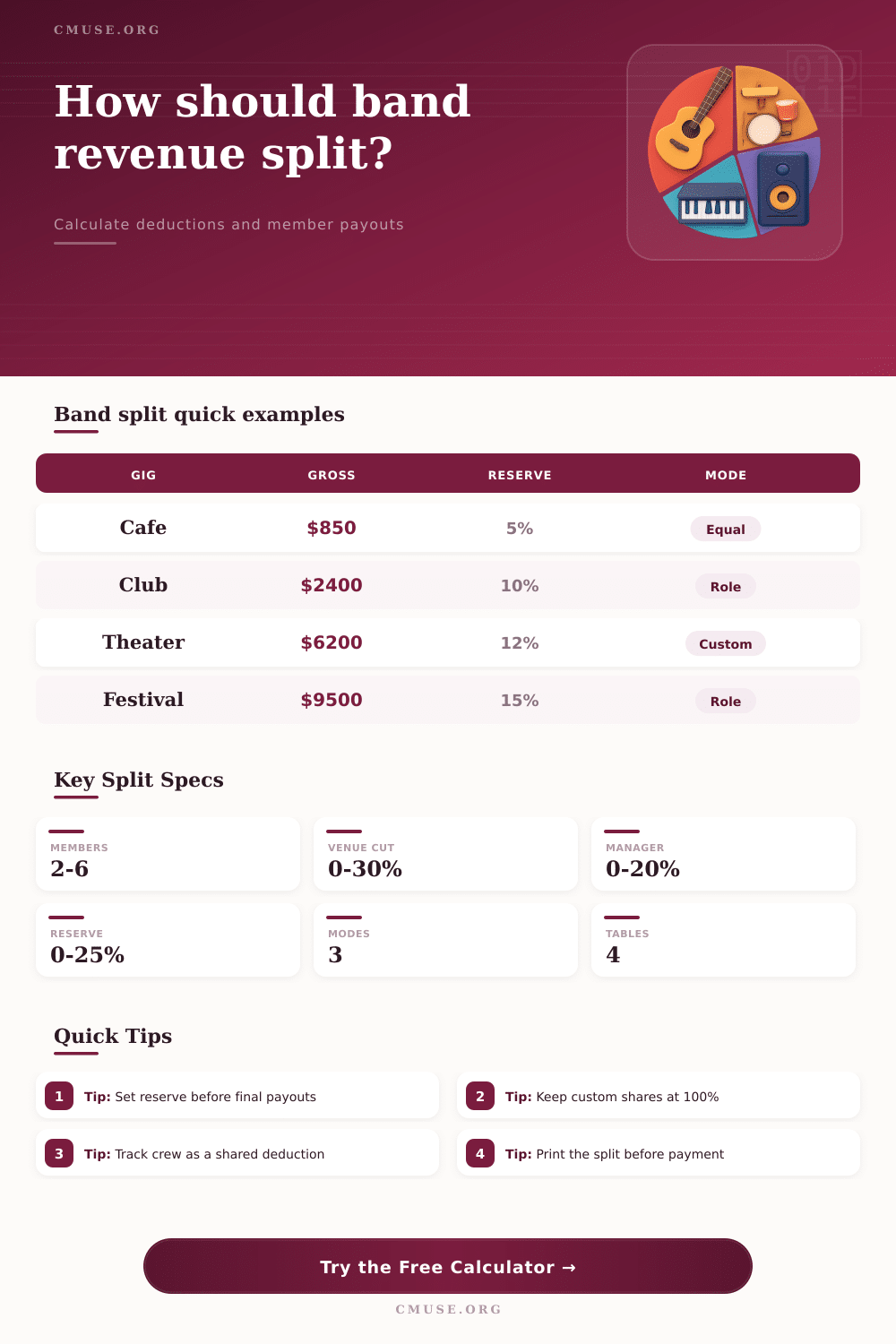
| Coffeehouse Duo | 850 | Small travel and light reserve | Equal |
| Club Door Split | 2400 | Venue share, crew, travel | Role weight |
| Wedding Band | 4800 | Manager, crew, travel, reserve | Role weight |
| Festival Slot | 9500 | Agent, crew, production overhead | Role weight |
| Streaming Royalty Pool | 1250 | No venue, no crew, reserve optional | Custom |
| Role Situation | Starter Weight | When To Use | Ledger Note |
|---|---|---|---|
| Equal core member | 1.00 | Shared rehearsals, shared travel, shared creative work | Good default for bands with standing members |
| Bandleader or MD | 1.20 to 1.50 | Handles booking, charts, set flow, or musical direction | Works best when admin labor is visible |
| Hired side player | 0.60 to 0.90 | One-off player with limited rehearsal or ownership | Confirm whether a minimum applies |
| Writer or producer share | Custom % | Royalty pool, sync fee, or release income | Use custom mode for exact agreements |
Most bands dont fight over moneys because a person is greedy, but most bands fight over money because the mathematical rules for the money was not written down before the musical performance occurred. Each band member may have specific role in the band that relate to money, such as who handles booking, who handles the van, or who brings the public address system. Consequently, there is no rule within the band regarding how the money should be distributed among the members.
This silence often follows between the band members creates tension within the group. A revenue split calculator removes this silence between the band members because the revenue split calculator ensure that each member is aware of how the revenue will be distributed before anyone recieve their money from the bands performance. The first decision that a revenue split calculator asks a band to make is whether all members should have the same share of revenue from the bands musical performances.
How to Split Band Money Fairly
All members will likely have the same share of revenue if each member both rehearse for the band and transports its equipment for its performances. However, it is likely that one member may have additional responsibilities beyond the other members to the band and revenue from its performances. These roles can be accounted for with the revenue split calculators role weight feature, which allows the band to assign multipliers to members to provide more revenue to those who spend more hours on non-performing task for the band.
The band may have to account for some of its revenue prior to distributing the remainder of the revenue to the band members, so the band must make deductions above the split line for the band members. Examples of deductions that a band may make prior to splitting revenue include venue cuts, manager percentages, and flat house charge. Following these deductions may be deductions for crew cost and travel costs for the band members.
The last deduction that may be made prior to distributing revenue to the band members is the establishment of a reserve percentage for the band. The reserve percentage is not considered profit for the band, but may be used for future repairs or repairs to the bands van. Many bands may choose to ignore this deduction, which is why revenue split calculators include this feature.
The order in which deductions are made is important for bands. For example, if the band deducts the reserve percentage before the manager’s percentage is deducted from the bands revenue, the manager will receive a percentage of money that the band members had previously decided to leave to the band. Additionally, if the crew costs are deducted after the split of the revenue between the band members, one band member will be required to pay for an expense that should be equally distributed among all band members.
The revenue split calculator establishes a specific order for all band members so that these types of errors do not occur with each musical performance by the band. The agreements amongst band members are often different than the bands settings within a revenue split calculator. For instance, bands may receive only one check for a wedding for their music, merchandise table, and a ceremony.
Additionally, bands that perform at festivals may receive a “production advance” for the festival that must be repaid if the sales of tickets for the festival are low. These types of conditions are outside of the control of a revenue split calculator, but the revenue split calculator includes a member table for tracking advances for the band. This table ensures that the band may subtract an advance that is paid to an individual from that individuals payment for the band, without affecting the share of revenue of the other band members.
Beyond the role weights within a revenue split calculator, many bands may use the custom percentage mode on revenue split calculators. For instance, the side musicians for a band may be required to receive a percentage of a sync license for the songs that are used in media. Additionally, the producer for a band may be required to receive a percentage of the streaming revenues of the bands music.
These percentages can be entered into the revenue split calculator so that the revenue split calculator automatically runs the calculations for the revenue for each band member. Band members often find that it is difficult to discuss money with a band that has grown from three members to five band members. For instance, each band member that has collected revenue from the performances of the band may feel that it is appropriate for the new band members to receive shares in the revenue from the band.
However, it is also common for band members to agree that the new members will receive shares after a probationary period for the band. A revenue split calculator does not make such a decision for the band, but does make clear the differences between splits with and without new band members. Even though the calculations and splits of revenue may be the least important discussion that a band has, it is important to have such a discussion.
Most band money disputes are not for large sum of money, but often for small costs that have been accumulated by one band member. By printing out the revenue split table prior to handing out the cash to the band members, the record of the money calculations for the band will replace the arguments between the band members. Though the numbers may not feel all that generous to each band member, the consistency of the calculations will help to maintain the band so that it can focus on its next musical performance.