Lighting Truss Weight Calculator
Estimate truss self-weight, fixture load, cable allowance, point load reactions, safety factor demand, working load limit use, and center load equivalent.
Choose a starting rig, then replace the numbers with the manufacturer WLL chart, exact fixture weights, clamps, cabling, hoists, and pickup details for the actual show.
Self-Weight
190 lb
Truss only over the entered span
Fixture Load
280 lb
Fixtures, clamps, and safeties
Uniform Load
24 lb/ft
Distributed equivalent across span
Status
Review
Planning result against WLL
| Truss Type | Typical Self-Weight | Common Use | Load Planning Note |
|---|---|---|---|
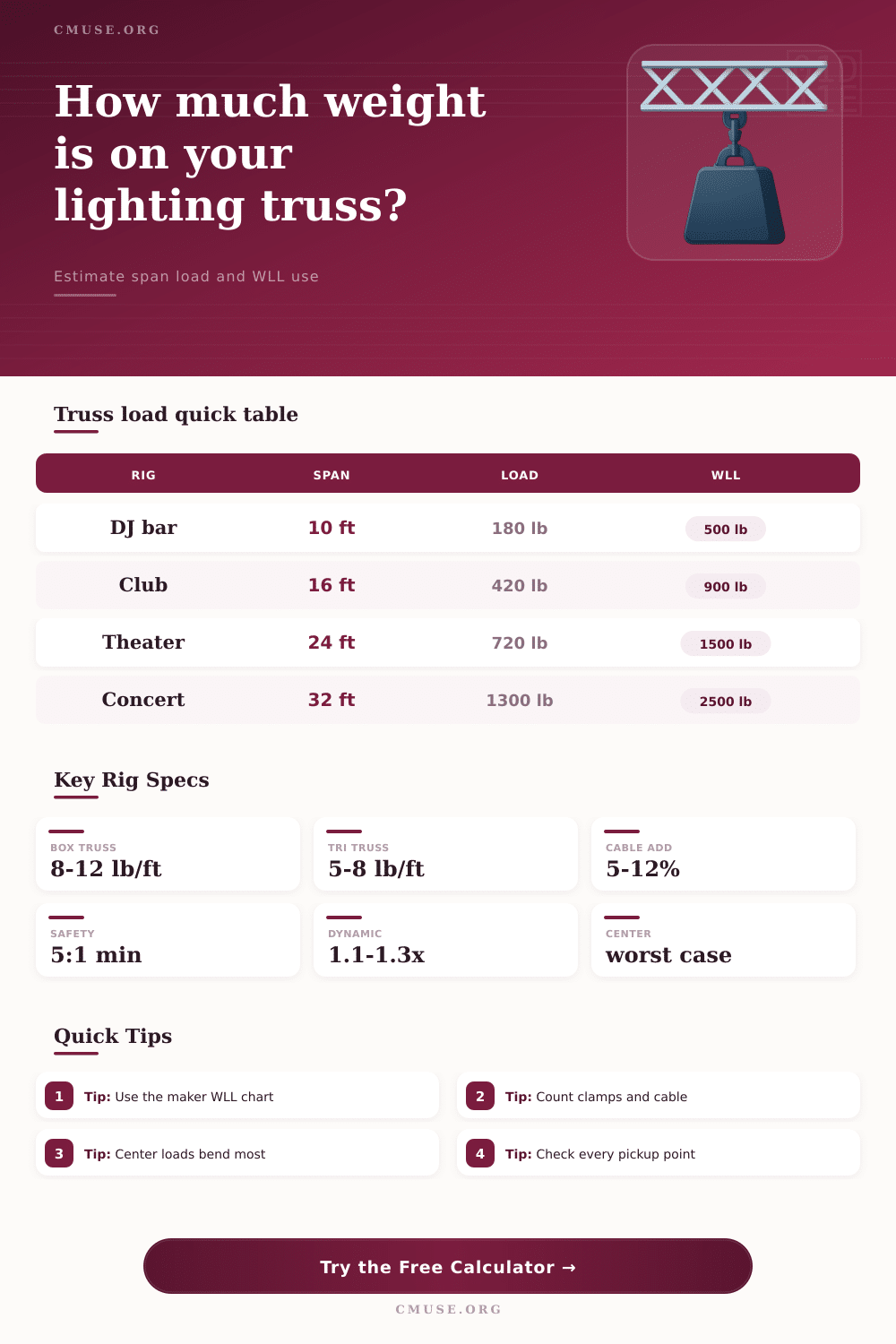
| 12 inch box truss | 8 to 12 lb/ft | Club, theater, corporate spans | Strong all-around option; always use the series chart |
| 20.5 inch box truss | 14 to 22 lb/ft | Concert spans and video support | Higher capacity but self-weight climbs quickly |
| Triangle truss | 5 to 8 lb/ft | Light bars and display frames | Orientation changes capacity more than many users expect |
| Ladder truss | 3 to 6 lb/ft | Small displays and scenic frames | Usually lower torsional capacity than box truss |
| Pattern | Simple Model | Center Bending Effect | When To Use |
|---|---|---|---|
| Evenly spaced | Uniform load | Moderate and predictable | Pars, LED bars, cable looms across the run |
| Center cluster | More load at midspan | Highest bending demand | Moving-head cluster, mirror ball, center video drop |
| Third-point clusters | Two balanced points | High but shared | Symmetric side clusters or PA trim additions |
| Near supports | End-biased load | Lower midspan bending | Motors, feeder looms, or fixtures near pickups |
| Preset | Span and Truss | Fixture Package | Typical Load Concern |
|---|---|---|---|
| Mobile DJ Bar | 10 ft at 5 lb/ft | 4 LED pars plus two small movers | Stand rating and end stability |
| Small Club Wash | 16 ft at 8 lb/ft | 8 pars, 4 movers, cable allowance | Fixture spacing and center cluster |
| Theater FOH Pipe | 24 ft at 10 lb/ft | Conventional wash and specials | Distributed load and pickup reaction |
| Festival Mid Span | 32 ft at 18 lb/ft | Large movers, strobes, and cable looms | WLL chart, wind plan, and motors |
| Term | Meaning | Calculator Use | Important Limit |
|---|---|---|---|
| WLL | Working load limit from a rated chart | Compares against factored rig load | Only valid for matching span and support conditions |
| Safety factor | Ratio between ultimate strength and working load | Shows implied ultimate demand | Does not replace inspection or engineering approval |
| Dynamic factor | Allowance for motion and handling | Multiplies the total dead load | Higher for moving lights, outdoor trims, and hoisting |
| Point load | Concentrated load at one span location | Used for reactions and center equivalent | Often more severe than the same load evenly spread |
Lighting truss calculation are necessary because lighting truss calculations will help you to understand the physical force that are acting upon the suspension system and how safe the truss is for the individuals underneath it. When you are hanging a lighting truss, you must consider the weight of the lighting fixtures that will be attach to the lighting truss. In addition to the weight of the lighting fixtures, you must also consider the weight of the lighting truss itself and how the weight will be distributed along the lighting truss.
If the lighting truss is not calculated correct, the individuals underneath the lighting truss may be in danger. For these reasons, there are specific input that must be made into the calculation to ensure the safety of the lighting truss. The first of these specific input is the span length of the lighting truss.
How to Calculate Lighting Truss Load and Safety
The span length will determine the amount of bend that will occur in the middle of the lighting truss. The second of these specific inputs is the self-weight per foot of the lighting truss. This input will help to determine the weight of the lighting truss relative than the weight of the lighting fixtures.
The third of these specific inputs is the Working Load Limit (WLL) of the lighting truss, which the manufacturer of the lighting truss provides. The WLL will indicate the tested weight capacity of the lighting truss for a specific span length and support configuration. In addition to these three specific input, it is also necessary to include the weight of every lighting fixture that will be attached to the lighting truss, as well as the weight of every clamp, safety cable, and yoke that will be use to attach the lighting fixtures to the lighting truss.
Finally, it is also necessary to include the weight of the cables that will be used to support the lighting truss; these additional ten percent or more of weight can significant impact the calculated safety of the lighting truss. The distribution of the weight of the lighting fixtures that are to be hung from the lighting truss is another important factor in the calculation of the safety of the lighting truss. The distribution of the lighting fixtures will impact the bending of the lighting truss.
Additionally, it is also necessary to include a dynamic factor in the calculation of the lighting truss. The reason for including this factor is that there will be movement of the lighting fixtures relative to the lighting truss and the environment in which the lighting truss is to be installed. For these reasons, a safety factor is implemented into the calculation.
A five-to-one safety factor is applied to lighting truss design to account for these dynamic force and to provide a margin of error for any unexpected item or additional weight that may be attached to the lighting truss. The outputs of the lighting truss calculation will provide you with specific data that will assist you in making decision regarding the lighting truss. For instance, each lighting truss will have a total dead load and a factored load.
Each lighting truss will have a utilization percentage and a reaction value. In the case that the utilization percentage is too high, it will be necessary to take some action to the lighting truss design to reduce the load upon the lighting truss. Such actions may include shortening the span of the lighting truss, reducing the number of lighting fixtures that are to be hung from the lighting truss, or by adding more pickup point along the lighting truss.
Many people make mistake when they attempt to calculate the lighting truss that will be used for the installation of the lighting fixtures. For example, many people forget to include the weight of the lighting truss itself in their calculation; the lighting truss itself can add several hundred pounds of weight to the lighting truss. Furthermore, people also often forget to include the weight of lighting fixtures that are to be hung from the lighting truss as an additional variable in their calculation.
Additionally, individuals may not account for dynamic variable of the lighting truss; the fact that each lighting fixture will move in relation to the lighting truss and the environment in which it is established. Finally, individuals may not use a proper safety factor; a five-to-one safety factor should be applied to allow for unexpected item or load to be hung from the lighting truss. These calculation must always be performed according to the specific documentation that is published for the lighting truss that is to be used in the installation of the lighting fixtures.
For example, not all lighting truss are created equal; some lighting truss design may have more weight than others, and they may have different specification for their weight capacity. The way that the load is to be distributed to the lighting truss will have a direct impact upon the outcome of the lighting truss calculation. For instance, if the lighting fixtures are to be distributed evenly along the lighting truss, the bending of the lighting truss will be even along its length.
However, if the lighting fixtures are to be clustered in the center of the lighting truss, there will be increased bending in the middle of the lighting truss. Finally, if the lighting fixtures are to be placed at the end of the lighting truss, there will be a reduction of the bending in the middle of the lighting truss; however, there will be an increase to the reaction force that are created at the lighting truss support point. Each of these outcome may be selected by the designer by using the lighting truss calculator to determine how each loading of the lighting fixture will impact the outcome of the calculations.
In order to properly calculate the lighting truss for which the lighting fixtures are to be hung, it is necessary for each designer to take specific action. Each designer should include the actual span length of the lighting truss that is to be utilized. Each designer should include the actual weight of the lighting truss itself.
Each designer should include the weight of each of the lighting fixture that will be hung from the lighting truss. Finally, each designer should also include a safety factor and a dynamic allowance for the lighting truss in their calculation. By using these variable and by including these specific piece of information in the lighting truss calculation, the utilization and reaction value will indicate to each designer whether or not the lighting truss plan that they have created is safe to use in the installation of their lighting fixture.
Thus, these calculation will allow each designer to adjust their plan prior to hanging the lighting truss from the support point in the air.