PA Speaker Placement Calculator
Plan main speaker aiming, listener coverage, delay zone timing, cabinet spacing, and sub-main alignment before you tune the system in the room.
Pick a venue shape to load realistic starting values. Every field remains editable, and final timing should still be verified with measurement, listening, and safe rigging practice.
The calculator estimates geometry and time-of-flight. Final deployment must consider speaker manufacturer coverage data, ceiling height, sight lines, rigging limits, and measured impulse response.
Audience throw
Front to rear loss
Sound speed ft/ms
Crossover wavelength
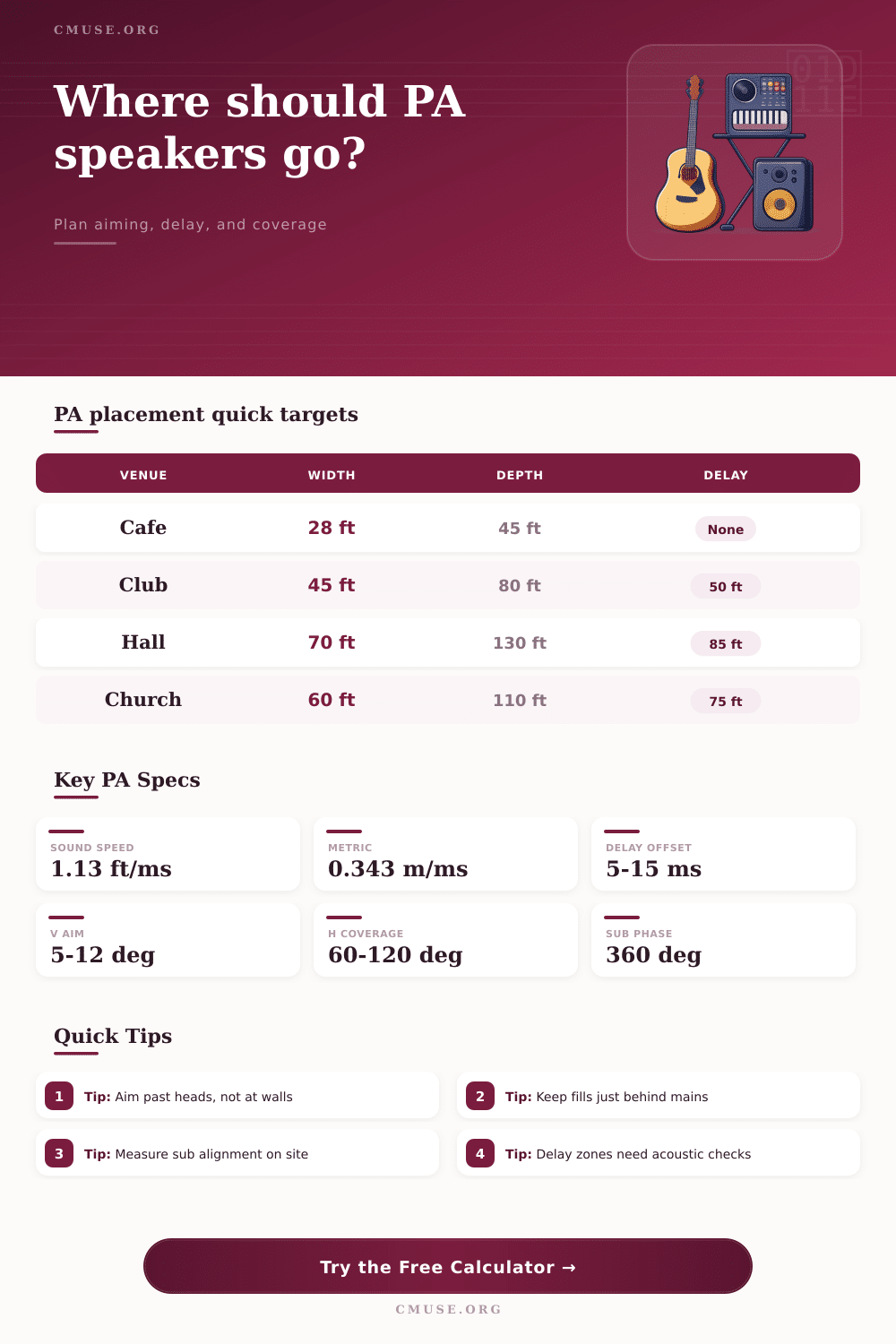
| Venue | Audience Size | Main Height | Typical Delay Start |
|---|---|---|---|
| Coffeehouse corner | 24-35 ft wide, 35-50 ft deep | 8-10 ft acoustic center | Usually none unless room is long and quiet |
| Rock club room | 40-55 ft wide, 65-90 ft deep | 10-14 ft acoustic center | 45-60 ft from stage with 5-10 ms offset |
| Worship hall | 50-75 ft wide, 90-130 ft deep | 14-22 ft acoustic center | 70-90 ft from stage, image held at mains |
| Outdoor festival | 80-160 ft wide, 180-350 ft deep | 18-35 ft acoustic center | 110-180 ft, often with multiple delay rings |
| Nominal Pattern | Best Use | Coverage At 50 ft | Placement Note |
|---|---|---|---|
| 60 degrees horizontal | Long throw, narrow rooms | 58 ft wide | Needs careful toe-in to avoid center buildup |
| 75 degrees horizontal | Medium rooms and clubs | 77 ft wide | Often works well for L/R point-source mains |
| 90 degrees horizontal | General PA coverage | 100 ft wide | Good default when side walls are controlled |
| 100-120 degrees horizontal | Short throw or wide rooms | 119-173 ft wide | Watch wall splash and open microphones |
| Distance Difference | Time At 68 F | Musical Meaning | Use In PA |
|---|---|---|---|
| 5 ft | 4.4 ms | Very short slap range | Fine alignment and small fill offsets |
| 10 ft | 8.9 ms | Precedence-friendly delay | Typical image offset for fills |
| 25 ft | 22.2 ms | Audible space if unmanaged | Delay speaker time-of-flight correction |
| 50 ft | 44.3 ms | Clear echo without alignment | Long room delay zone timing |
| Crossover | Wavelength | Half Cycle | Alignment Note |
|---|---|---|---|
| 60 Hz | 18.8 ft / 5.7 m | 8.3 ms | Small distance changes create large phase shifts |
| 80 Hz | 14.1 ft / 4.3 m | 6.3 ms | Common live sound sub-main crossover point |
| 100 Hz | 11.3 ft / 3.4 m | 5.0 ms | Useful for compact tops with limited low end |
| 120 Hz | 9.4 ft / 2.9 m | 4.2 ms | More localization risk if subs are spread wide |
Speaker placement can affect teh entire sounds of a show because speaker placement determine how the sound travels through the room. Moving a speaker just one foot or changing an angle of a speaker by a few degrees can change the way that sound covers the audiences. If a speaker is properly placed, the sound within the room will be more even throughout the room.
If the speakers isnt properly placed, however, the sound within the room may have muddy areas that are difficult to hear. The shape of the room is one of the primary factor to consider when placing speakers into a room. The shape of the room determines the way in which sound travels to the listeners within that room.
How to Place Speakers for Even Sound
In a long and narrow room, the speakers should be aimed differently than in a wide and shallow room. In the long and narrow rooms, the distance from the speakers to the last listener in the room will be much more greater than in the wide and shallow rooms. Additionally, the height of the speakers is another of the primary factor to consider.
If the speakers are placed above the level of the audiences ears, the speakers will need to have a downward angle to aim the sound to the audience. If the angle is too steep, the audience in the front rows of the audience will be exposed to too much sounds. If the angle is too flat, however, the sound will hit the back wall of the room.
Another of the factors to consider is the coverage angle of the speakers. For instance, a speaker with a 90 degree coverage angle may be appropriate for a club with that coverage angle, but may not allow sound to reach the sides of a wide hall. To address this issue, either toe in can be used or side fill speakers can be added to the system.
The vertical coverage pattern of the speakers also has an effect on the sound in the room. The vertical coverage of the sound energy should be aimed in such a way that the sound does not hit the ceiling of the room. A too-tight vertical coverage angle, however, will require more precision in aiming the speakers.
A deviation from the proper aim will cause the sound to not reach the audience in the last row of the listening area. Another factor to consider is the placement of the delay speakers. Delay speakers are used in those instances in which the main speakers cannot reach the back of the room.
The goal with the placement of delay speakers is to ensure that every area of the room sounds the same. Thus, the same amount of time should be provided to the individuals in the rear of the room as those in the front of the room. The delay offset can be calculated based off the distance between the delay speakers and the main speakers.
If the offset is not provided to the delay speakers, the audience will feel the sound as distant from those seated in the back of the room. Subwoofers is placed in a manner that is different from the placement of the main speakers. The subwoofers and main speakers are different in that low frequencies are similar to pressure in the room as opposed to the directed sound of the main speakers.
Thus, the distance between the subwoofers and main speakers impact the way in which they combine with the rest of the sound in the room. The crossover frequency and the wavelength effect the combination between the subwoofers and main speakers. A small change in the distance between the subwoofers and main speakers can change the combination from additive to subtractive.
Thus, a measurement microphone should be used to measure the way in which the subwoofers and main speakers combines with each other. Air temperature can impact the way in which the sound travels through the room. More specifically, air temperature can impact the timing of the sound.
The speed of sound changes with air temperature; sound move more slowly in cold air than in warm air. Thus, changing the air temperature in the room will impact the way in which delay speakers are felt by the audience. For example, if a band moves from an air conditioned room to an outdoor location, the difference in air temperature will impact the sound created by the delay speakers; the audience will feel as if the delay speakers are late in relation to the main speakers because of the change in air temperature.
Finally, there are some common mistake in speaker placement. For instance, many speaker placement strategies involve aiming the speakers at the back wall of the room rather than the audience in the last row of the room. Additionally, the left and right main speakers are often too far apart from each other for the width of the audience in the room.
Finally, delay zones are often created with only the time-of-flight difference between the main and delay speakers, but without adding a precedence offset to that time-of-flight difference. While there are some calculations that can be made regarding the placement of speakers, the decisions must also be made with you’re ears. For instance, as the engineers walk through the room with music playing, the engineers should check the vocals for evenness at the sides of the audience, as the subwoofers should not be canceling each other out in the middle of the room.
Small adjustments can be made to the placement of the speakers after this initial sound check. Small adjustments to placement will account for the way in which the sound reflects off of the surfaces in the room and how the air in the room impact the sound. Finally, when main and delay speakers are properly placed, the two will act as if they are one speaker.