Noise Reduction Coefficient Calculator
Calculate arithmetic NRC from 250, 500, 1000, and 2000 Hz absorption coefficients, compare a SAA-style proxy, and estimate room absorption contribution.
🎧Material And Room Presets
Presets load realistic room dimensions, surface finishes, treatment areas, and absorption coefficients. You can edit every field after loading one.
⚙Room And Surface Inputs
📊Absorber Coefficients
📌NRC Spec Grid
🧱Material Absorption Reference
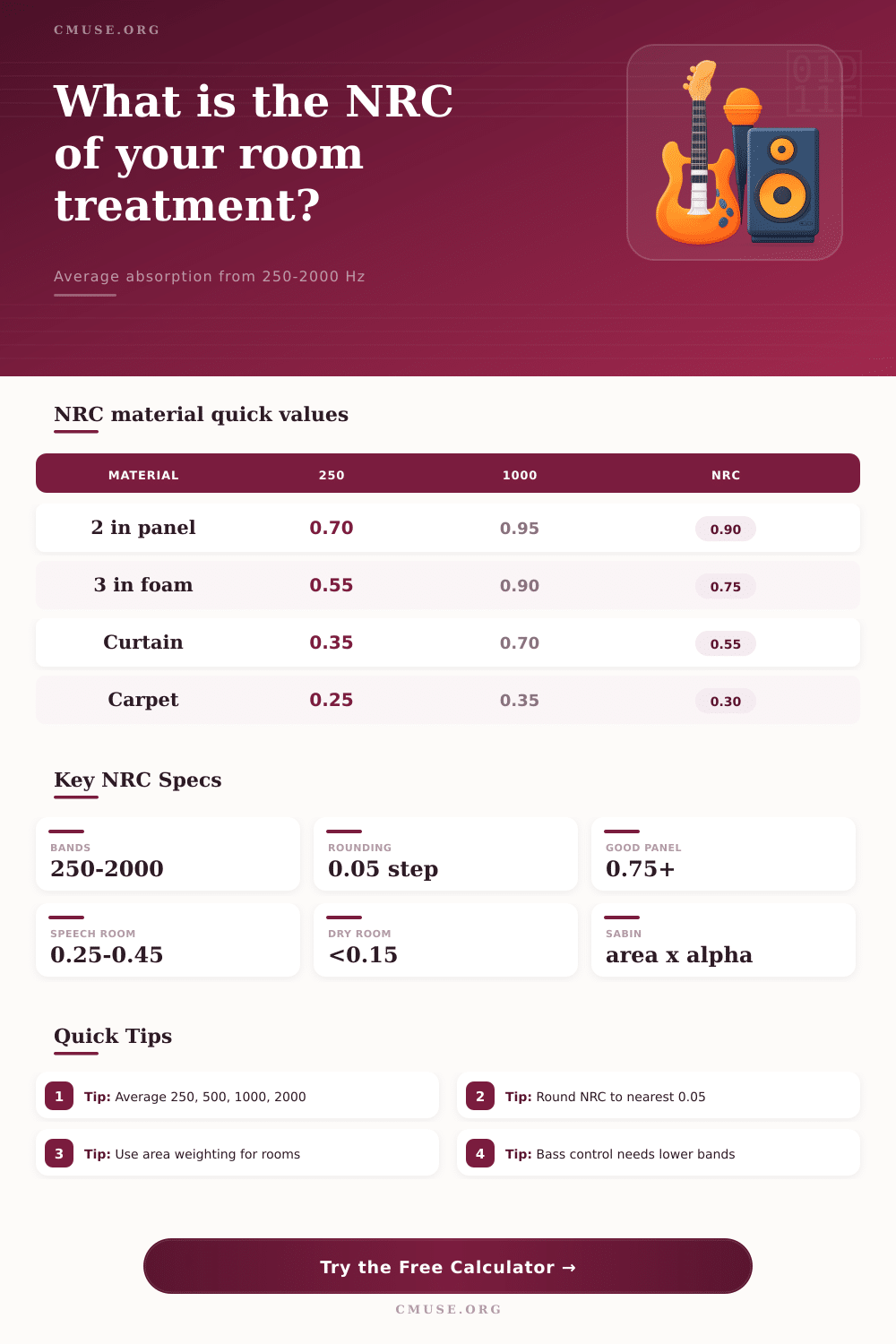
| Material | 250 Hz | 500 Hz | 1000 Hz | 2000 Hz | NRC |
|---|---|---|---|---|---|
| 2 in mineral wool panel | 0.70 | 0.95 | 1.00 | 0.95 | 0.90 |
| 4 in mineral wool panel | 0.95 | 1.05 | 1.05 | 1.00 | 1.00 |
| 2 in acoustic foam | 0.35 | 0.65 | 0.85 | 0.90 | 0.70 |
| 3 in acoustic foam | 0.55 | 0.80 | 0.90 | 0.90 | 0.80 |
| Heavy theater curtain | 0.35 | 0.55 | 0.70 | 0.70 | 0.60 |
| Acoustic ceiling tile | 0.60 | 0.75 | 0.85 | 0.85 | 0.75 |
📐NRC Rounding And SAA-Style Comparison
| Metric | Bands Used | Rounding | Best Use |
|---|---|---|---|
| NRC arithmetic average | 250, 500, 1000, 2000 Hz | Nearest 0.05 | Fast material comparison |
| Raw four-band average | Same four octave bands | Usually shown to 0.01 | Check the unrounded value |
| SAA-style proxy | Interpolated 200 to 2500 Hz | Shown to 0.01 | Broadband trend comparison |
| Room weighted average | Surface area times alpha | Shown to 0.01 | Room absorption contribution |
🎶Room Target Table
| Room Type | Typical RT60 | Useful Average Absorption | Primary NRC Concern |
|---|---|---|---|
| Voice booth | 0.15 to 0.30 sec | 0.35 to 0.60 | Avoid a boxy 250 Hz dip |
| Podcast room | 0.25 to 0.45 sec | 0.25 to 0.45 | Speech clarity and flutter |
| Mix room | 0.30 to 0.50 sec | 0.20 to 0.35 | Symmetry and broadband balance |
| Practice room | 0.45 to 0.80 sec | 0.15 to 0.30 | Keep some liveliness |
| Lecture room | 0.50 to 0.80 sec | 0.20 to 0.35 | Speech absorption coverage |
| Stage rehearsal | 0.70 to 1.20 sec | 0.12 to 0.25 | Control excess reflections |
📋Preset Room Summary
| Preset | Dimensions | Treatment | Default Area |
|---|---|---|---|
| Podcast Den | 10 x 9 x 8 ft | 2 in acoustic foam | 42 sq ft |
| Vocal Booth | 5 x 5 x 7 ft | Heavy theater curtain | 65 sq ft |
| Home Studio 10x12 | 12 x 10 x 8 ft | 2 in mineral wool | 48 sq ft |
| Mix Room 14x12 | 14 x 12 x 8.5 ft | 4 in mineral wool | 72 sq ft |
| Stage Area 20x16 | 20 x 16 x 12 ft | Polyester cloud panels | 160 sq ft |
💡NRC Tips
The noise reduction coefficient, or NRC, is an number that indicates how much sound a material will absorb. When you enter a room that feel echoey or dead, you are experiencing the range of absorption that different surface have for sound. The NRC allow for a quick comparison of materials by calculating the absorption of four frequencies (250, 500, 1000, and 2000 hertz) and rounding the results to the nearest 0.05.
The resulting NRC number indicate how much sound energy that a panel or curtain will remove from a given room. This number can help to indicate the sound treatment that would need to be purchase for a treatment of that room. The NRC has, however, some limitations.
What NRC Means and How to Reduce Room Echo
Mainly, the NRC only measure four frequency bands. A panel could have a good NRC but allow sound at low frequency to reflect within the room. Since the NRC does not measure those low frequencies, the room can still have low frequencies reflecting within the treatment with panel treatments.
A proxy to the NRC, based upon the SAA standard, measures twelve different points within the range of 200 to 2500 hertz to provide an overview of the sound absorption of a material. This additional reading may help to reveal whether a material removes sound evenly throughout the frequency range or whether it only removes sounds within a specific range, like the speech range. The NRC and SAA-style proxy values for a material can help to reveal whether a material will work within a specific type of treatment.
Another factor that can impact sound within a treatment is the geometry of the room and the sound absorbing of it’s existing surfaces. For instance, if a thick carpet is located on a concrete floor, that floor will absorb the majority of the sound energy within the midrange frequencies. In this case, adding panels to the walls will not have as great of an impact upon the sound within the room as adding those sound absorbing panels to an empty gypsum box.
The available sound treatment calculator account for these existing sounds by allowing the users to select the sound absorbing values of the floor, the walls, and the ceiling. Additionally, the area that the sound absorbing panels will cover is subtracted from the total area of the room. Finally, the calculator can account for the sound that the humans within the room provide to the room.
Humans provide a large amount of sound absorbing power at the speech frequencies; two or three people can provide as many sabin as a single sound absorbing panel. Thus, reverberation time can change with the addition of these individuals into the room. Another factor that can change the sound absorbing power of a panel is its mounting method within the treatment room.
If a panel is mounted flat against the wall, it will lose some of its low frequency sound absorbing power. If the same panel is hung with a two or four inch gap between the panel and the wall, or if it is utilized as a freestanding baffle, it will absorb more sound, especially at low frequencies under 500 hertz. A multiplier is provided for each mounting method so as to reveal the effect that each mounting method will have upon the average sound absorbing power of the treatment room.
For instance, ceiling clouds will replace the ceiling’s sound absorbing coefficient, wall panels will replace the sound absorbing coefficient of the wall, and freestanding baffles will add to the sound absorbing power of the room without replacing any existing sound absorbing coefficients. Thus, freestanding baffles are more efficient than wall mounted panels in large rooms. After entering the sound absorbing values of each of the treatment rooms surfaces, the sound absorbing power of the sound absorbing treatment to be purchased, and the number of individuals that will be within the room, the sound treatment calculator will provide an estimate of the sound absorbing power of the treatment (NRC) and the total sound absorption of the room in sabins.
Using the Sabine formula, the calculator can also provide an estimation of the resulting reverberation time of the room with the addition of the sound absorbing treatment. This reverberation time can help to reveal if a space will feel controlled or lively. If the calculated reverberation time is longer than the target reverberation time, the calculator can provide an estimate of how many additional sabins is required to achieve the target reverberation time.
This can allow the sound treaters to decide what additional treatment will be required for the room. A table on the site provides information regarding the sound absorption power (NRC) of common sound absorbing materials. Beyond the NRC of the materials, the table also reveals the limitations of the NRC.
For instance, the table reveals that a 2-inch thick mineral wool panel and a 3-inch thick foam panel may have similar NRC values. However, the mineral wool panel may absorb more sound than the foam panel at frequencies below 250 hertz and above 2000 hertz. Thus, the mineral wool panel may be better for a vocal booth and the foam panel may be better suited for a room that is to be used for music practice.
This tool allows users to experiment with the sound absorbing power of different materials within the treatment room. Finally, in most rooms there are factors that contribute to the scattering of sound within the room, like the bookshelves, furniture, and corners. The Sabine formula does not calculate scattering.
Therefore, some adjustments may have to be made after installing the sound absorbing panels. Additionally, air absorption become more important in large treatment rooms. Sound can travel through the ducts of the HVAC system.
Thus, while the sound treatment room calculator is helpful in determining the sound treatment that is required for a room, some adjustments may have to be made after installing the sound absorbing panels to ensure that the sound within the room is as desired. The NRC is just one data point that must be considered when treating sound within a room. Other data points include the amount of low frequency control that is required of the treatment and the amount of area that will be treated.