Bass Trap Size Calculator
Estimate trap depth, quarter wavelength, room mode match, porous absorber effectiveness, corner coverage, and treatment volume.
🎧 Bass Control Presets
🔧 Trap and Room Inputs
| Axis | Mode | Frequency | Target gap |
|---|
📊 Bass Trap Spec Grid
📐 Frequency Depth Reference
| Target frequency | Quarter wavelength | Practical porous depth | Typical use |
|---|---|---|---|
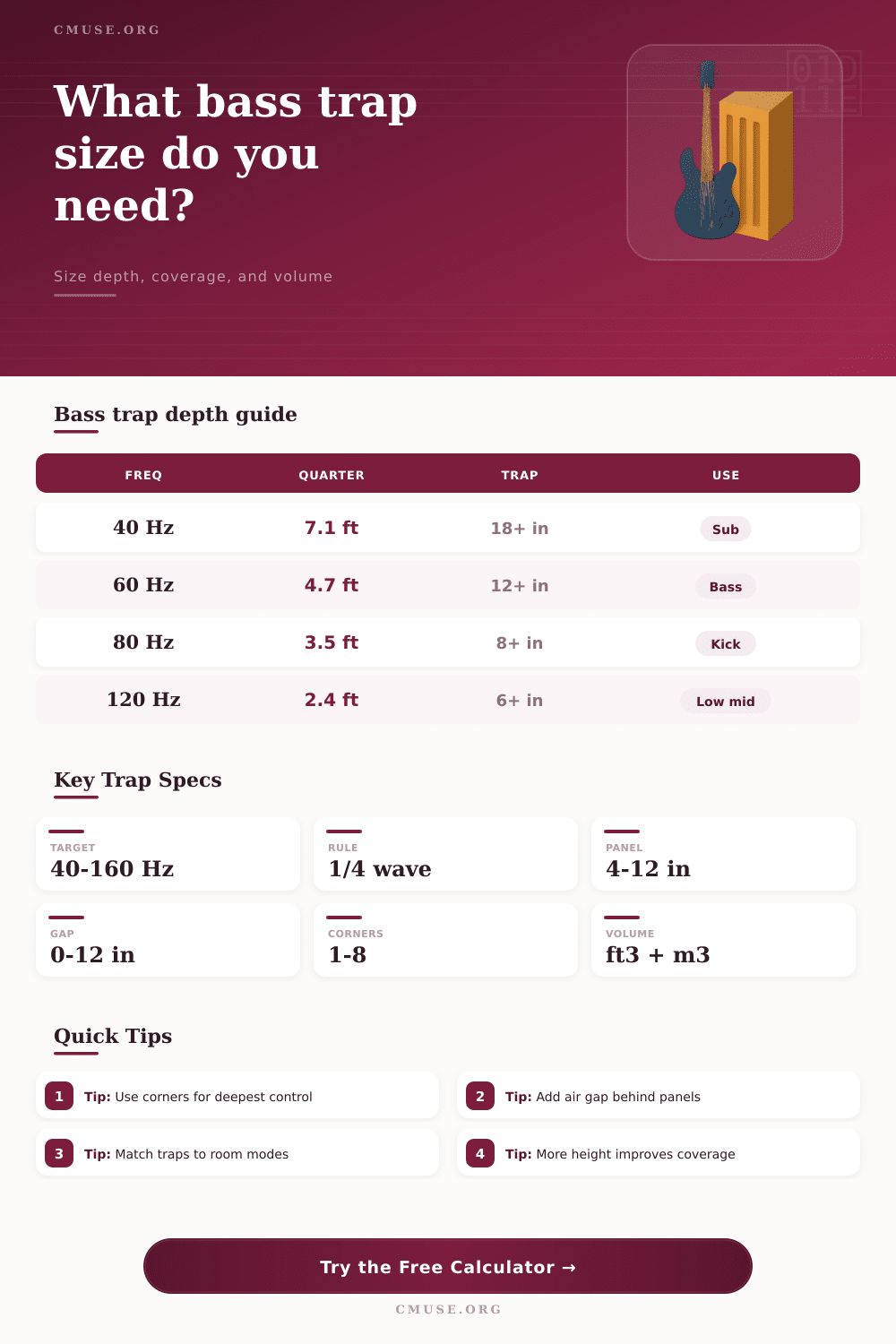
| 40 Hz | 7.1 ft / 2.15 m | 18-24 in plus corner | Sub room mode |
| 60 Hz | 4.7 ft / 1.43 m | 12-18 in plus corner | Kick and bass weight |
| 80 Hz | 3.5 ft / 1.07 m | 8-12 in plus gap | Upper bass control |
| 120 Hz | 2.4 ft / 0.72 m | 6-8 in plus gap | Low-mid buildup |
🧱 Absorber Material Comparison
| Material | Density cue | Low-frequency behavior | Best trap style |
|---|---|---|---|
| Low-flow wool | 4 pcf | Deep porous layers | Superchunk |
| Mineral wool | 6 pcf | Balanced broadband | Straddled corner |
| Rigid fiberglass | 6 pcf | Good panel control | Wall panel with gap |
| Open-cell foam | Light | Less deep bass | Upper bass only |
🎧 Common Room Starting Points
| Room profile | Main issue | Trap target | Starting size |
|---|---|---|---|
| Bedroom studio | 60-90 Hz peaks | 4 corners | 6 in panel plus gap |
| Small control room | 45-70 Hz length mode | Front corners | 12 in superchunk |
| Drum room | 70-120 Hz bloom | Rear corners | 8 in straddled panel |
| Theater room | 30-60 Hz LFE buildup | All boundaries | 18 in corner core |
Bass traps are used for acoustic treatment in a room, and bass traps are design to absorb the low-frequency sound wave in that treated room. The reason that low-frequency sound waves require such large amounts of physical space before they lose there energy is that the wavelengths of those sound waves are so long. Without enough sound absorption in the proper area of the room, the low-frequency sound waves will reflect off the surfaces of the room, contributing to sound issue within that treated room.
The calculator require specific inputs to determine the best acoustic treatment for the room. The dimensions of the room (length, width, and height) will help to determine the axial modes that resonate within the room. These axial modes will create peaks and dip in the sound levels in the treated room.
How to design bass traps for your room
The target frequency that is to be treated will help to determine the wavelength of sound that the bass traps will need to absorb. The temperature of the treated room will play a role in the speed of sound within that room. Because the speed of sound impacts the wavelength of sound within the room, the dimensions of the trap will need to change accordingly.
The concept of the quarter wavelength will help to determine where the porous absorber that will be used in the bass trap should be placed. At a frequency of 60 Hz, the wavelength of sound is approximately four and a half feet in length. Place the porous absorber at one quarter of that wavelength, where the velocity of the particles is at its peak.
The calculator will determine the amount of the quarter wavelength that can be reached with the depth of the panel and the air gap that can be created between the panel and the treated room wall. If the depth of the panel and air gap are found to be too shallow for the target frequency, deeper panels with a larger air gap, or both, will be required. The calculator can also adjust for the different style of bass traps that can be constructed.
The type of material that is used in the traps will impact the low-frequency sound waves that are absorbed. The density and the flow resistance of the material will impact the amount of energy from the sound waves that is converted into heat. Bass traps often use mineral wool as the material for its traps.
The mineral wool is used because it sit at a useful middle ground in terms of density. Lighter fiberglass panels are required to be deeper in their construction to absorb the low-frequency sounds. Very dense rigid boards will often reflect the sound waves if they are not placed into an air gap with the wall.
Each material that is chosen for the traps will have a factor applied to the effectiveness of the traps using the calculator. This factor will ensure the percentage of effectiveness incorporates the type of material that is chosen for the traps. Corners within the treated room will be the most effective locations for the bass traps to be installed.
Three surfaces within the room will come together in the corner, which will make the traps located in that spot the most effective. The traps will be most effective in the corners of the room because the three dimensional structure of the space will contribute to the effectiveness of the traps. The calculator will ask for the number of corners that will be treated and the percentage of the height of the corners that will be covered.
If the traps are placed in the corners of the room in partial stack, they may be less effective than if they were installed in full stacks. However, the math behind the calculator indicates that using partial stacks will provide diminishing return if the percentage of the corner heights that are covered is less than seventy percent. The calculation of the total volume of the bass traps will help the room treatment designer to budget for the materials needed to build the traps.
The volume calculation will be of use in the budgeting process and in comparison to other treatment option that could be used in the treated room. Every dimension within the treated room will resonate at specific frequencies known as mode. These modes within the treated room can make it difficult to control the low-frequency sounds in the room.
Modes may be present in each dimension within the treated room. If the target frequency of the sound waves to be treated are close to these modes, one trap may not have sufficient effectiveness in absorbing those sound waves. The mode table will display the modes in order of closeness to the target frequency.
The frequencies in the treated room can be clustered at certain frequencies. These clusters will require more than one single bass panel to be installed in a specific spot within the room. One of the mistakes that many room treatment designers make is using thin panels in an attempt to treat the low-frequency issue in the room.
Thin panels will not have any effect upon the low-frequency sound waves. Another mistake is to build very large superchunks in the corners of the treated rooms when the issues with the treated room are at a higher frequency. The calculator will prevent these type of mistake from being made by showing the relationship between the frequency that is to be treated and the depth of the bass panels that will be built.
The air gaps behind the traps will be important in determining the effectiveness of those traps. The air gaps allow the traps to work at a larger range of wavelengths. The calculator will model the air gap so that its contribution to the effectiveness of the traps is accounted for.
For example, the calculator may show that a six-inch deep panel with a six-inch gap in the treated room will be more effective than a twelve-inch deep panel that is placed directly against the wall of the treated room. The percentage of effectiveness will include the effectiveness of the material, the mounting method of the traps, the corners of the treated room that are to be treated, and the existing treatment of the treated room. This percentage will help to plan the construction of the bass traps.
However, the percentage is not to be trusted as a guarantee in terms of the effectiveness of those traps. The factors that may affect the treated room in ways that the calculator cannot account for (such as furniture and doors) are variables that cannot be controlled with the calculator. However, the percentage of effectiveness will still help to compare the various construction option for the room.
Many different pattern may emerge from the calculator. Small rooms may require the deepest bass traps in the front corners of the treated room. Medium sized rooms may allow for both type of traps to be constructed.
Large rooms may require the use of soffit traps or multiple run of the traps along the rear wall of the treated room. These choices become available to the construction designer once the designer determines the frequency that needs to be treated in the room and the depth of the traps required. The goal for constructing bass traps is to create a room whose low-frequency sound are even from seat to seat and from note to note.
When the percentage of effectiveness reaches seventy percent with the target frequency, the designer is ready to begin building the bass traps.