Soundproofing Calculator
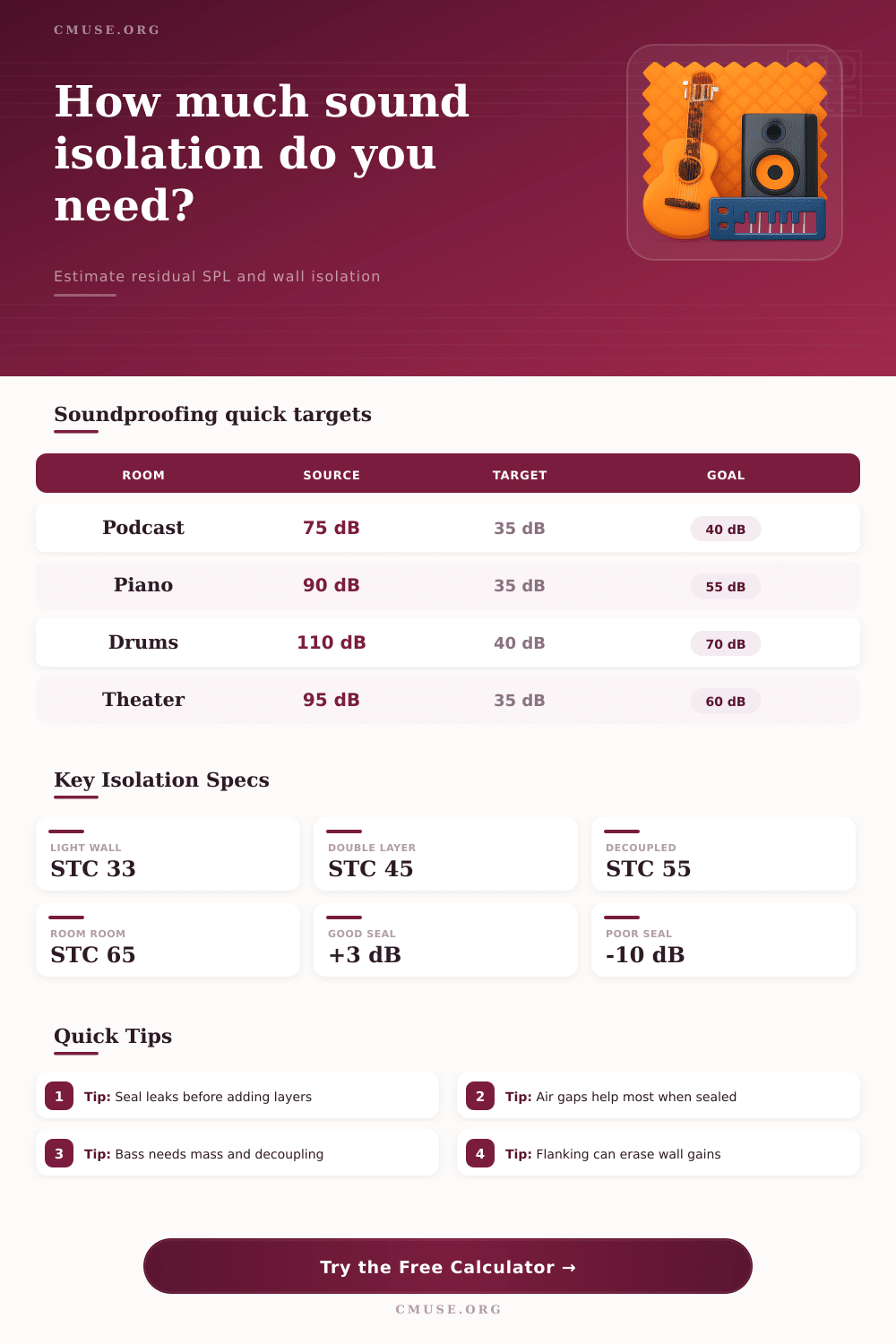
Estimate source SPL reduction, target isolation, STC-style layer gains, air-gap benefit, flanking loss, mass-law transmission loss, and residual sound level.
🎧Room And Isolation Presets
Presets load realistic music and audio isolation scenarios; every field remains editable after the preset is applied.
⚙Soundproofing Inputs
📊Material And Spec Grid
📑Assembly Reference Table
| Assembly | Typical STC | Best Use | Watch Point |
|---|---|---|---|
| Single stud drywall | 33 to 38 | Speech privacy only | Weak for music bass |
| Double drywall one side | 40 to 46 | Moderate apartment walls | Studs still bridge sound |
| Resilient channel wall | 45 to 55 | Voice, TV, light instruments | Short circuits reduce gains |
| Staggered stud wall | 50 to 60 | Practice rooms | Needs careful sealing |
| Double stud wall | 58 to 68 | Studios and theater rooms | Doors and ducts become limits |
| Dense masonry wall | 50 to 62 | High mass partitions | Flanking through slabs |
📐Layer, Mass, And Air Gap Table
| Treatment | Added Mass | Typical Gain | Useful For |
|---|---|---|---|
| 5/8 in drywall | 2.2 psf / 10.7 kg/m2 | 2 to 4 dB | General wall mass |
| Damped drywall layer | 2.3 psf / 11.2 kg/m2 | 4 to 7 dB | Midband control |
| Mass loaded vinyl | 1.0 psf / 4.9 kg/m2 | 2 to 5 dB | Thin barrier upgrade |
| 3.5 in sealed cavity | No mass | 3 to 6 dB | Decoupled walls |
| 6 in plus cavity | No mass | 5 to 9 dB | Studio partitions |
| Mineral wool fill | Minor | 2 to 4 dB | Cavity resonance control |
🔍Flanking Factor Table
| Condition | Penalty | Common Path | Result Meaning |
|---|---|---|---|
| Excellent seals | 1 to 2 dB | Minimal edge leakage | Wall rating is believable |
| Good seals | 3 to 5 dB | Small outlet and trim gaps | Strong practical result |
| Average seals | 6 to 8 dB | Door undercuts and boxes | Wall gains partly capped |
| Weak seals | 9 to 13 dB | Ducts, shared framing, gaps | Leak control is priority |
| Poor seals | 14 to 20 dB | Visible openings | Mass upgrades will disappoint |
🎶Room Comparison And Spec Grid
| Room Type | Typical Source SPL | Useful Isolation | Primary Risk |
|---|---|---|---|
| Podcast closet | 70 to 78 dB | 35 to 45 dB | Door and HVAC noise |
| Vocal booth | 85 to 95 dB | 45 to 55 dB | Flanking through ceiling |
| Piano practice room | 88 to 98 dB | 50 to 60 dB | Low-mid energy |
| Drum room | 105 to 115 dB | 65 to 75 dB | Bass and structure paths |
| Home theater | 90 to 105 dB | 55 to 65 dB | Subwoofer transmission |
| Rehearsal studio | 100 to 115 dB | 65 to 80 dB | Doors, ducts, floating floor |
💡Soundproofing Tips
When you live near a drum kit or when you attempt to record vocals in a room that share a wall with another room, one of the primary concerns is the effectiveness of the soundproofing between those two room. Sound dont travel in straight line; instead, sound travels through wall studs, around electrical outlet in the wall, and through gap between ceilings and roofs in the shared wall. A calculator can help to determine the sound isolation that your construction can provide by utilizing several data point regarding the sound levels in your spaces, the masses of the walls, the depths of air gap in the wall, and other factor that contribute to the reduction of sound transmission through the wall.
The calculations that you must first perform use two sound level measurement: the sound pressure level of the source of the sound (such as your drum kit) and the target level of sound that you would like to restrict from traveling through the shared wall to the other room (such as to the vocals recording space). These two sound level can be used to calculate the required level of sound isolation. The calculator allow for the input of a manual goal for sound isolation that is more restrictive than the calculated level required; some spaces may need to be quiet than others.
How to Use the Soundproofing Calculator
For instance, one of the spaces may be used as a sleeping area, while another of the spaces may only need to be quiet enough for private conversations. One of the primary factor that contributes to sound isolation is the mass of the wall that is constructed between the two rooms. The calculator can calculate the mass of the existing wall, as well as ask the designer for the mass of any additional material that are to be installed into the wall.
Additional mass in the wall will restrict the movement of vibrations of the walls that transmit sound; however, the addition of mass does not linearly increase the sound isolation of the wall. The improvement in sound isolation that is gained through the addition of mass to the wall follow the mass law. For frequencies that include low bass notes (such as 125 Hz) more mass is required to provide the same level of sound isolation as walls of greater mass for frequencies that contain higher notes (such as 1,000 Hz).
Thus, additional mass will benefit bass frequencies more than it will benefit high frequency sound that emanate from a drum kit or vocal performances. Another factor that can lead to sound isolation between two wall is the use of an air gap and cavity fill. An air gap is an enclosed space created between two faces of a wall.
Sound can vibrate the face of the wall, but the air gap prevent the vibration from vibrating the other face of the wall. The depth of that air gap and the use of sound absorbing material within that cavity can be accounted for in the calculator. Cavities with air gaps provide modest sound isolation relative to the sound isolation contributed by the addition of mass to the walls, but the use of cavity fill is a cost-effective way to increase sound isolation, especially for the frequency where adding mass does not improve sound isolation as much.
Flanking is a factor in sound isolation that is often underestimated. Sound can travel through the floor between rooms, through shared duct between HVAC systems, or even through the gaps under a door between rooms. The calculator asks for the seal condition of the construction between the two rooms.
For instance, excellent seals will reduce the sound isolation of the walls by a minimal amount, while average seals or seals that are deficient in some area will reduce the sound isolation of the walls by a significant amount. To avoid these sound leaks, the outlets in the walls need to be taped to prevent sound from traveling through the walls to the other room through those shared space. Two reference table are provided for assistance in sound isolation calculations.
Single stud walls typically have an STC rating of around the low thirties, while double studs or decoupled walls can have an STC rating of the high fifties and low sixties. These ratings are not guarantees that the wall will achieve such sound isolation; however, they do provide starting point for the sound isolation that can be achieved with the parameter that are entered into the calculator. Additionally, a grid of potential construction material allows for the comparison of the isolation of different construction methods to determine if the additional cost of one construction method justifies the improvements in sound isolation provided to the vocal or drum recording room.
Due to the number of factor that can impact the effectiveness of sound isolation between rooms, actual construction and layout of the rooms may differ from those idealized example. For instance, the location of HVAC returns, the placement of electrical outlet in the walls, and the placement of furniture in the spaces will impact the actual sound isolation between the two rooms. These factors cannot be accounted for in the construction calculator, but they do require that the builder or sound engineer account for them in the construction process.
For instance, if the calculator shows that the constructed room will achieve an outcome that is well-above the target sound level, there will be some margin for error in construction. However, if the soundproofing is calculated to only achieve the target sound level, any missed factor will cause the sound levels to rise above the target level that is constructed in the program. The best way to utilize this calculation tool is to first determine the level of sound that will be emanating from the source in each room, as well as the sound level that is required in the target level.
Following that determination, allow the program to calculate the required mass, flanking sound level, and other initial estimate. Based on these initial calculations, it is possible to determine whether the addition of additional mass, sound absorption material to the air gaps, and the sealing of the perimeter between the two rooms will allow the target sound level to be achieved. The calculator will not create the construction plan for the rooms; however, it will ensure that any planning occurs with an understanding of the number and calculations that will create sound isolation between the two rooms.