
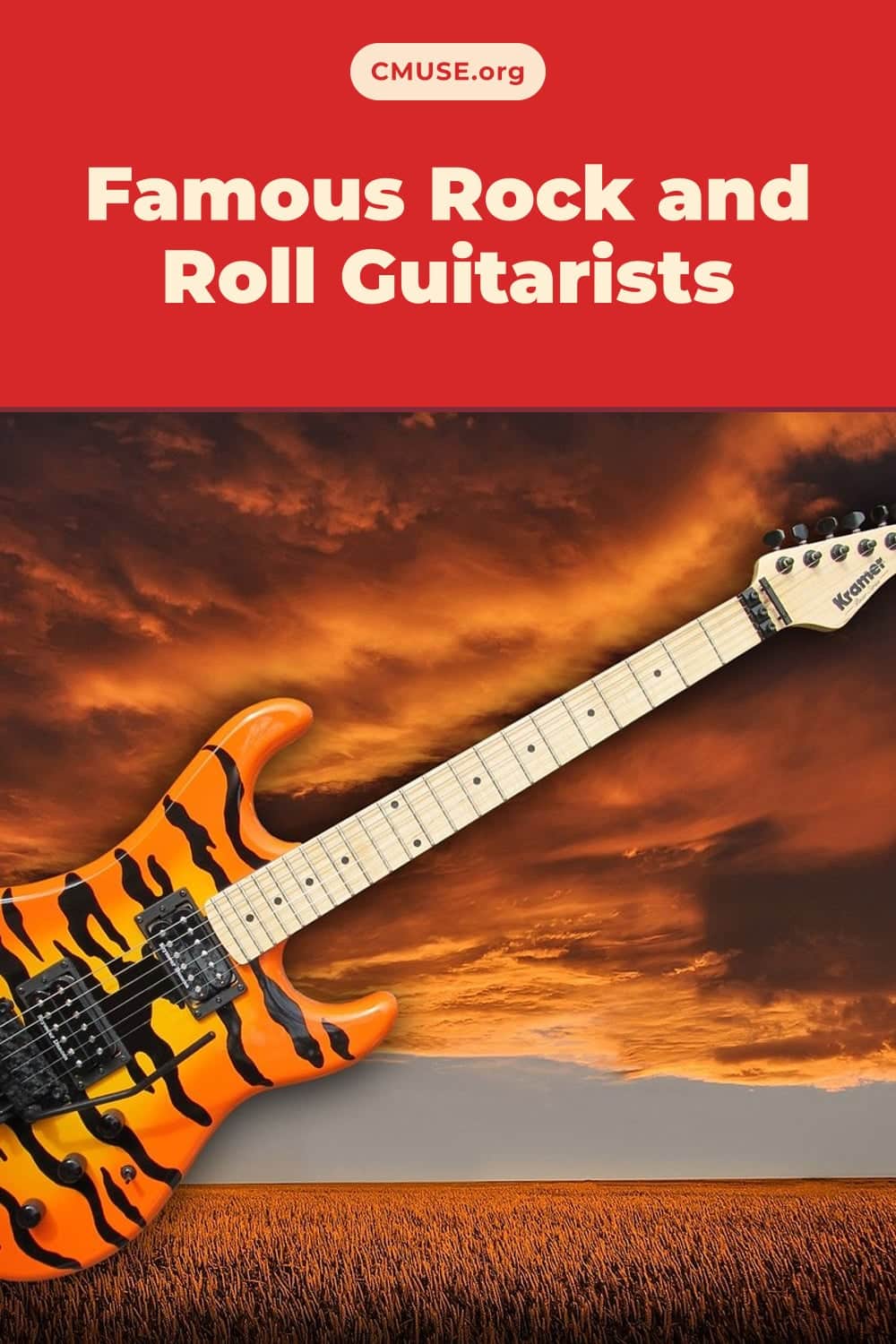
The electric guitar is the beating heart of rock and roll. From the moment it was plugged in and turned up, it stopped being a simple instrument and became a weapon, a voice, and a lightning rod all at once. The players who learned to speak through it shaped entire generations, defined stadiums full of screaming fans, and left behind solos that still give people chills decades later.
Their stories are messy, loud, and often larger than life, which is exactly why they matter.
What separates the true legends from the merely talented is not just speed or flash. It is the unmistakable personality that bleeds out of every note they play. Some bent strings until they cried, others attacked the instrument like it owed them money.
A few barely seemed to move at all yet somehow made six strings sound like an entire orchestra on fire. The list that follows gathers ten guitarists who changed the game in ways both obvious and subtle. Each one earned their place through innovation, attitude, or sheer sonic courage.
You will hear their influence every time you turn on the radio or walk into a club where a band is plugging in.
Ten Legendary Guitarists Who Changed Music
1. Jimi Hendrix
Jimi Hendrix remains the undisputed king for a reason that goes beyond his showmanship. He took the electric guitar into territory no one had imagined possible, treating it like an extension of his own nervous system rather than a tool. When he played the Star Spangled Banner at Woodstock, the feedback, whammy bar dives, and aggressive string bending turned the national anthem into a protest, a prayer, and a war cry all at once.
Hendrix discovered ways to make the guitar imitate rockets, sirens, and human screams while still anchoring everything to soulful blues phrasing. His willingness to sacrifice conventional technique for pure expression opened doors that every subsequent rock guitarist walked through. The tradeoff was that his approach demanded total surrender to the moment, which is why so few players have ever matched his reckless freedom.
2. Keith Richards
Keith Richards built the Rolling Stones on a foundation of open tunings and rhythmic riffing that felt dangerous even at slow tempos. His famous five-string guitar technique, achieved by removing the low E string, created the snarling, empty space that defines Satisfaction and countless other classics. Richards never chased flashy leads the way others did.
Instead he locked into grooves so deep they became hypnotic, then stabbed single notes or double stops at exactly the right instant to make the whole thing explode. What makes him essential is the way he proved rock and roll could be as much about feel and attitude as technical display. His riffs sound simple until you try to replicate the swing and menace he gets out of them.
That deceptive simplicity is exactly why his playing has remained relevant for more than half a century.
3. Jimmy Page
Jimmy Page turned the recording studio into his own personal guitar laboratory. With Led Zeppelin he layered multiple guitar parts that somehow still felt raw and live, creating an illusion of impossible size. His use of the violin bow on the guitar produced otherworldly sustained tones that became signatures on tracks like Dazed and Confused.
Yet Page could also deliver lightning fast fingerpicking on acoustic passages that rivaled any folk virtuoso. The contrast between his delicate touch and his thunderous electric work gave Zeppelin its emotional range. He understood that dynamics, not just volume, are what make an audience lean in or get knocked back in their seats.
That mastery of light and shade is what keeps his influence alive in every band that tries to sound epic without sounding cartoonish.
4. Eric Clapton
Eric Clapton arrived on the scene with a tone so rich and vocal-like that people literally wrote graffiti declaring he was God. His early work with the Bluesbreakers and Cream showed that the electric guitar could sing sustained melodies with the same emotional depth as a saxophone or human voice. Clapton favored slow bends, heavy vibrato, and a fat overdriven tone that made every note feel important.
While his later career drifted toward smoother territory, those early recordings remain master classes in taste and restraint. He proved that speed is optional when your phrasing carries genuine feeling. The lesson stuck with generations of players who realized that saying more with fewer notes is often the harder path.
5. Eddie Van Halen
Eddie Van Halen exploded onto the scene in 1978 and permanently raised the bar for technical ability. His tapping technique, where both hands hammer notes on the fretboard, sounded like an extra guitarist had joined the band. Combined with his whammy bar acrobatics and an almost supernatural sense of rhythm, it created a new vocabulary for rock guitar.
What often gets overlooked is how musical those flashy solos actually were. Van Halen rarely played notes just to show off. Every burst of speed served the song, which is why Eruption still feels fresh instead of dated.
He made impossible technique accessible to kids practicing in their bedrooms and in doing so pushed an entire generation to work harder on their craft.
6. Angus Young
Angus Young of AC/DC proves that passion and groove can outshine technical fireworks every single time. Standing barely five feet tall in his schoolboy uniform, he runs around the stage like a live wire while delivering some of the most memorable riffs in rock history. His lead playing is built on pentatonic scales, pinched harmonics, and relentless energy rather than complex theory.
That approach works because it perfectly matches the band’s no frills, high octane boogie. Young reminds us that rock and roll at its core is about making bodies move. His solos might not impress jazz fusion fans, but they make entire arenas jump in unison, which was always the assignment.
7. Pete Townshend
Jimmy Page, wait no, we already covered him. Let’s talk about Pete Townshend instead. The Who would have been a very different band without his windmill strumming and aggressive power chords.
Townshend treated the guitar like a percussion instrument as much as a melodic one, smashing out chords with such force that his hands bled on a regular basis. His use of feedback as a compositional tool on songs like My Generation added raw texture that felt dangerous. Beyond the physicality, Townshend wrote some of the most ambitious conceptual pieces in rock, using the guitar to drive narratives that filled entire albums.
That combination of brute force and intellectual ambition created a template that ambitious rock bands still follow.
8. Slash
Slash brought a welcome dose of bluesy swagger back to mainstream rock in the late eighties. His playing on Appetite for Destruction combined gritty pentatonic runs with soaring, melodic phrasing that cut through the mix like a knife. The tone he got from his Les Paul through a Marshall stack became so identifiable that gear companies still try to replicate it.
What makes Slash special is the way his solos breathe. He leaves space between phrases, lets notes ring, and builds tension before releasing it in satisfying bends. In an era of increasingly mechanical shredding, his warm, vocal approach felt like a throwback and a revelation at the same time.
9. Jeff Beck
Jeff Beck took a completely different route from almost everyone else on this list. After leaving the Yardbirds he pursued a career that blended rock, jazz, funk, and even electronica without ever sounding like he was trying too hard. Beck’s mastery of the whammy bar allowed him to mimic human speech, slide guitar, and synthesizer swoops with shocking realism.
He could play with jaw dropping speed and precision but often chose to focus on tone and dynamics instead. His version of Cause We’ve Ended As Lovers remains one of the most expressive instrumental performances ever captured on record. Beck proved that constant reinvention and curiosity keep a guitarist interesting long after the initial flash of youth has faded.
10. Chuck Berry
Last but far from least comes Chuck Berry, the man who essentially invented rock and roll guitar as we know it. His double stop riffs, country influenced bends, and driving rhythm patterns became the blueprint that every subsequent player borrowed from. Johnny B. Goode is not just a great song.
It is a complete guitar thesis that contains everything the instrument would spend the next seventy years expanding upon. Berry played with such joy and rhythmic authority that his music crossed racial boundaries in an America that was not ready for it. Without his pioneering work, none of the names above would have had the vocabulary they needed to develop their own voices.
That is why his influence echoes through every distorted amplifier still being turned up to ten.
These ten players represent different eras, approaches, and philosophies, yet they all share one common trait. Each found a way to make the guitar sound like it was speaking directly to them before they passed the message along to us. The instrument keeps evolving with new technology and fresh talent, but the DNA these legends left behind remains unmistakable.
Next time you hear a guitar riff that stops you in your tracks, take a moment to trace its ancestry. You will almost certainly find one of these names somewhere in its family tree. And then pick up your own guitar and see what you can add to the conversation.
The instrument is still waiting for new voices.