
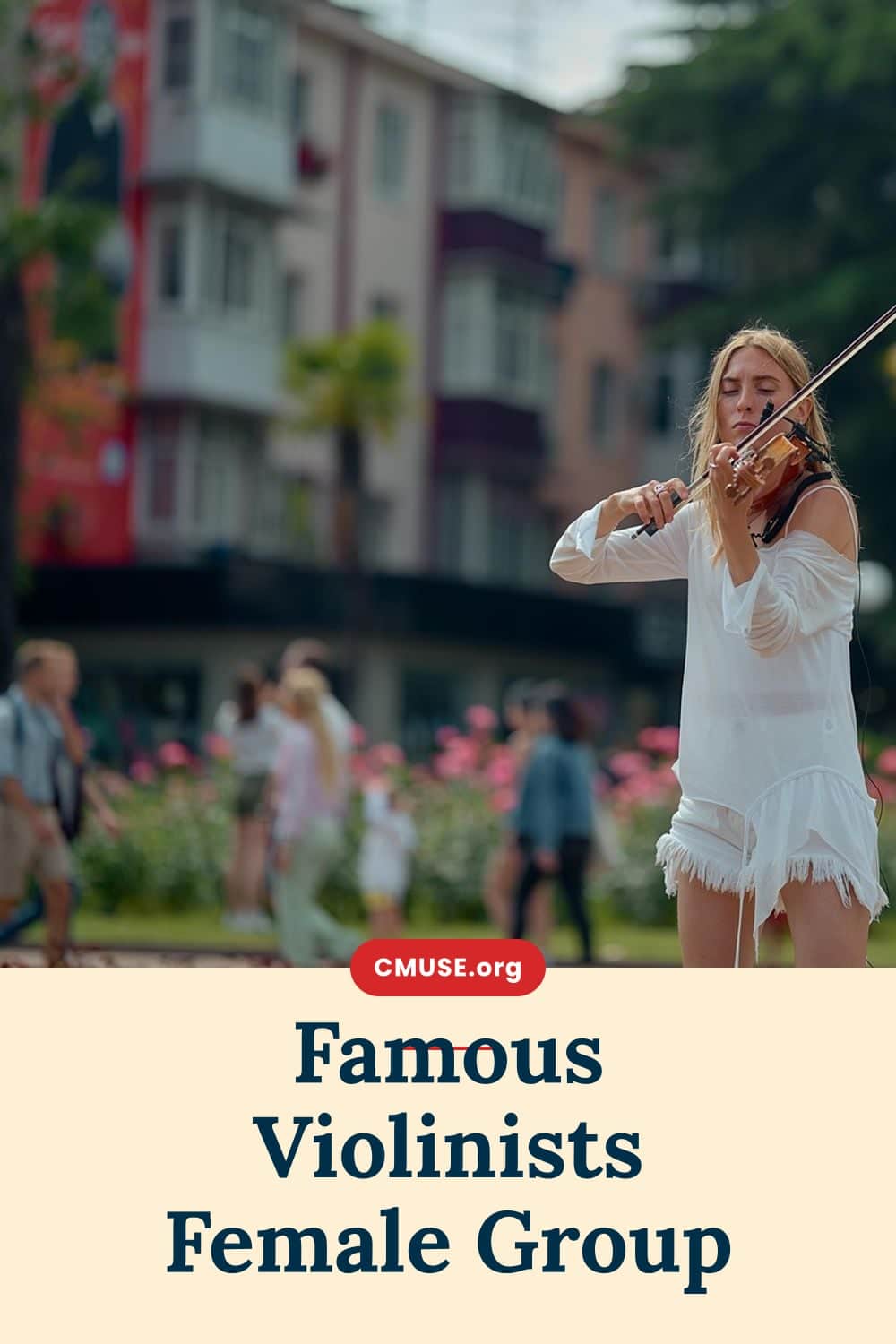
The violin has a way of cutting straight through to the heart. One moment it’s a wooden box with strings, the next it’s singing with a human voice that feels almost too intimate for a concert hall. When the player is a woman, something extra happens.
The instrument’s graceful curves and the performer’s physical command create a conversation that audiences have never tired of. These women did not simply play the violin well. They redefined what the instrument could say and who was allowed to say it.
Their stories matter because they fought on two fronts at once. They battled the technical demands of an unforgiving instrument while also pushing against the idea that serious music was a man’s domain. The list that follows gathers some of the most remarkable female violinists of the last two centuries.
Each one changed the art form in her own way. Some revolutionized technique, others brought new emotional depth, and a few simply refused to disappear when the world told them to step aside. Their legacies still echo every time a young girl picks up a quarter-size violin and dreams of the stage.
Remarkable Female Violinists Who Changed Music
1. Anne Sophie Mutter
Anne-Sophie Mutter stands at the top for a reason. Few violinists in any era have combined technical perfection with such fearless musical personality. Born in Germany in 1963, she was already performing with Herbert von Karajan and the Berlin Philharmonic by age thirteen.
What separates her is the way she treats every note as a living decision rather than a settled tradition. Listen to her recordings of the Beethoven concerto and you hear phrases that breathe like spoken sentences, pauses that feel dangerously spontaneous. She commissions new works constantly, giving composers like Sofia Gubaidulina and Unsuk Chin a prominent voice through her instrument.
The tradeoff is that her intensity can sometimes feel overwhelming in more delicate repertoire, yet that same force is exactly why she belongs at the head of this list.
A fresh paragraph starts the next name because each artist deserves her own space.
2. Ginette Neveu
Jascha Heifetz once called Ginette Neveu the greatest woman violinist he had ever heard, and the praise carried weight coming from him. The French prodigy possessed a dark, smoky tone that seemed to come from somewhere deeper than her slight frame should have allowed. Her 1940s recording of the Brahms concerto still sets a benchmark for passion without sentimentality.
Tragically, Neveu died in a plane crash at thirty, cutting short what promised to be a career without limits. That brevity makes her legend especially potent. You listen knowing the clock was already ticking, and every phrase feels urgent.
Her story reminds us that greatness sometimes arrives early and leaves too soon.
3. Maud Powell
The next figure rewrote the rules of what a violinist could be. Maud Powell, born in 1867 in Illinois, became the first American to build an international solo career on the instrument. She studied in Europe but returned home determined to prove American musicians belonged on the world stage.
Powell championed new American music when most soloists stuck to European warhorses. She gave the U.S. premiere of the Tchaikovsky concerto and performed works by African-American composers at a time when few white artists would. Her tone was robust rather than delicate, built for large halls and determined audiences.
She also wrote extensively about the challenges female musicians faced, articles that still read with startling clarity today. Powell showed that a violinist could be both virtuoso and advocate.
4. Hilary Hahn
Hilary Hahn brings us into the present with a career that feels like a master class in thoughtful independence. American-born and Curtis-trained, she waited until her late twenties to record the Bach sonatas and partitas, works most prodigies tackle in their teens. The wait paid off in interpretations of such crystalline clarity that they feel almost inevitable.
Hahn’s tone is pure without being thin, precise without sounding mechanical. What truly sets her apart is her commitment to new music and her unusually transparent relationship with fans through social media and liner notes. She explains her choices without ever sounding defensive.
In an era when many soloists chase Instagram fame, Hahn reminds us that substance and generosity can still coexist at the highest level.
5. Camilla Urso
Going further back, we meet Camilla Urso, a name too few remember today. Born in France in 1842, she toured the United States as a child prodigy when women were expected to play only in parlors. Urso’s father, a flutist, insisted she study violin despite warnings that the instrument would ruin her health and reputation.
She became a sensation, performing from New Orleans to San Francisco at a time when those cities were still frontier towns. Her technique was said to rival any man’s, yet reviewers could never resist commenting on her appearance first. Urso kept performing into her fifties, proving that a female violinist could sustain a long career.
Her persistence opened doors for every woman who followed.
6. Viktorie Hlouskova
The Czech violinist Viktorie Hlousková offers a different kind of inspiration. Active in the early twentieth century, she specialized in the most demanding virtuoso showpieces while raising a family in an era that offered no support for working mothers in music. Her recordings of Paganini caprices reveal a bow arm of steel and a left hand that flew across the fingerboard with almost no visible effort.
What matters most about Hlousková is how she balanced public acclaim with private life without apology. She once told an interviewer that motherhood made her a better musician because it taught her to focus intensely in short bursts of time. That insight still resonates with women trying to manage both careers and families today.
7. Kyung Wha Chung
No discussion of great female violinists can ignore Kyung-Wha Chung. The South Korean artist burst onto the scene in the 1970s with a sound that combined laser-like focus and Romantic warmth. Her recording of the Bartók concerto with Simon Rattle remains a touchstone for how to balance folk energy with classical structure.
Chung’s career took an unexpected turn when she stepped away from performing for several years to raise her children, then returned with renewed depth. That hiatus gave her interpretations of the Brahms and Elgar concertos a maturity that younger players rarely achieve. She has spoken candidly about the physical toll of playing at the highest level, including the shoulder injuries that eventually shortened her career.
Her honesty about both the glory and the cost feels rare and necessary.
8. Ida Haendel
Ida Haendel occupies a special place because she seemed to exist outside normal time. Born in Poland in 1928, she performed well into her nineties with a tone that grew only richer with age. Haendel never won the major competitions that launch modern careers, yet she built a legendary reputation through sheer musical conviction.
Her Elgar concerto is particularly famous for its nobility and restraint. She played with a heavy, singing vibrato that announced its presence the moment the bow touched the string. What she lacked in marketing savvy she made up for in authenticity.
Haendel once said she learned everything from listening to birds and old men singing in synagogues. That combination of nature and tradition explains the earthy wisdom in her playing.
9. Sarah Chang
Finally we come to Sarah Chang, who represents both the promise and the pressure of early stardom. Signed to a major label at nine years old after auditioning for legendary managers, Chang became the face of the prodigy phenomenon in the 1990s. Her early recordings show a technical command that bordered on the superhuman, especially in the Sibelius concerto which became her signature. As she matured, she had to fight the perception that she was forever that nine-year-old wunderkind.
The struggle made her artistry more interesting. Later performances reveal greater flexibility of tempo and a willingness to take musical risks that younger Sarah might have avoided. Her journey illustrates how female violinists must constantly reinvent themselves in the public eye.
These women share more than just technical brilliance. Each faced skepticism about whether a female body could produce the power and stamina required for serious violin playing. Each heard variations on the same tired questions about marriage, children, and whether the instrument suited a woman’s temperament.
And each answered with her bow. Their collective legacy is not only a catalog of great recordings but also a widened path for the girls now entering conservatories around the world.
The next time you hear a young female violinist step onto a stage, remember the shoulders she stands on. Those shoulders belong to Mutter’s fearless musicality, Neveu’s tragic fire, Powell’s pioneering spirit, and all the others who refused to let tradition dictate their limits. The violin has always been a storyteller.
Thanks to them, it now tells a much richer range of stories.