
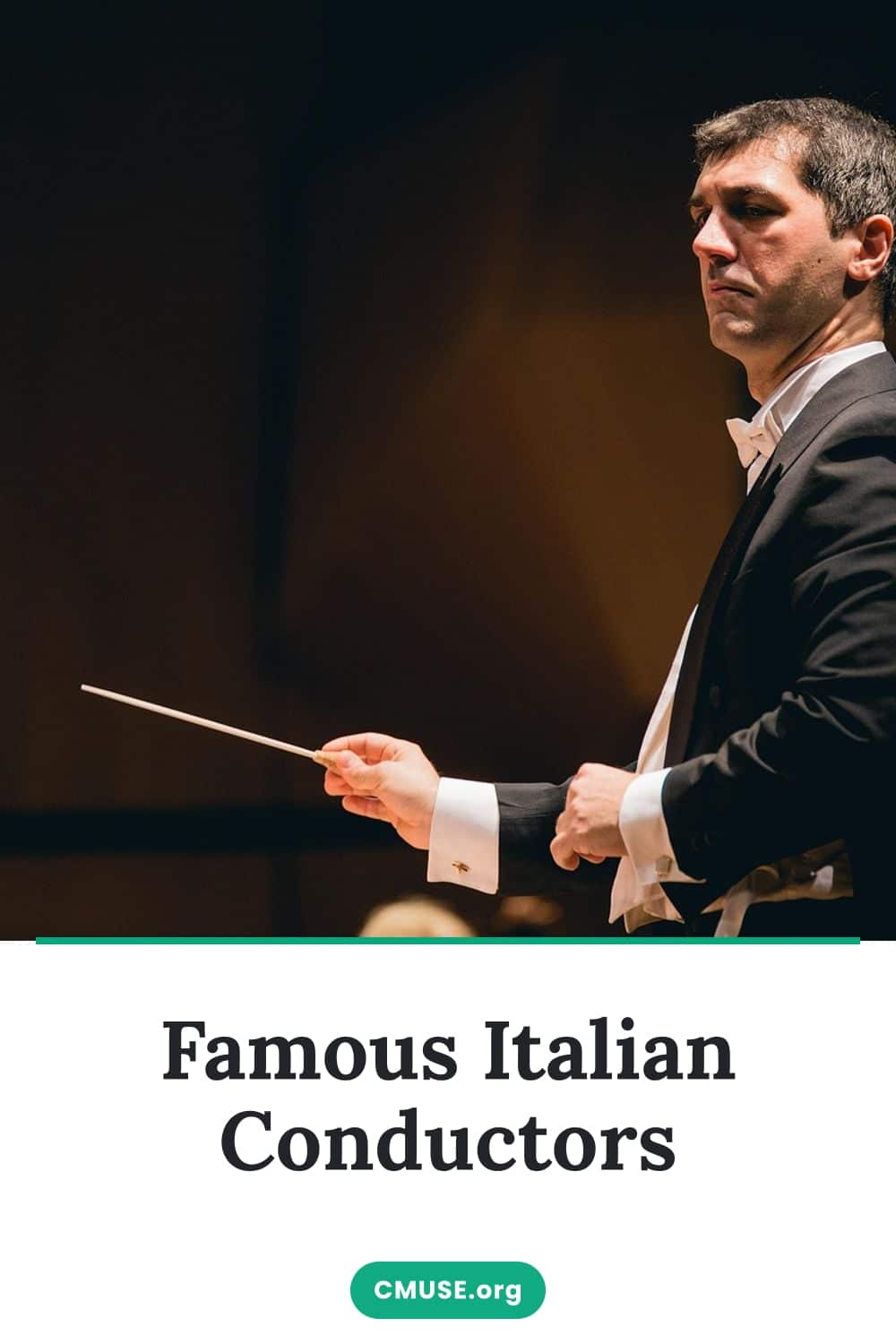
Italian conductors have shaped the sound of classical music for more than a century. Their gestures can coax velvet tone from an orchestra one moment and unleash raw power the next. Standing on the podium they become interpreters, psychologists, and occasionally tyrants, all in service of a composer’s vision.
What separates the merely good from the legendary is a mysterious blend of ear, memory, charisma, and sheer willpower.
These men did not simply wave batons. They redefined how we hear familiar scores, demanded standards that reshaped entire ensembles, and left recordings that still serve as reference points. Whether you are a casual listener discovering opera for the first time or a seasoned concertgoer, their stories reveal why the conductor’s role remains central to the orchestral experience.
The following conductors earned their places through transformative work that continues to echo today.
Legendary Italian Conductors Who Changed Music
1. Arturo Toscanini
Arturo Toscanini stands at the head of any serious list for a reason that goes beyond his fame. Born in 1867, he began his conducting career almost by accident after stepping in as a cellist to lead a performance of Aida from memory when the scheduled conductor fell ill. That combination of photographic recall and iron discipline defined his entire career.
He insisted on textual fidelity at a time when many maestros treated scores as suggestions. Orchestras feared and revered him in equal measure because he could hear a single wrong note in a sea of sound and would stop rehearsal until it was fixed.
His tenure at La Scala and later with the NBC Symphony Orchestra, which was created specifically for him, set new standards for precision and transparency. Toscanini stripped away sentimental excesses that had crept into Italian opera, restoring a leaner, more dramatic urgency. Listening to his Beethoven or Verdi today still feels shockingly modern.
The man could be ruthless, yet that ruthlessness came from a deep love of the music itself. He showed that respect for the composer and theatrical fire are not opposites but partners.
2. Herbert von Karajan
After Toscanini the podium belonged for decades to a conductor whose style could not have been more different. Herbert von Karajan brought glamour, sleek virtuosity, and an almost cinematic sense of color to everything he touched. Though Austrian by birth, his long association with Italian repertoire and his recordings with La Scala and the Berlin Philharmonic made him an honorary figure in Italian musical life.
His interpretations of Puccini and Verdi combined luxurious orchestral sheen with an uncanny sense of theatrical timing.
Karajan understood that Italian opera lives in the interplay between voice and orchestra. He would linger over a phrase until the soprano’s line floated on a bed of perfectly balanced strings, then snap the tempo forward with surgical precision. Critics sometimes accused him of excessive polish, but that polish served a purpose: it made complex scores accessible without dumbing them down.
His filmed performances reveal another truth. The man conducted with his eyes closed much of the time, trusting the orchestra to follow his inner vision. That level of mutual confidence only comes after years of rigorous preparation.
3. Tullio Serafin
While Toscanini and Karajan dominated the international stage, Tullio Serafin worked quietly as one of the greatest behind-the-scenes architects of Italian opera in the twentieth century. From the 1920s through the 1950s he served as the guiding hand for several generations of singers at La Scala, the Metropolitan Opera, and countless Italian houses. Maria Callas credited him with teaching her the bel canto tradition that would make her famous.
Serafin had an encyclopedic knowledge of forgotten scores and lost traditions, and he used that knowledge to revive works by Bellini, Donizetti, and early Verdi that had slipped from the repertoire.
What made Serafin special was his flexibility. Where Toscanini could be inflexible in pursuit of perfection, Serafin adjusted tempi and dynamics to suit the voice in front of him while never losing the architectural shape of the piece. He understood that opera is ultimately about human drama expressed through singing.
His recordings with Callas in the 1950s remain master classes in how to support a singer without ever overwhelming her. Many of today’s conductors still study those performances to learn the art of accompaniment.
4. Riccardo Muti
No discussion of Italian conductors would be complete without Riccardo Muti, who carried the Toscanini tradition of textual rigor into the late twentieth and early twenty-first centuries. As music director of La Scala from 1986 to 2005, Muti waged war on sloppy tradition and provincial habits. He demanded that orchestras relearn basic principles of ensemble and intonation, often provoking walkouts and public arguments.
The results spoke for themselves. Under his leadership La Scala regained its reputation as one of the world’s most exciting operatic laboratories.
Muti’s Verdi is muscular and clear-eyed, never sentimental. His performances of the Requiem have a visceral power that can make an audience feel physically shaken. Yet he also possesses a refined sense of lyricism that shines in Mozart and Bellini.
What sets him apart is his ability to combine intellectual command with an almost volcanic emotional force. When Muti conducts you feel that every note matters because he believes it does. That conviction remains infectious even when his interpretations spark debate.
5. Claudio Abbado
Claudio Abbado took a different path. Where Muti emphasized discipline, Abbado cultivated a collaborative spirit that empowered musicians to contribute ideas. His work with La Scala in the 1970s and 1980s transformed the house into a more democratic artistic enterprise.
He introduced contemporary music alongside the Italian classics and expanded the orchestra’s horizons with Mahler and Russian repertoire. Italian audiences sometimes grumbled that he was neglecting the native tradition, but Abbado’s Verdi and Rossini were anything but neglectful.
His later years with the Lucerne Festival Orchestra revealed a conductor who had grown even more poetic and transparent. Abbado conducted with minimal gesture, trusting the players to listen to one another. The result was an orchestral sound that seemed to breathe as a single organism.
He proved that Italian musicality does not require an autocratic baton. Sensitivity and collective intelligence can produce performances of equal fire and finesse.
6. Gianandrea Noseda
Gianandrea Noseda represents the current generation carrying the torch. As music director of the National Symphony Orchestra in Washington and former principal guest conductor at the Mariinsky, he has shown that Italian conductors no longer need to be based in Italy to exert worldwide influence. His Verdi performances combine the rhythmic vitality of Toscanini with the color sense of Karajan and the theatrical instinct of Serafin.
Noseda also champions neglected Italian composers such as Franco Alfano and Umberto Giordano, reminding listeners that the peninsula’s musical riches extend far beyond the big three of Verdi, Puccini, and Rossini.
What makes Noseda particularly interesting is his ability to adapt. He can deliver a ferocious account of Otello one night and a chamber-like reading of Donizetti the next without ever seeming inconsistent. That versatility reflects a broader truth about modern conducting.
The best practitioners absorb multiple traditions rather than clinging to a single school. Noseda’s success suggests the Italian baton remains as potent as ever.
These conductors succeeded in different eras and with different personalities, yet they share one quality. Each understood that the score is both blueprint and invitation. Toscanini read it like holy writ.
Karajan painted on its canvas. Serafin used it as a map for vocal drama. Muti defended it like a lawyer in court.
Abbado treated it as a living conversation. Noseda approaches it as a storyteller with multiple dialects at his command.
The next time you hear a familiar overture or aria, pause to consider the invisible hand shaping the performance. That hand belongs to someone who spent decades mastering an invisible art. Italian conductors taught the world that precision and passion need not cancel each other out.
They can, when handled by a master, become the same thing. The podium may look like a small square of wood, but from it these men conducted entire universes of feeling. Their legacy is not merely a catalog of great recordings.
It is the continuing belief that music, given proper care, can still shake us to the core.