Chord Spelling Calculator
Spell chords by musical letter, not just pitch class: choose a root, quality, inversion, extensions, alterations, enharmonic policy, and note-name system.
🎼 Named Chord Presets
🎹 Chord Inputs
Spelling Breakdown
| Role | Interval | Theory Name | Simple Enharmonic | Frequency |
|---|
📊 Current Chord Spec Grid
📘 Quality Formula Reference
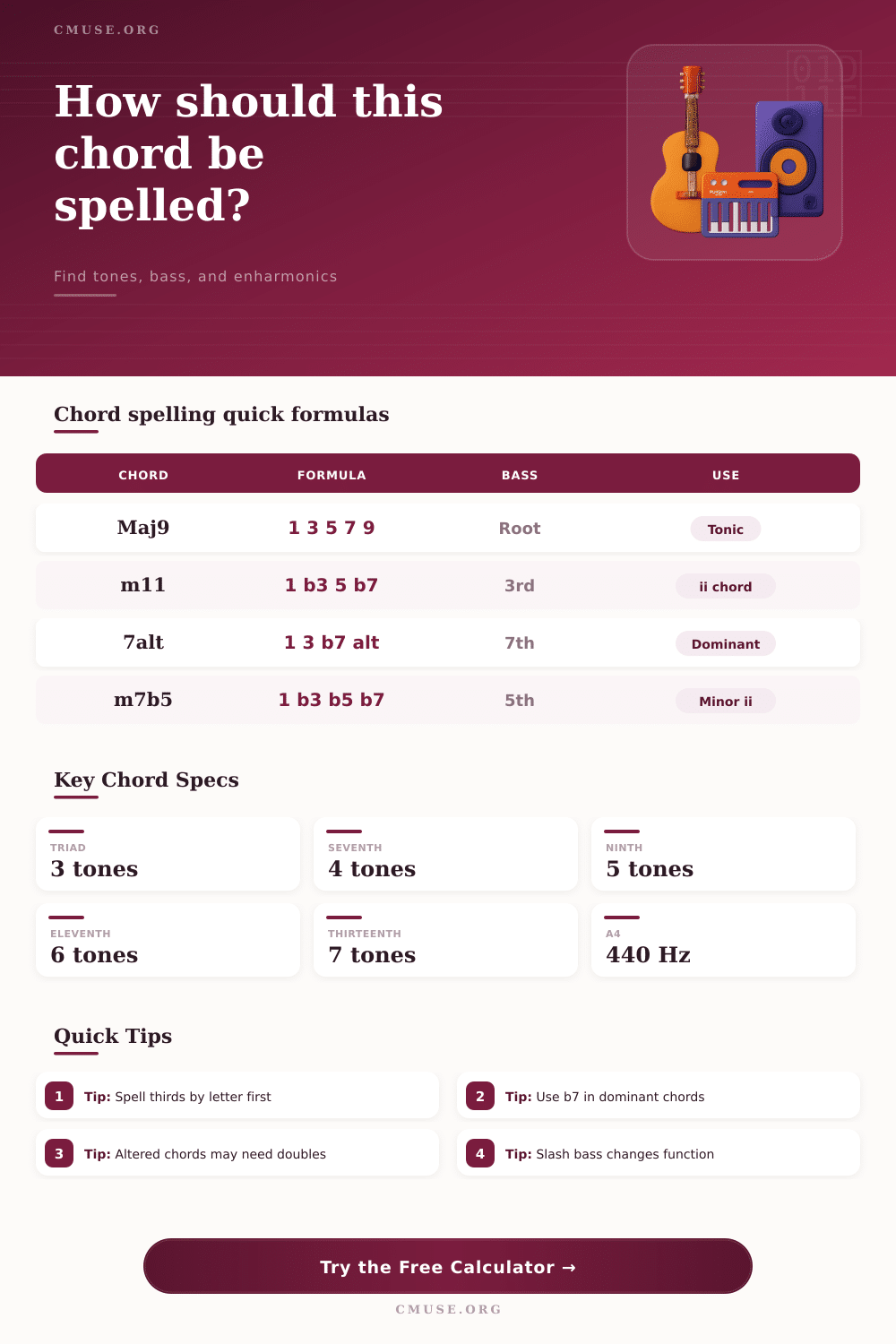
| Quality | Core formula | Default seventh | Typical symbol |
|---|---|---|---|
| Major | 1 3 5 | Major 7 for maj7 | C, Cmaj7, Cmaj9 |
| Minor | 1 b3 5 | Minor 7 for m7 | Cm, Cm7, Cm11 |
| Dominant | 1 3 5 b7 | Minor 7 | C7, C9, C13 |
| Minor major | 1 b3 5 7 | Major 7 | CmMaj7, CmMaj9 |
| Half-diminished | 1 b3 b5 b7 | Minor 7 | Cm7b5 |
| Diminished | 1 b3 b5 bb7 | Diminished 7 | Cdim7 |
♯ Extension and Alteration Map
| Choice | Added tones | Spelling idea | Best use |
|---|---|---|---|
| Inside | 9, 11, 13 | Diatonic extensions | Readable pop, jazz, and arranging parts |
| Lydian | 9, #11, 13 | Raise the fourth-letter degree | Major chords that need bright color |
| Bebop | 9 and 13 | Keep dominant tones simple | Swing, blues, and lead sheets |
| Flat or sharp 9 | b9 or #9 | Same second letter, altered accidental | Dominant pull and minor-key cadences |
| Altered | b9 #9 #11 b13 | Several altered degrees at once | Strong V7 to tonic resolution |
| Sus color | 9, 11, 13 | Third replaced by fourth | Gospel, modal, and pedal harmony |
🔀 Enharmonic Naming Comparison
| Pitch class | Sharp name | Flat name | Why spelling changes |
|---|---|---|---|
| 1 | C# | Db | Use C# as a raised C degree, Db as a lowered D degree. |
| 3 | D# | Eb | D# often appears in sharp-key leading tones; Eb is the common minor third from C. |
| 6 | F# | Gb | F# is a raised fourth from C; Gb is a lowered fifth. |
| 8 | G# | Ab | G# can be a leading tone to A; Ab is a flat sixth or minor third from F. |
| 10 | A# | Bb | A# is a raised sixth; Bb is the usual dominant seventh above C. |
📋 Preset Comparison Grid
| Preset | Primary sound | Spelling pressure | Useful check |
|---|---|---|---|
| Cmaj9 Lydian | Bright tonic color | Low | Make sure #11 spells as F#, not Gb. |
| G7alt Release | Dominant tension | High | Altered ninths share the A-letter degree. |
| F#m7b5 Minor ii | Minor predominant | Medium | The b5 should be C, not B#. |
| Ebdim7 Leading | Symmetric leading tone | High | Diminished sevenths may require bb7. |
| Fsus13 Gospel | Suspended dominant | Low | The 11 replaces the third in sus spelling. |
Chord spelling are a way to write musical notes on the page, and chord spelling will tell the reader how the chord will work within the keys. Chord spelling will indicate which note should be played in the bass of the chord, as well as indicate whether a given note within the chord will act as a leading tone or a color tone for that chord. While it may seem like the difference between an F sharp and a G flat are small, using the wrong spelling for a chord will cause a singer or guitarist to play the wrong note.
Thus, chord spelling act as a grammar of the chord that allows all players involved in a song to move in the same direction. Many players is able to spell major and minor chords, but often struggle with chords that contain sevenths and ninths. One reason for this is that dominant seventh chords contain a tension due to the presence of a lowered seventh note within the chord.
Chord Spelling Basics
Additionally, altering a ninth note within a chord requires the musician to choose between two different letters for that note, as they exists on the same piano key. A chord calculator tool will provide mathematical result for a chord once the user chooses the root note, chord quality, extension of chord, and alteration of chord. A lydian raised eleventh chord contains a raised fourth scale degree within the chord, which is represented as a sharp note within the chord rather than a flat note.
Using the sharp indicates that the chord isnt minor. Chord inversions involve changing the note that is played in the bass of a chord. While the chord still contains the same notes as it did prior to inversion, the chord calculator tool will display both the resulting bass note and the slash symbol for that chord.
The choice of inversion alters the function of that chord within the song. For instance, first inversion major seventh chords is often used as passing chords between two root-positioned chords. Third inversion dominant seventh chords place the seventh of the chord in the bass note to create stepwise movement between chords.
Thus, choice of inversion requires a decision of whether chord spellings should focus upon theoretical considerations or upon those that are easy readable by players of that chord. There are two main policy for spelling chords, each with its own benefits. The first is known as the theoretical mode policy, which requires each scale degree within a chord to maintain its expected letter.
Thus, theoretical mode can result in double flats or double sharps within the chord. The other policy is known as the simplified mode policy, wherein fewer ledger lines are used so that players can more easily sight read the chord. However, using simplified mode sacrifice some of the theoretical considerations for chord spelling.
Jazz musicians may prefer simplified mode due to the need to quickly understand the function of each chord in a jazz standard. String quartet players, however, may prefer theoretical mode so that the chords voice leading appear logical on the page. Thus, chord calculators allow players to toggle between each of these modes so that each player can compare each mode side by side.
Some of the mistakes that may occur when spelling a chord are based off a consideration of pitch classes rather than scale degrees. For instance, the most common chord spelling error is choosing to write a C sharp major chord but spelling the third as an F natural. While the F natural is the correct pitch class for that chord, the letter name is the wrong choice.
Instead, the third scale degree must have the letter E sharp for that chord to be correctly spell. Another common mistake is spelling the flat fifth of a half diminished chord as a sharp fourth. The chord calculator will warn players if the chord contains double accidentals, but avoiding mistakes may occur if the player chooses to first name the letter of the scale degree and then add the required accidental to that note.
The choice of chord spelling can be based upon the specific needs of the music. For instance, a gospel pianist may choose to utilize flats rather than sharps to allow the congregation that is singing along to more easily read those chords. In contrast, a classical composer may prefer the use of sharps rather than flats to allow the chord to move upward in the sheet music by a half step.
Both choices are valid for these musician. In addition to displaying each chord that is spelled out for a given chord, the chord calculator also tracks the guide tones for that chord. Guide tones are the third and seventh of the chord, and are the elements that define the chord altogether.
Using guide tones that are voiced close together will create an immediate understanding of whether the chord is major or minor. Spreading the guide tones out over a wider range of pitches alters the color of the chord, but does not otherwise alter the spelling of the chord. The chord calculator will display both the range and the frequency spacing of the guide tones, but requires the musician to make a decision regarding what spread to use for the chord.
The musician may desire the tension that is created when the guide tones are close together, or they may desire the chords to open up with the guide tones spaced out over a wider area. Chord spelling is a tool for musicians to communicate with one another about the chord that they intend to use in their composition or performance. While there are rules for each of the modes displayed by chord calculators, chord spellings is not a series of absolute rule.
The chord calculator allows musicians to view the different spellings for each mode for a given chord, and to choose the spelling that is most appropriate for each musicians skill level and the needs of the music that they are create.