Note Duration Calculator
Convert BPM, time signature, note value, dots, tuplets, bars, beats, samples, MIDI ticks, and frame positions into exact rhythmic timing.
🎵 Named Rhythm Presets
⚙ Duration Inputs
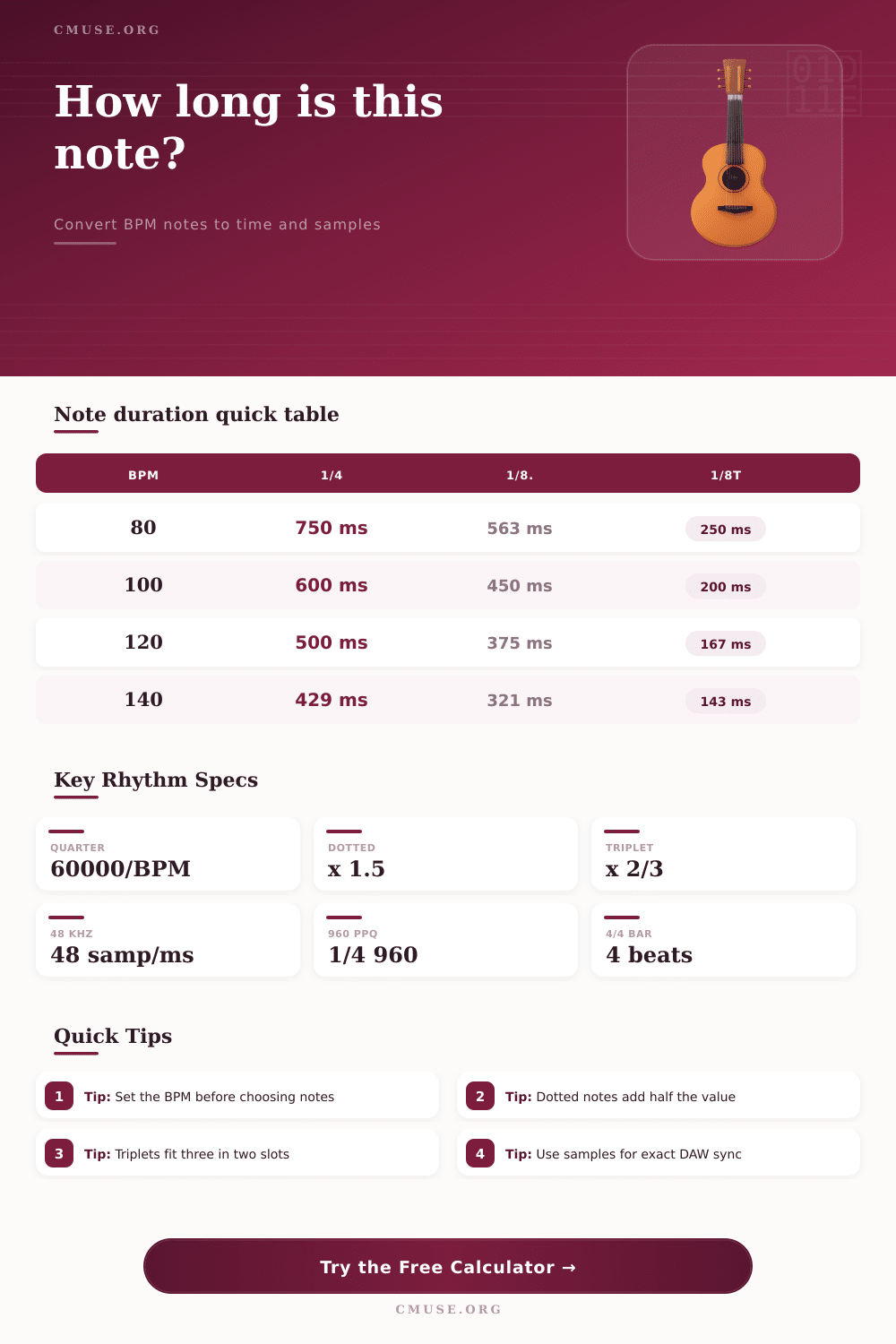
Core formula: quarter note milliseconds equals 60000 divided by BPM. Note value, dotted modifiers, tuplet ratios, time signature, sample rate, and PPQ are then applied to build timing results.
📊 Rhythm Formula Spec Grid
🔀 Modifier Comparison Grid
Uses the selected note value directly against the quarter-note tempo.
Adds half of the note value, common for delay throws and syncopation.
Adds half plus a quarter of the note value for extended held rhythms.
Compresses grouped notes into a chosen span for triplet and odd-grid timing.
📝 Note Value Reference Table
| Base Note | Quarter Factor | 120 BPM Straight | 960 PPQ Ticks |
|---|---|---|---|
| Whole note | 4.0000 quarters | 2000.00 ms | 3840 ticks |
| Half note | 2.0000 quarters | 1000.00 ms | 1920 ticks |
| Quarter note | 1.0000 quarter | 500.00 ms | 960 ticks |
| Eighth note | 0.5000 quarters | 250.00 ms | 480 ticks |
| Sixteenth note | 0.2500 quarters | 125.00 ms | 240 ticks |
| Thirty-second note | 0.1250 quarters | 62.50 ms | 120 ticks |
| Sixty-fourth note | 0.0625 quarters | 31.25 ms | 60 ticks |
⏱ BPM Timing Table
| BPM | Quarter | Dotted Eighth | Eighth Triplet | One 4/4 Bar |
|---|---|---|---|---|
| 60 BPM | 1000.00 ms | 750.00 ms | 333.33 ms | 4.000 sec |
| 80 BPM | 750.00 ms | 562.50 ms | 250.00 ms | 3.000 sec |
| 100 BPM | 600.00 ms | 450.00 ms | 200.00 ms | 2.400 sec |
| 120 BPM | 500.00 ms | 375.00 ms | 166.67 ms | 2.000 sec |
| 140 BPM | 428.57 ms | 321.43 ms | 142.86 ms | 1.714 sec |
| 174 BPM | 344.83 ms | 258.62 ms | 114.94 ms | 1.379 sec |
🎼 Bar and Phrase Duration Table
| Meter | Beat Unit | Quarter Units Per Bar | 8 Bars at 120 | Typical Use |
|---|---|---|---|---|
| 4/4 | Quarter note | 4.0 quarters | 16.00 sec | Pop, rock, dance, scoring grids |
| 3/4 | Quarter note | 3.0 quarters | 12.00 sec | Waltz, ballad, chamber phrases |
| 6/8 | Eighth note | 3.0 quarters | 12.00 sec | Compound pulse and rolling ballads |
| 5/4 | Quarter note | 5.0 quarters | 20.00 sec | Odd-meter grooves and film cues |
| 7/8 | Eighth note | 3.5 quarters | 14.00 sec | Asymmetric riffs and mixed-meter cues |
🎚 Sample, Tick, and Frame Table
| Duration | 48 kHz Samples | 96 kHz Samples | 960 PPQ Ticks | 30 fps Frames |
|---|---|---|---|---|
| Quarter at 120 | 24000 | 48000 | 960 | 15.00 |
| Eighth at 120 | 12000 | 24000 | 480 | 7.50 |
| Dotted eighth at 120 | 18000 | 36000 | 720 | 11.25 |
| Eighth triplet at 120 | 8000 | 16000 | 320 | 5.00 |
| Sixteenth at 120 | 6000 | 12000 | 240 | 3.75 |
| One 4/4 bar at 120 | 96000 | 192000 | 3840 | 60.00 |
A note duration calculator will calculate the length of musical notes based off the tempo and the time signature of the song. All music exist on a grid that is based on mathematical placements of the musical element. If the snare drum or the delay repeat isnt placed correctly on this grid, the music will not have the proper groove.
The calculation required to find the correct mathematical placement of the musical elements are complex due to the various musical variables. A note duration calculator will help you by perform these complex calculations after you enter the tempo and the time signature of your song. The first variable to consider with a note duration calculator is the tempo of the song.
How a Note Duration Calculator Works
The tempo is measured in beat per minute (BPM). You can calculate the length of a quarter note in milliseconds by dividing 60,000 by the BPM of the song. At a tempo of 72 BPM, a quarter note will last for 833 milliseconds.
At a tempo of 174 BPM, however, the same quarter note will last for only 345 millisecond. The tempo of the song affect many other variable of the musical composition. For example, if there are more milliseconds in a quarter note, there will be more time for musical ornament to be placed in that quarter note.
Additionally, there will be more time for a delay tail to dissipate before the next note are played. The second variable to consider with a note duration calculator is the value of the musical notes. There are various size for musical notes.
A whole note has a large note value, but music producer typicaly use smaller note value such as eighth and sixteenth notes. The smaller the note values, the less time between each note. For example, a 30-millisecond error in timing will not be noticeable when apply to a quarter note.
However, the same 30-millisecond error will move a 32nd note completely off of the musical grid. Note duration calculator allow music producers to account for these small timings. Additionally, they allow for the addition or subtraction of milliseconds from a note for various reason.
The third variable to consider with a note duration calculator is the time signature. The time signature indicate the number of beat in a bar of music. For example, 4/4 time signatures have four quarter notes in a bar.
Another example is 6/8 time signatures that have a different pulse than 4/4 time signatures because 6/8 is a compound time signature. Note duration calculators account for the top and bottom number of a time signature so that the length of a bar of music and the length of a musical phrase are correctly calculate. If a producer does not use a note duration calculator to account for the time signature of a song, the producer will incorrectly calculate the length of the bars of music.
The fourth and final variable to consider with a note duration calculator are the sample rate and the MIDI resolution of the music software. Once you have determine the length of a musical note in milliseconds, it may be necessary to calculate the length of that note in audio sample and in MIDI ticks. To calculate the length of a musical note in audio samples, the sample rate will be used.
For example, you can use a sample rate of 48,000 sample per minute. The length of the musical note in MIDI ticks can be calculated by using the parts per quarter note (PPQ) setting of the music sequencing software. Note duration calculators calculate these variable so that music producers can avoid rounding error in the calculations.
If producers avoid rounding error, the musical loops will not drift from the musical grid during playing session that last for a long period of time. Music producer often make mistake with their calculations. For example, they may use the wrong unit for their calculations.
Let’s say that the BPM of a song is correctly entered into a note duration calculator. However, the producer select the wrong musical note value. If the quarter note is selected when a sixteenth note was intended, the calculated duration will be incorrect for delay setting.
This will overwhelm the musical mix. Another example of the mistake that producers may make is miscalculating the number of beat in a bar for a 6/8 time signature. Instead of correctly counting the number of dotted quarter note in the bar, the mistake would be to count the number of eighth notes in that bar.
By running calculations through a note duration calculator before implementing musical ideas into the music composition software, producers will avoid these mistake. A note duration calculator will provide a baseline for musical compositions. When music is produced in the real world, the tempo may change.
Furthermore, a live drummer may not play back to the click of the metronome. A note duration calculator cannot calculate human error or latencies. However, it can calculate the mathematical baseline for musical compositions.
Any musical note can be calculated for its exact duration. From there, the music producer can decide how far from the calculated duration the notes will be moved to provide a “human” feel to the music. Since note duration calculators dont have any opinion or bias towards the music that is to be produced, the calculations are purely of the timing of the musical clock for the music productions to remain deliberate.