Frequency Ratio Calculator
Compare two frequencies, simplify their ratio, convert the distance to cents, and identify the nearest just or equal-tempered interval.
🎼 Named Interval Presets
⚙ Frequency and Ratio Inputs
Use frequency mode for measured Hz pairs or ratio mode for theoretical intervals. Interval matching is octave-reduced, while the breakdown preserves signed direction.
📊 Current Comparison Spec Grid
Frequency B divided by Frequency A before octave reduction.
Interval mapped into a single octave for naming.
Nearest equal-temperament step in the selected division.
Match rating from just and equal interval offsets.
🧮 Ratio Formula Grid
🎹 Just Interval Ratio Table
| Interval | Just Ratio | Just Cents | 12-TET Cents | Offset |
|---|---|---|---|---|
| Unison | 1:1 | 0.000 | 0 | 0.000 |
| Minor second | 16:15 | 111.731 | 100 | +11.731 |
| Major second | 9:8 | 203.910 | 200 | +3.910 |
| Minor third | 6:5 | 315.641 | 300 | +15.641 |
| Major third | 5:4 | 386.314 | 400 | -13.686 |
| Perfect fourth | 4:3 | 498.045 | 500 | -1.955 |
| Perfect fifth | 3:2 | 701.955 | 700 | +1.955 |
| Major sixth | 5:3 | 884.359 | 900 | -15.641 |
| Harmonic seventh | 7:4 | 968.826 | 1000 | -31.174 |
| Octave | 2:1 | 1200.000 | 1200 | 0.000 |
🎼 Equal Temperament Approximation Table
| EDO | Step Size | Best For | Ratio Reading | Watch Point |
|---|---|---|---|---|
| 12-TET | 100.000 cents | Piano, guitar, MIDI | Nearest semitone | Pure thirds shift strongly |
| 19-EDO | 63.158 cents | Meantone color | Thirds improve | Fifths are narrower |
| 24-EDO | 50.000 cents | Quarter tones | Half-semitone grid | Just fifth still offset |
| 31-EDO | 38.710 cents | Meantone and JI work | Good 5-limit mapping | Step names need care |
| 53-EDO | 22.642 cents | Fine tuning maps | Close fifths and thirds | Complex notation |
🔍 Frequency Pair Examples
| Frequency Pair | Raw Ratio | Simplified | Cents | Interval Reading |
|---|---|---|---|---|
| 220 Hz to 330 Hz | 1.500000 | 3:2 | 701.955 | Pure perfect fifth |
| 261.626 Hz to 327.033 Hz | 1.250000 | 5:4 | 386.314 | Pure major third |
| 440 Hz to 442 Hz | 1.004545 | 221:220 | 7.851 | A reference drift |
| 440 Hz to 622.254 Hz | 1.414214 | 99:70 | 600.000 | Equal tritone |
| 330 Hz to 660 Hz | 2.000000 | 2:1 | 1200.000 | Octave duplication |
📝 Ratio Simplification Reference
| Simplification Limit | Useful When | Example Reading | Tradeoff |
|---|---|---|---|
| 16 denominator | Fast musical labels | 3:2, 5:4, 7:4 | May hide small offsets |
| 32 denominator | Most tuning checks | 31:16 or 27:16 | Balanced clarity |
| 64 denominator | Microtonal sketches | 45:32 or 81:64 | More complex names |
| 128 denominator | Precise analysis | 128:121 style ratios | Less readable by ear |
When you play two musical note at the same time, those two notes has a distance between them. The distance between those two notes can be described as the relationship between the two frequencies that those notes emits. The relationship between those two frequencies can be represent as a ratio.
A frequency ratio calculator can transform that relationship between the two frequencies into a ratio that you can read. Many musician use frequency ratios because many musicians need to understand the relationship between two frequencies. For example, a violinist need to understand the relationship between two frequencies in order to tune an open fifth on their instrument.
How a frequency ratio calculator works
An electronic musician may use frequency ratios to understand how a specific ratio of two frequencies differ from the equal tempered ratio of those same two frequencies. A sound engineer may use frequency ratios to understand the drift between a reference tone and an oscillator. Each musician may use frequency ratios for a different reason, but each musician utilize the same mathematical numbers to calculate the relationship between those two frequencies.
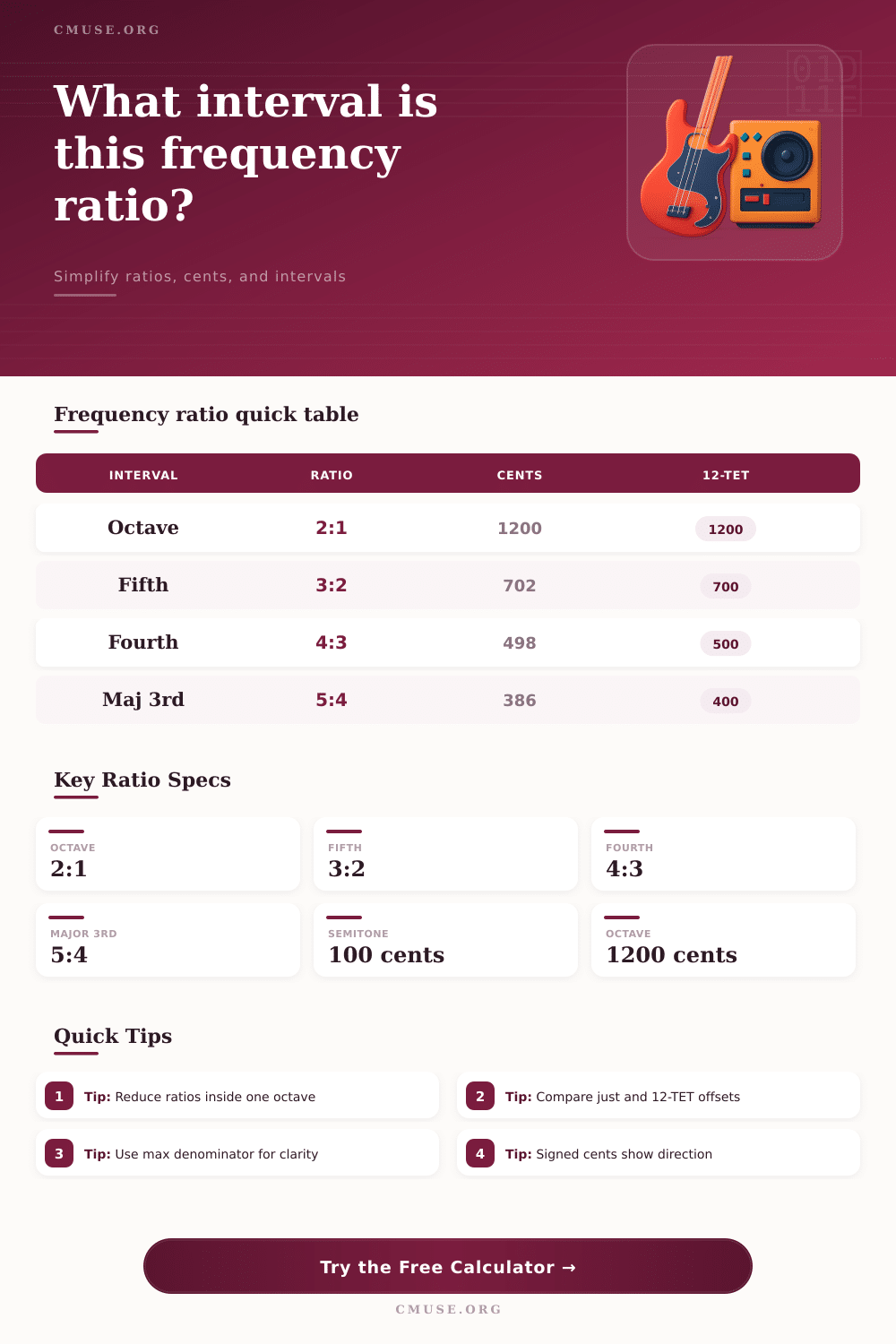
The difference between a just interval and an equal tempered interval is a matter of practicality. A just interval of a major third have a ratio of 5:4. In equal temperament, a major third is 400 cents.
These two values is different, yet the gap between them is very small. A composer creating music for fixed pitch instruments may accept the equal tempered interval. A vocal director may prefer to tune a chorus to the just interval.
A frequency ratio calculator can calculate these values for you; all you must do is enter the frequencies that you would like to compare. A frequency ratio calculator often include a simplification limit. The simplification limit determine the complexity of the ratio that the frequency ratio calculator will report.
The larger the denominator in a fraction, the more complexly that fraction is. A frequency ratio calculator will report a more complex fraction if the simplification limit are larger. For instance, a ratio of 45:32 is more accurate than a ratio of 3:2, but most performers is more comfortable with a simpler fraction.
By lowering the simplification limit, the frequency ratio calculator will report a ratio using simpler fraction. A simpler fraction is easier for a person to understand and use during a rehearsal or while working in a recording studio. Thus, the simplification limit is both a mathematical and practical choice for the musician.
The other two choice on the frequency ratio calculator are the signed and the upward options. The signed option will show the distance between the two tones as they exist in time. The upward option will report the distance between the two tones as a positive value.
While either of these option will provide the correct information, the signed may be more useful for understanding if a particular tone is flat or sharp compared to another. Another use for a frequency ratio calculator is to determine equal temperament division that are larger than twelve steps. For example, nineteen-tone equal temperament (19-ET) and thirty-one-tone equal temperament (31-ET) is two different tuning systems that bring just intervals closer to equal tempered intervals.
A frequency ratio calculator can compute the offset that each of these division will create. For instance, the offset can be used to determine if a set of intervals need to be retuned before it is played for its audience. There is some variables to real instruments and rooms that cannot be accounted for in a frequency ratio calculator.
For instance, the temperature in which an instrument was played can change the pitch of a wind instrument. The humidity in the room can alter the pitch of string instruments. A singers vibrato can change the pitch of an interval that is sung by that singer.
Thus, while a frequency ratio calculator can give a musician the mathematical measurement of the frequency of two tones, it cannot account for the variables of the physical world that may alter the frequency of those tones while they are being played. Musicians often make mistake with a frequency ratio calculator if they do not understand the expectations of the tool. For example, a musician might expect every measurement from the frequency ratio calculator to be a target to be achieved.
Yet, often a ratio is only an approximation. Another mistake is to expect that the equal tempered scale will reproduce every just interval exactly as they sound. Yet, it do not.
Before using a frequency ratio calculator, a musician should of decide what level of accuracy is required for the task that they are to perform with the instrument. For instance, a song that will be recorded with pitch correction may allow for a much larger offset from the target intervals than an a cappella song that will be performed without the use of pitch correction software. The reference table that come with most frequency ratio calculators can help a musician to understand what level of offset between just and equal tempered intervals is audible.
These reference tables provides information about the ratios of the most common just intervals and their offsets from equal tempered intervals. By consulting the tables before entering the frequencies that you wish to compare, you will have an understanding of the size of intervals that can be considered audible or inaudible within a chord. The value of measuring frequency ratios provide clarity to the choices that musicians make.
By understanding the relationship between two musical tones in terms of their frequencies and the ratio between those frequencies, musicians can make informed decisions about how to tune their instrument, how to compose their music, and how to perform their music for their audiences.