Sound Power Level to Sound Pressure Level Calculator
Convert acoustic sound power level, Lw, into estimated sound pressure level, Lp, at a listener or measurement point using distance loss, directivity, boundary radiation, room support, and air absorption.
🎵 Source and Distance Presets
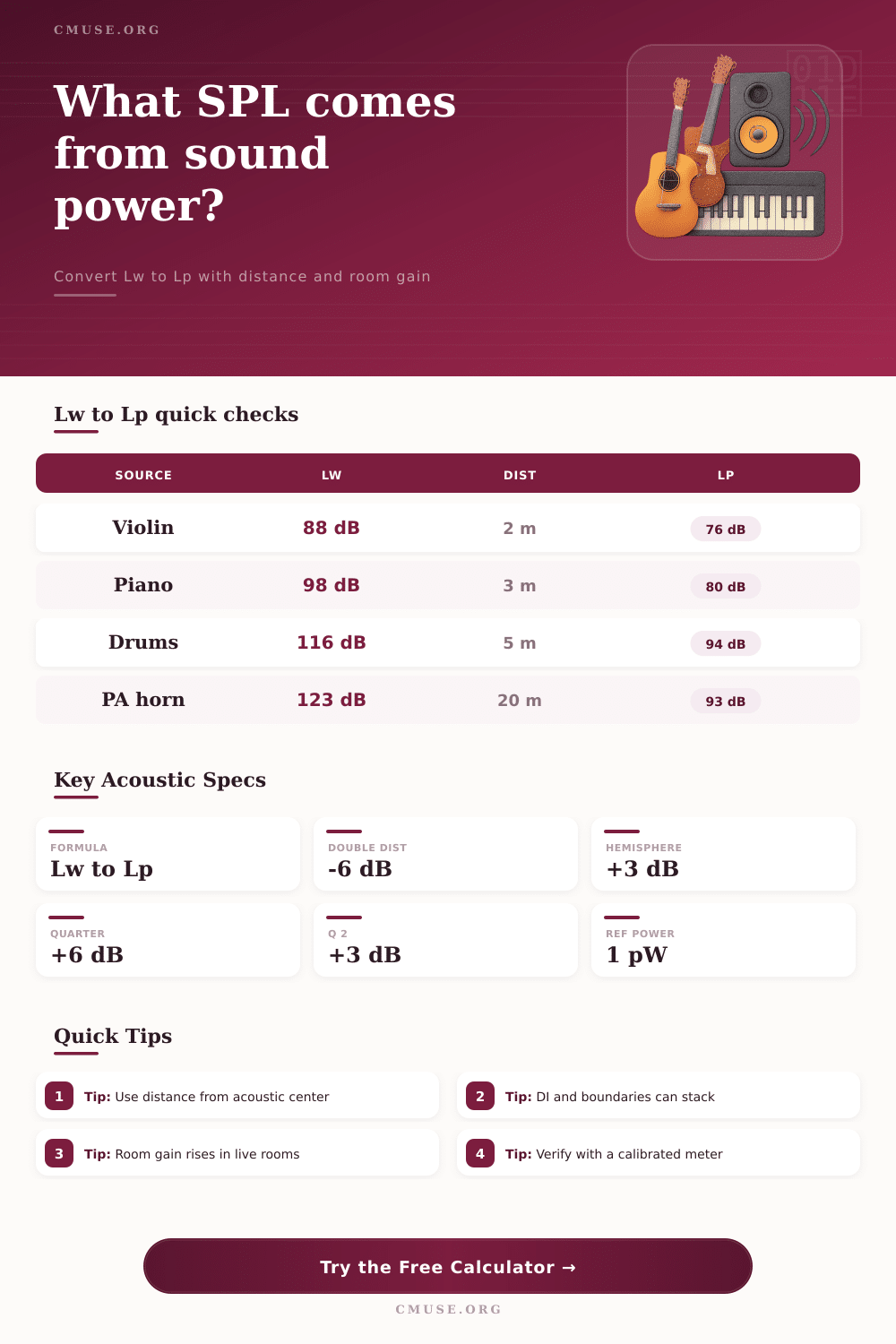
Core equation: Lp = Lw + directivity - 20log10(r) - 11. The calculator then adds radiation-space and room adjustments, and subtracts long-throw air loss.
⚙ Acoustic Conversion Inputs
Distance Step Comparison
| Distance | Core Lp | Adjusted Lp | Use |
|---|---|---|---|
| -- | -- | -- | -- |
📊 Acoustic Spec Grid
🔍 Model Comparison
Free Field
Treated Room
Live Room
Sabine
📚 Reference Tables
| Distance change | Level change | Reason | Practical reading |
|---|---|---|---|
| Distance doubles | -6.0 dB | 20log10(2) | Direct sound is much quieter. |
| Distance triples | -9.5 dB | 20log10(3) | Useful for stage-to-seat checks. |
| Distance halves | +6.0 dB | 20log10(0.5) | Close mics see large gains. |
| 10x farther | -20.0 dB | Inverse-square pressure | Outdoor throws need power and aiming. |
| Radiation condition | Adjustment | Equivalent space | Typical audio example |
|---|---|---|---|
| Full space | 0 dB | Spherical | Flown source away from boundaries. |
| Half space | +3 dB | Hemisphere | Speaker or instrument on a large floor. |
| Quarter space | +6 dB | Wall-floor | Cabinet near a hard wall and floor. |
| Eighth space | +9 dB | Corner | Low-frequency source in a hard corner. |
| Source type | Approx Lw range | Typical DI | Use in calculator |
|---|---|---|---|
| Solo strings or woodwind | 82 to 96 dB | 0 to 2 dB | Practice room or chamber estimates. |
| Grand piano or choir | 94 to 106 dB | 0 to 3 dB | Rehearsal and room-support studies. |
| Drum kit or brass section | 108 to 120 dB | 1 to 5 dB | Peak exposure and distance planning. |
| PA horn or monitor wedge | 112 to 126 dB | 4 to 12 dB | Coverage prediction and on-axis throw. |
| Room surface profile | Absorption coefficient | Room behavior | Calculator setting |
|---|---|---|---|
| Hard rehearsal room | 0.08 to 0.15 | Strong reflections and buildup | Live room or Sabine low absorption. |
| Balanced music room | 0.18 to 0.30 | Moderate support with controlled decay | Small balanced room or Sabine. |
| Absorptive studio | 0.35 to 0.60 | Less diffuse support | Treated room or Sabine high absorption. |
| Outdoor field | Not applicable | No room return | Outdoor / anechoic mode. |
In order to determine the sound pressure level at a specific seat from a sound source, it is necesary for a musician, sound engineer, or venue manager to understand the difference between sound power level and sound pressure level. Sound power level is the value that is published for most sound sources, but the value that reaches the listener’s ears is the sound pressure level. Because sound power and sound pressure level are different physical quantity, it isnt possible to mathematically convert one to the other through simple subtraction.
Because this problem exists in rehearsal rooms, on outdoor stages, and during recording sessions, an accurate tool to calculate sound pressure level from sound power levels is necesary. Sound power level is the total amount of acoustic energy that a source radiates. The sound power level do not change with the distance between the listener and the sound source.
How to Find the Sound Pressure Level at a Seat
Sound pressure level, however, does change with distance from the sound source, the shape and reflectiveness of the spaces around the sound source. For instance, a violin may have a sound power level of 88 decibels, but the sound pressure level that a listener experiences two meters from the violin will depend upon whether the violin is positioned in the middle of a room, against a wall, or outdoors. The calculator can mathematically calculate these variable for the user and provide the resulting sound pressure level for that sound source at that distance.
Distance between the listener and the sound source is one of the factor that affects sound pressure level. Distance is also one of the factors that those calculating sound pressure levels often misjudge. Sound pressure level decreases with the inverse square of the distance from the source that is radiating the sound, meaning that every time the distance between the listener and the sound source is doubled, the direct sound energy decrease by six decibels.
Therefore, both guitarist and audience member will experience different sound pressure levels from the same guitarist positioned three feet from his amplifier versus twenty feet from his amplifier. By entering various distances into the calculator, one can understand at what distances the sound pressure level becomes uncomfortable or even marginal. Directivity of the sound source is another of the factors that can have a large effect upon the sound pressure level at a specific listener.
The sound energy radiated by some sound sources is focused forward of the source, while other sound sources radiate sound energy equally in all directions. Therefore, a sound source like a brass bell or loudspeaker with horns will radiate most of its sound energy along its central axis, leading to increased sound pressure levels at listeners positioned along that axis. Any positioning of the sound source that is off of that central axis will reduce the sound pressure level at those listeners of the sound source.
These two variables have an effect upon sound pressure level independently of one another; the sound source is intentionaly made separate variables to allow for both to be adjusted without making another change to sound pressure level. The third factor that can have a large effect upon sound pressure level is the characteristics of the rooms in which the sound source is playing. In a live room, some of the sound energy radiated by the sound source reflects off of the walls and returns to the listener.
These reflected sound waves can add to the direct sound that reaches the listener. Beyond the critical distance from the sound source (where reflected sound becomes the majority of the sound that is heard by the listener), these reflected sound waves are especially common and strong. The small balanced live room may add some to the sound pressure level to the sound that is radiated by the sound source.
However, an heavily treated listening studio may lose some of the sound pressure level to the reflections of sound waves off of the reflective studio surfaces. Using the Sabine option for the calculation, the size of the room in square feet and the average sound absorption coefficient for the surfaces in the room can be entered, and the calculator will calculate the sound pressure level from the reflected sound waves in the room. This factor is especially important in those who wish to play from a carpeted classroom to a concrete rehearsal room.
Air absorption is one more factor that affects sound, and it is one that is especially important for outdoor venues. Air absorption is the phenomenon in which the air absorbs high frequency sound energy over long distances. Although the absorption of sound energy per hundred meters of distance is relatively small for most distances, that loss of sound energy compounds over long distances.
Air absorption is a factor that is accounted for in the sound pressure level calculation. However, the calculator calculates it after sound pressure level, distance, directivity, and boundary effects. Another factor in the calculation of sound pressure level is the background level of sound at the listener’s position.
A calculated sound pressure level of 78 decibels will not be useful if the background noise level at the listener’s position is 70 decibels. The difference in sound pressure level between the calculated figure and the background noise level at the listener will determine whether the sound source remains intelligible to the listener. Many people make mistakes in calculating sound pressure levels if they skip some of the necesary steps in the calculation.
For example, distance may be incorrectly measured from the sound source to the front of the speaker cabinet rather than from the sound source to the acoustic center of the speaker cabinet. Another common mistake is ignoring boundary loading of the speaker to the stage upon which it is positioned. The sound pressure level calculated using an anechoic chart is not useful for sound sources that are reflected in a reflective hall.
These and other mistakes can shift the calculated sound pressure level by several decibels. These variables are made visible to the user in the calculation so as to ensure that the sound pressure level figure is honest and accurate. Real rooms have additional complications to the calculations that the mathematical model of sound pressure level calculation cannot account for.
The sound absorption of the audience can change with the number of individuals that are in the audience. The placement of furnitures in the room will change the reflections of sound that are reflected into the listeners’ ears. The sound reflections outdoors can change with the temperature gradients in the outdoor environment.
These complications of real rooms can be ignored in the calculation of sound pressure level. The sound pressure level calculated by the calculator is an estimate only. A quick sound measurement with a sound pressure level meter should be made after the installation of the sound system.
This measurement will provide a more accurate sound pressure level to the listener than the mathematical model. The value of performing this type of calculation is more than the sound pressure level that is provided by the calculator. The value of performing the calculation is in the identification of the various factors that contribute to the sound pressure level at the listener.
By making each of these factors explicit within the calculation, the uncertainty of the sound pressure level at the listener is reduced. Thus, the sound pressure level calculation transforms uncertainty in loudness to the listener into clarity regarding the expected loudness of the sound source.