Horn Transposition Calculator
Convert between written and concert pitch for horn in F, Bb, Eb, D, C, E, G, A, and Bb basso parts, with register checks and phrase mapping.
🎺 Horn and Orchestral Presets
⚙ Written, Concert, Horn Key, and Register Inputs
📊 Live Horn Spec Grid
⚖ Comparison and Spec Grid
🎼 Horn Key Transposition Table
| Horn Key | Concert C Written As | Written Offset | Sounding Rule | Common Context |
|---|
🗺 Current Transposition Mapping
| Concert Pitch | Written Pitch | Interval | Frequency | Register |
|---|
📘 Clef and Register Reference
| Area | Concert Range | Written F-Horn Range | Use | Watch Point |
|---|---|---|---|---|
| Pedal / very low | F1 to B1 | C2 to F#2 | Special color or cue | Often slow and exposed |
| Low horn | C2 to B2 | G2 to F#3 | 4th horn, dark harmony | Balance and clarity |
| Middle staff | C3 to G4 | G3 to D5 | Most orchestral writing | Best blend area |
| High horn | Ab4 to C5 | Eb5 to G5 | Principal solos and climaxes | Endurance matters |
| Extreme high | Db5 and above | Ab5 and above | Special effect or virtuoso line | Confirm player and context |
🎭 Named Preset Comparison Table
| Preset | Direction | Horn Key | Input Pitch | Result Focus |
|---|
🔢 Interval Offset Reference
| Semitones | Interval | Use In Horn Work | From Concert C |
|---|---|---|---|
| 0 | Unison | Horn in C or no added offset | C |
| +2 | Major 2nd | Bb alto horn part | D |
| +5 | Perfect 4th | G horn crook | F |
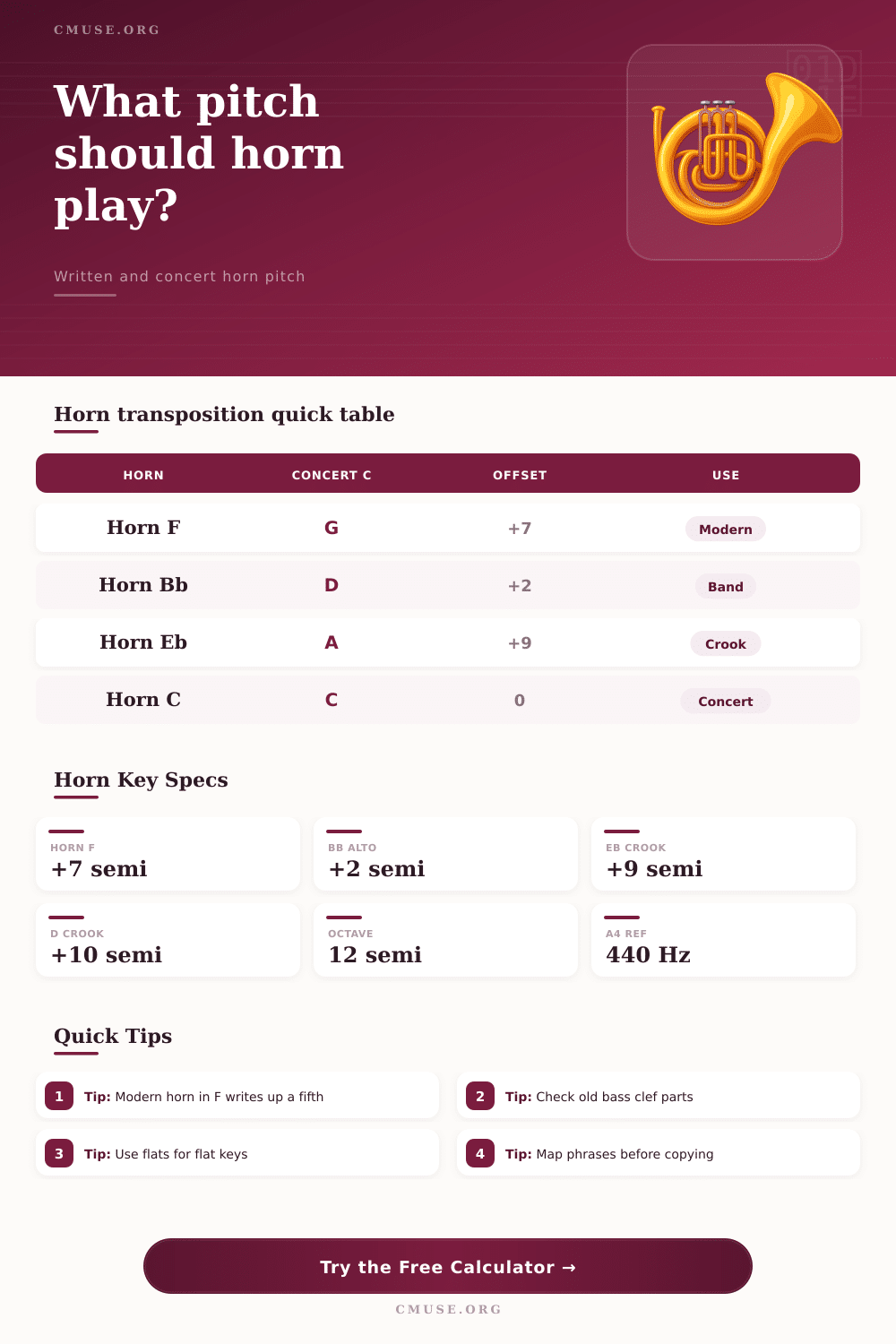
| +7 | Perfect 5th | Modern horn in F | G |
| +8 | Minor 6th | Horn in E | Ab |
| +9 | Major 6th | Horn in Eb | A |
| +10 | Minor 7th | Horn in D | Bb |
| +14 | Major 9th | Bb basso convention | D5 |
Translating musical notes on a page to the sounds emerging from a horn require an understanding of the transposition process for horns. Horn players have to contend with the horn’s unique range of written notes to sounding notes. A single note written on a horn part can sound at the same pitch as the written note or as much than a ninth lower than the written note on the horn part.
There are a variety of reasons that a horn player might need to understand this process. Whether from the conductor’s requirements to achieve a specific sound for a section of music, whether from the composer writing a high note that is exposed to the audience in that orchestral work, or whether the horn player is working with an edition of a musical part written for older horn with different crooks. Once the horn player has selected the key for the horn part and the direction for transposition (from written to sounding or from sounding to written), the horn player can perform the mathematics necessary to calculate the sounding pitch or the written pitch.
How to Transpose Horn Parts
Moddern orchestral horn parts is written for a horn in F, and those parts require horn players to read music written a perfect fifth lower than the sounding pitch. This range is made available on the F horn part because it allows horn players to more easy access both the middle, low, and high registers of the horn. For older musical parts that used different horn crooks, such as an Eb crook, the resulting horn parts will not appear the same as those written for modern horns in F.
The direction of horn transposition is a critical setting for horn players because the direction of the conversion from written to sounding or sounding to written is dependent upon the horn player’s goal.
If the horn player is reading horn parts written for horns, they will need to calculate the sounding pitch of each written note. If the horn player is writing horn parts for the horn they will play, they will need to determine the written pitch for each sounding note. Though the mathematics involved in horn transposition are the same for horn players in both scenario, the horn player will begin with either the sounding pitch or the written pitch to arrive at the other value.
Both approaches are common among horn players as they rehearse and study score for orchestral works. Beyond the register of horn parts written for horns, there are other factors that influence horn players. Horn players often encounter music that requires them to play low notes on the horn.
Low horn writing produces a dark sound, and low notes are played below the staff in musical scores. In contrast, high notes on the horn are played above the staff and require more endurance from the horn player. While the calculator can automatically classify each note written for a horn according to register, the decision of which register to play can be based upon the music itself.
Some editions will require horn players to write notes to remain within a certain register, regardless of the sounding pitch of those notes. The calculator allows horn players to establish a preference for which register the horn player will use when writing musical parts for horns. Some editions of musical parts will require written notes to be close to the staff in which musical notes are written, while other editions will leave the written note and sounding pitch of each note in the part literal.
The note spelling preference setting allows horn players to choose between using flats for notes in flat keys or using sharps for notes in sharp keys. Though the calculator will use the default notation preference for each horn key, the horn player may choose to change this setting. This setting is most useful for horn players who must copy musical line or prepare cues for other instruments.
The mapping of musical phrases allows horn players to transpose entire lines of music written for horns. By pasting a short musical passage into the calculator, horn players can see the entire transposed musical phrase in the calculator. Rather than transposing each note individually in the score being played, mapping musical phrases can catch problem that might result from the transposition of individual notes.
For horn players, an octave jump that seems effective when playing horns in concert pitch may lead to awkward horn playing when the horn player transposes that note. Additionally, an accidental in the original music that was effective for the horn player may become a double flat or a double sharp after transposition into another key for the horn section. By running a musical phrase through the calculator before copying the phrase into a musical part for the horn section, horn players will save time and create fewer errors.
Beyond the various settings for horn keys and notes, horn players must contend with some editions of old musical parts for bass clef notes. Some musical parts for horns written in the past required horn players to read bass clef notes as they appeared on the staff for the horn parts. Other musical parts required horn players to read those same bass clef notes one octave lower than they were written.
The clef setting in the horn part calculator allows horn players to test both clefs so that they dont have to guess which clef to use when playing from a musical part. This setting is helpful for horn players preparing musical parts from editions of orchestral scores from the nineteenth century. Horns have a specific range of notes that can be played by horn players.
Notes in the extreme low register of horns or those in the extreme high register may be playable. However, low notes for pedal tones require a horn player to use a relaxed embouchure when playing these notes. High notes that lie above the staff require alot of endurance from the horn player.
The register of notes classified by the horn part note calculator allows a horn player to understand whether a musical line will be comfortable for the horn section or whether the horn player will be required to play music that is exposed. Horn transposition is the process of matching the written musical notes on a musical score to the physical horn in the player’s hands. By removing the need for horn players to complete calculations manually, the horn part note calculator allows horn players to focus upon the music written for them for horns.
Using this calculator, horn players can ensure that musical lines written for horns match what they intend for the horn section, that all notes are spelled correctly, and that all musical lines fall in registers that they intend for the horn player. Once horn players have settled on a musical line that they feel is appropriate according to register, spelling, and pitch, the horn part will be a functional tool for the horn player.