Overtone Series Calculator
Calculate overtone frequencies, harmonic ratios, octave-reduced cents, nearest 12-tone note names, cents deviation, and partial-by-partial reference tables from any fundamental.
🎼 Instrument And Fundamental Presets
⚙ Fundamental, Overtone Index, And Note Matching
Acoustic overtone numbering usually counts the first overtone as partial 2. Switch the convention if your source labels the fundamental as partial 1.
📊 Overtone Series Spec Grid
🔎 Comparison Grid
Low Partials
Prime Colors
High Partials
12-TET Offset
🎶 Calculated Overtone Breakdown Table
| Overtone | Partial | Frequency | Ratio | Interval Cents | Nearest Note | Deviation | Level |
|---|---|---|---|---|---|---|---|
| 0 | 1 | 82.41 Hz | 1/1 | 0.00 | E2 | 0.00 c | 0.0 dB |
📐 Natural Overtone Interval Reference
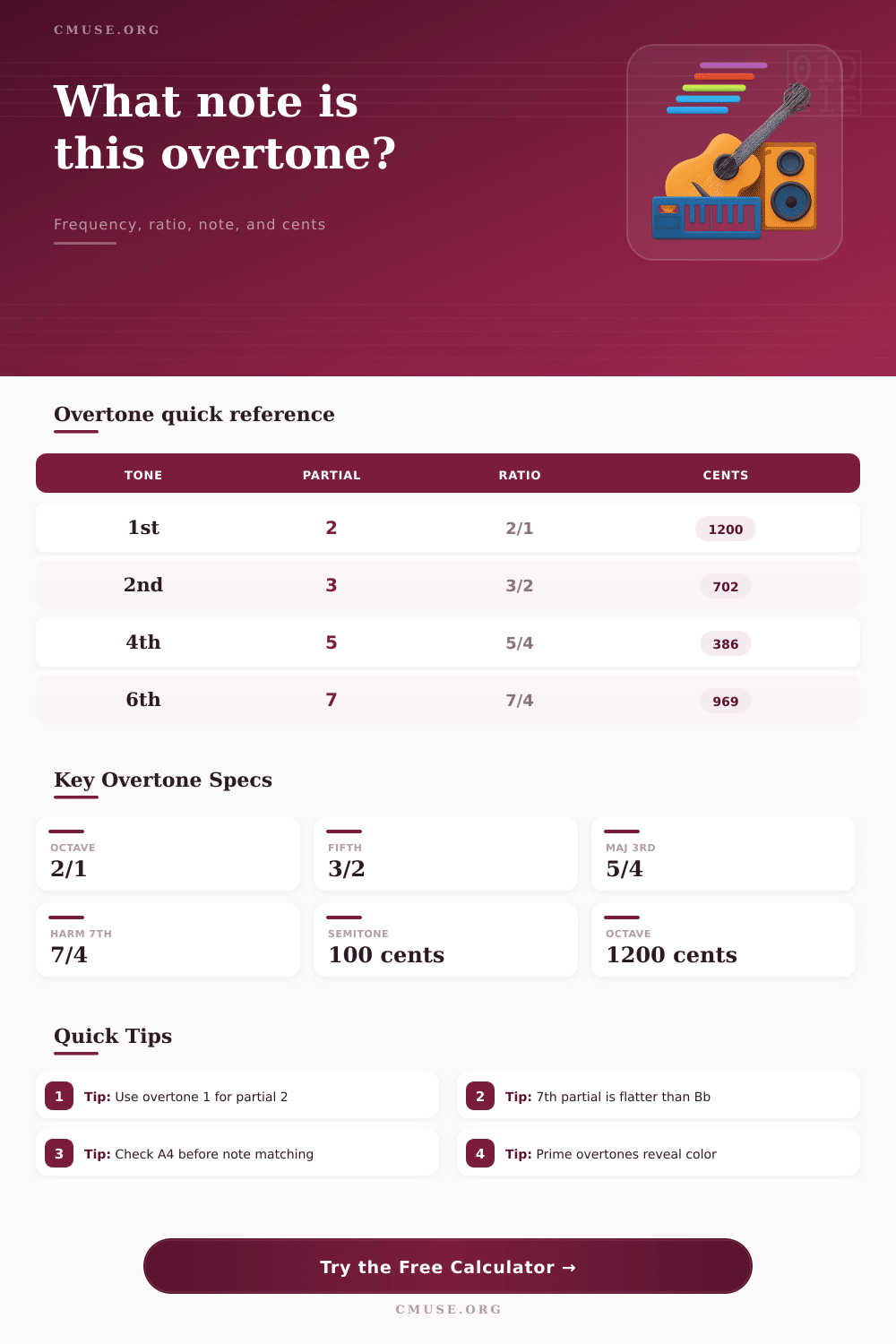
| Overtone Index | Partial | Reduced Ratio | Common Name | Cents | 12-TET Difference |
|---|---|---|---|---|---|
| 0 | 1 | 1/1 | Fundamental | 0.00 | 0.00 c |
| 1 | 2 | 1/1 | Octave return | 0.00 | 0.00 c |
| 2 | 3 | 3/2 | Just fifth | 701.96 | +1.96 c |
| 3 | 4 | 1/1 | Second octave | 0.00 | 0.00 c |
| 4 | 5 | 5/4 | Just major third | 386.31 | -13.69 c |
| 5 | 6 | 3/2 | Fifth return | 701.96 | +1.96 c |
| 6 | 7 | 7/4 | Harmonic seventh | 968.83 | -31.17 c |
| 10 | 11 | 11/8 | Undecimal fourth | 551.32 | -48.68 c |
| 12 | 13 | 13/8 | Tridecimal sixth | 840.53 | +40.53 c |
🎻 Instrument Fundamental Reference
| Instrument Source | Fundamental | Frequency | Useful Overtone Check | Resulting Partial |
|---|---|---|---|---|
| Pipe organ pedal | C1 | 32.703 Hz | Overtone 2 | G2 color partial |
| Double bass open string | E1 | 41.203 Hz | Overtone 4 | Major third color |
| Cello open string | C2 | 65.406 Hz | Overtone 6 | Harmonic seventh |
| Guitar low string | E2 | 82.407 Hz | Overtone 3 | Two-octave return |
| Trombone fundamental | Bb2 | 116.541 Hz | Overtone 5 | Fifth return |
| Violin open string | G3 | 195.998 Hz | Overtone 4 | Major third color |
| Clarinet chalumeau | D4 | 293.665 Hz | Overtone 2 | Twelfth behavior |
| Flute fundamental | C5 | 523.251 Hz | Overtone 1 | Octave check |
📌 Practical Overtone Tips
The overtone series are a collection of frequencies that occur when an instrument produce a sound. Furthermore, the overtone series is also the reason that different instruments creates different sounds even if they are playing the same pitch. When a string or air column within an instrument vibrate, the vibration do not create only one pitch.
Rather, the vibration create a fundamental pitch (the lowest frequency of vibration) and a series of higher frequencies, known as partials. These partials create the different sounds of different instruments, and the overtones is the reason for these different sounds. The calculator will convert the overtone series into mathematical numbers.
Overtone series and the calculator
Furthermore, the calculator allow a user to select the frequency that is to be used in calculating the overtone series. For each frequency that is calculated, a user can choose to consider the frequencies as either partials or overtones. Based on the chosen frequency and the selected consideration of the frequencies as either partials or overtones, the calculator will calculate the frequencies of the overtones, the ratios of each overtone to the fundamental frequency, and the nearest equal tempered notes to each overtone.
There is a difference between considering the partials and the overtones as numbered the same, and some individuals may get confused by these differing concepts. For example, some textbooks states that the fundamental frequency of an instrument is the first partial. Other textbooks, however, state that the first partial is the first overtone that the vibration of a string or air column creates.
These settings can be changed within the calculator, thus allowing the calculator to match the definitions of these terms that are published in the textbook that is being used. With the settings adjusted to the desired values, the mathematical logic for each instrument will be the same. For example, the overtone series will be the same for a violin as it will be for a double bass, but they will exist in different octaves.
The intervals of the overtones do not contain even frequencies, but do contain a specific mathematical series that describes the series of intervals that are created by the overtones. For example, the second overtone creates an interval of an octave for the fundamental frequency, the third overtone creates a just fifth interval, the fourth overtone creates a perfect fourth interval, and the fifth overtone create a major third interval. The seventh overtone creates a harmonic seventh interval, but this interval often does not sound the same as the seventh note created in equal temperament tuning for that note.
For this reason, musicians such as brass musicians may adjust the pitch of the 乐器 to lower the partial that creates the seventh overtone, as well as string musicians to adjust their string tunings. The reference table that is included with the calculator includes the mathematical number of cents that each overtone is from the nearest equal tempered note. These values can allow a musician to understand whether or not a deviation from the equal tempered scale for that specific instrument is acceptable.
For example, the major third note that strings create may be closer to the equal tempered interval than the major third created by brass instruments, and the musicians may have to adjust their instruments to accommodate for this. In addition, the strength of the partials is not the same for each instrument. For example, some instruments, such as a flute, may exhibit the highest strength for the lowest partials, but other instruments, such as a guitar with distortion effects, may exhibit the strongest presence of the upper partials.
The level estimate for each overtone will model the strength of each of these overtones, allowing the musician to understand which overtones is audible to an individual. The calculator allow a user to select any frequency of A4. This feature allows the calculator to reflect the different historical and contemporary pitch standards. For example, if the A4 frequency is changed, the names of each note will change, as will the offset frequencies in cents.
For instance, the deviation from standard for a trombone part played at an A435 pitch will be more different than the deviation for a trombone part played at an A442 pitch. Thus, the musician will have to be aware of the reference frequency for the A note to understand what pitch is being created in terms of cents from the calculated overtone. Some of the ways that the calculator can be used is in the decision of the fingerings for instruments such as brass instruments, the slide positions for brass instruments, or even the tunings of the strings of string instruments.
For instance, if a musician is to play the eleventh partial of a low brass instrument, the calculator will indicate that the partial will be nearly fifty cents away from the nearest equal tempered note. Thus, the musician will be able to adjust their instrument to ensure that there is no clash between partials created by different players in that band. Furthermore, the same logic can be applied to other instruments, such as trombones, tubas, vocal drones, and even electronic instruments.
The overtone series is a series of frequencies that are created by musical instruments. Furthermore, the relationship between each of these series can be made visible to the musician through the use of this calculator to determine each of these frequencies and relationships.