Pitch to Frequency Calculator
Convert note name and octave into Hz with A4 reference tuning, cents offset, temperament color, MIDI number, wavelength, and surrounding pitch tables.
🎵 Named Pitch Presets
⚙ Pitch Inputs
Equal-tempered base formula: frequency = A4 x 2^((MIDI - 69) / 12). Temperament and cents are added as fine pitch offsets after the note and octave create the MIDI number.
📊 Pitch Calculation Spec Grid
🔎 Temperament Comparison Grid
Every semitone is 100 cents, matching piano, MIDI, DAW, and tuner defaults.
Moves each pitch class toward simple harmonic ratios relative to the selected tonic.
Builds pitch color from stacked perfect fifths, often sharpening thirds against 12-TET.
Snaps the chromatic degree to 19, 24, or 31 equal divisions of the octave.
🎼 Generated Nearby Pitch Table
| Pitch | MIDI | Equal Hz | Final Hz | Total Offset | Period |
|---|
🎚 A4 Reference Table
| Reference | A4 Hz | Cents vs A440 | Common Context |
|---|---|---|---|
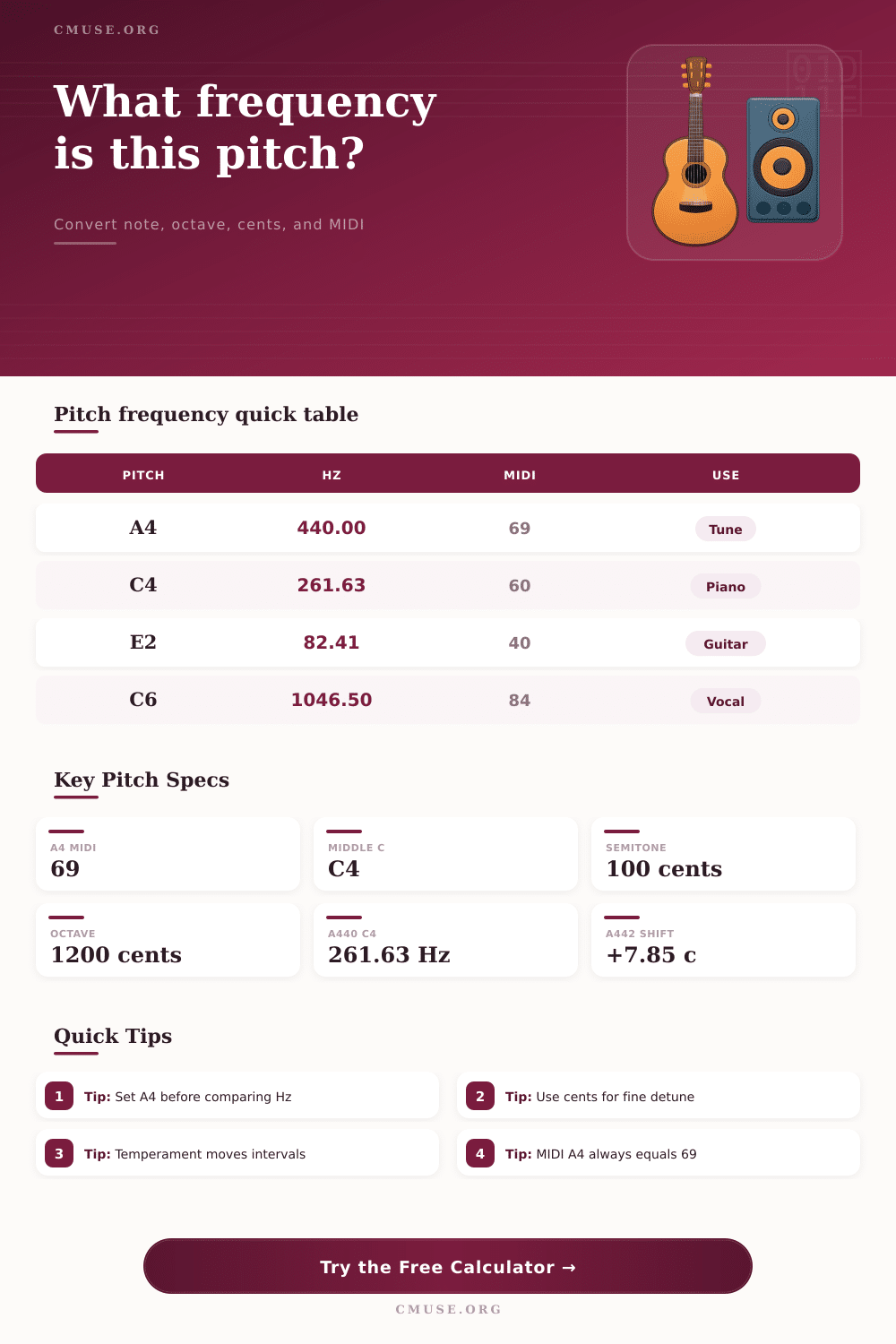
| A440 Standard | 440.000 Hz | 0.00 cents | Default MIDI, DAW, tuner, keyboard, and general ensemble reference |
| A442 Orchestra | 442.000 Hz | +7.85 cents | Many modern orchestras and brighter wind or string tuning checks |
| A443 High Concert | 443.000 Hz | +11.76 cents | High concert pitch comparison for orchestral and hall calibration |
| A438 Warm Choir | 438.000 Hz | -7.89 cents | Lower choral, organ, or warmer ensemble reference pitch |
| A432 Lower Reference | 432.000 Hz | -31.77 cents | Lower reference pitch comparison for alternate tuning sessions |
| A415 Baroque | 415.000 Hz | -101.27 cents | Early-music reference close to one equal-tempered semitone below A440 |
| A392 Low Baroque | 392.000 Hz | -203.91 cents | Lower historical reference close to modern G4 at A440 |
📐 MIDI and Octave Reference Table
| Pitch | MIDI | A440 Frequency | Range Context | Octave Note |
|---|---|---|---|---|
| C0 | 12 | 16.35 Hz | Sub-bass and pipe organ reference | Start of octave 0 |
| C1 | 24 | 32.70 Hz | Deep bass register and acoustic fundamentals | Start of octave 1 |
| C2 | 36 | 65.41 Hz | Low instrument and bass line reference | Start of octave 2 |
| C3 | 48 | 130.81 Hz | Lower keyboard and cello register reference | Start of octave 3 |
| C4 | 60 | 261.63 Hz | Middle C in scientific pitch notation | Start of octave 4 |
| A4 | 69 | 440.00 Hz | Primary tuning reference and MIDI anchor | Concert A |
| C5 | 72 | 523.25 Hz | Upper middle keyboard and vocal register | Start of octave 5 |
| C6 | 84 | 1046.50 Hz | Soprano high C and upper melody reference | Start of octave 6 |
| C8 | 108 | 4186.01 Hz | Top piano octave reference | Start of octave 8 |
🧮 Temperament Offset Table
| Chromatic Degree | Just Offset | Pythagorean Offset | Meantone Offset | Interpretation |
|---|
📝 Formula and Specification Grid
| Item | Formula or Value | Meaning | Result Use |
|---|---|---|---|
| MIDI from note | (octave + 1) x 12 + pitch class | Maps note name and octave to a numeric pitch | Creates the semitone distance from A4 |
| Equal Hz | A4 x 2^((MIDI - 69) / 12) | Standard equal-tempered pitch frequency | Main frequency before fine offsets |
| Cents ratio | 2^(cents / 1200) | Converts a cent offset into a multiplier | Applies detune and temperament offsets |
| Wavelength | speed of sound / frequency | Acoustic wave length in air at selected temperature | Useful for resonance and room mode checks |
Pitch is both an physical vibration of the air that move at a measurable rate and is often described using note names. While note names can be used to identify a pitch, frequencies can also be use to identify a pitch. The unit of frequency is the hertz, which measure the rate of the physical vibration of the air.
Musicians can use frequency to ensure that their instruments is in tune. Additionally, musicians can use frequency to program synthesizers and to orchestras to match a specific standard. The frequency can be calculated using a mathematical formula that involve the relationship of octaves to the twelve steps within an octave.
How Pitch and Tuning Work
Every octave increase the frequency of the sound wave by a factor of two. Within an octave, the twelve steps within the octave are evened out to evenly distribute the frequency. To calculate the frequency of a note, three variable must be assigned: the specific note, the octave of the note, and the reference point for A4. Musicians use the reference point for A4 to calculate the frequency of every other note in the system.
Standard tuning use 440 hertz for A4. However, orchestras often use a higher reference for A4. Early music group use a lower reference for A4, such as 415 hertz. Using a different reference point for A4 will change the frequency of every other note in the system. Cents are a unit of measurement that allows for the adjustment of a pitch.
One cent is equal to one one-hundredth of a semitone. Humans can only detect the difference between two pitch when they are played at the same time. The offset field allow for a musical note to be nudged or moved by a certain number of cents.
The offset field does not change the name or the octave of the note. The offset occur after the calculation of the base frequency of the note. Musicians use a temperament system to determine the placement of each note within a scale relative to another note.
Twelve-tone equal temperament make every interval the same distance from the next interval. This system is often used for digital instruments, as all digital instruments use the same system for notes. Just intonation use simple ratios of frequency between the tonic note of a chord and the other notes in that chord.
Just intonation often sound sour when away from the tonic note. Pythagorean tuning create intervals by using perfect fifths. The intervals of thirds created by this system are much more wider than other musical systems.
These different systems can be compared using the calculator within the page. Additionally, each system can be selected and a user can choose a tonic note to view how each note within that scale has a different frequency according to that system. MIDI assign a number to each note within the musical scale.
These numbers are integer. A4 is always represented by the MIDI number 69. All other notes has the same MIDI number in relation to A4. If a note is transposed, the MIDI number will shift.
However, the sounding pitch may be the same. Additionally, the calculator also provides the wavelength of the note. The wavelength is the length of the sound wave in physical space.
This measurement depend on the frequency of the note and the temperature of the air. This value is rarely written in musical score. Common mistake are made in the calculation of frequency.
One of the most common is treating one variable in the calculation as if it is fixed while other variable change within the group of musicians, for instance. If the reference point for A4 is set at 440 hertz, but the ensemble of musicians use 442 hertz, all instruments will be out of tune. If just intonation or Pythagorean tuning is used, the musician will have to ensure that the starting note for that system is not ignored.
If it is ignored, the other notes will fall on the wrong side of the interval. Additionally, the cents offset should not be added to the note calculated using the temperament system, as this would be double-counting the adjustment to that note. Tables on the page provide information about the musical notes.
One table provide information about different reference points for A4 and the difference of those notes in cents from 440 hertz. The other table provide information about different MIDI numbers, which octave each note is within, and the frequency of those notes. While these tables are not necessary to memorize, they can be referred to quickly for information.
For instance, the tables can be used to find the difference in frequency between A415 and moddern pitch for music. Additionally, these tables can be used to find in what part of the MIDI system the note of middle C live. The calculator act as a translator between the note names of music to the frequencies of those notes.
Each of the variable can be chosen to match the situation that exists. The outputs of the situation is presented for the musician to understand the concept of pitch as a note and a frequency.