Tonearm Resonance Frequency Calculator
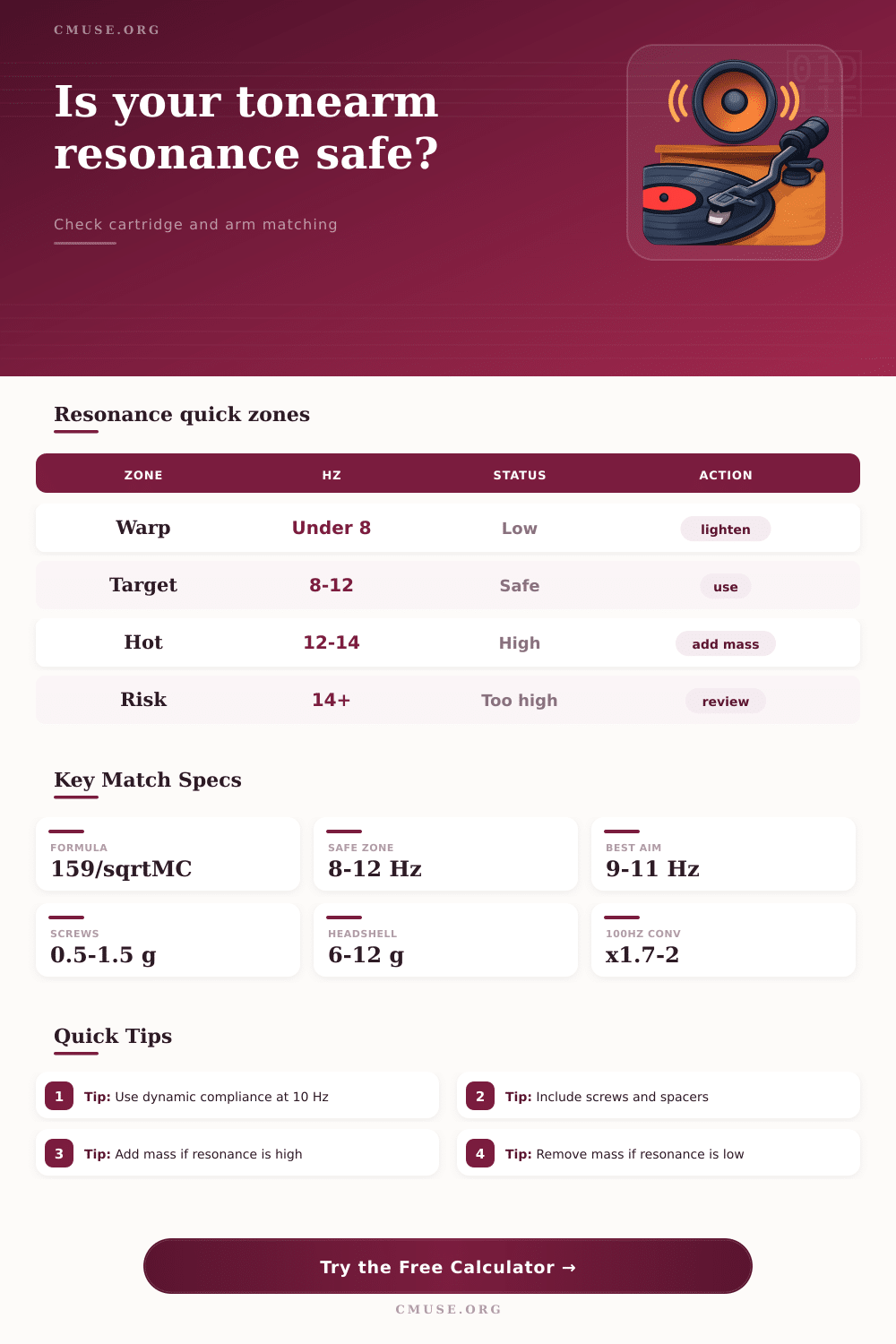
Match tonearm effective mass, cartridge mass, screw mass, headshell weight, and cartridge compliance to estimate vertical resonance and the safe 8-12 Hz target zone.
🎛Named Turntable and Tonearm Presets
Preset values are starting points: effective mass, cartridge body weight, mounting hardware, and compliance vary by headshell, stylus version, and manufacturer measurement method. Enter your measured values for final setup.
⚙Mass, Compliance, and Setup Inputs
📌Current Match Snapshot
📊Comparison and Spec Grid
📝Live Mass and Compliance Scenarios
| Scenario | Total mass | Compliance | Resonance | Reading |
|---|---|---|---|---|
| Calculate to fill the scenario table. | ||||
🎵Resonance Zone Reference
| Resonance band | Setup meaning | Typical symptom | Common correction |
|---|---|---|---|
| Below 7 Hz | Very low arm-cartridge resonance. | Record warps and footfalls can excite large motion. | Reduce mass or choose lower compliance. |
| 7 to 8 Hz | Borderline low but sometimes usable. | Warp sensitivity can rise, especially without damping. | Lighten headshell or verify with a test record. |
| 8 to 12 Hz | Commonly recommended safe zone. | Usually quiet tracking behavior with normal records. | Fine-tune by listening and checking tracking. |
| 12 to 14 Hz | Borderline high resonance. | Bass or groove modulation may sound less settled. | Add small mass or choose higher compliance. |
| Above 14 Hz | High arm-cartridge resonance. | Can overlap low-bass musical energy. | Add mass, heavier cartridge, or softer suspension. |
🎚Turntable Preset Comparison
| Preset | Effective mass | Cartridge mass | Compliance basis | Expected range |
|---|---|---|---|---|
| Technics SL-1200 + VM95 | 12 g | 6.1 g | 10 Hz estimate | around 9-11 Hz |
| Rega Planar 3 + Elys | 11 g | 5.5 g | moderate compliance | around 9-12 Hz |
| Pro-Ject Debut + 2M | 8.6 g | 7.2 g | 22 cu class | around 9-11 Hz |
| Thorens TD-160 + Shure | 7.5 g | 6.6 g | high compliance | around 8-10 Hz |
| Rega Arm + DL-103 | 11.5 g | 8.5 g | 100 Hz converted | often high without mass |
| Low-Mass Arm + ADC | 6 g | 5.8 g | high compliance | around 8-10 Hz |
📐Compliance Conversion Guide
| Published spec type | How to enter it | Reasonable multiplier | Use with caution when |
|---|---|---|---|
| Dynamic compliance at 10 Hz | Enter the published value directly. | 1.0 | Best basis for the formula. |
| Dynamic compliance at 100 Hz | Select a 100 Hz conversion estimate. | 1.7 to 2.0 | Suspension behavior differs by cartridge. |
| Static compliance | Use the static estimate only as a rough proxy. | about 0.5 | Static values can overstate dynamic movement. |
| Unknown compliance | Try 8, 15, 22, and 30 cu scenarios. | custom | Verify with measurement or test record. |
🔧Mass Adjustment Reference
| Adjustment | Approx added mass | Frequency effect | Practical note |
|---|---|---|---|
| Nylon screws | 0.2 to 0.5 g | Raises resonance slightly versus metal screws. | Useful when a match is too low. |
| Steel screws and nuts | 0.8 to 1.6 g | Lowers resonance a little. | Often the normal baseline. |
| Headshell weight plate | 2 to 4 g | Lowers resonance clearly. | Can help low-compliance moving coils. |
| Heavier headshell swap | 3 to 8 g | Lowers resonance strongly. | Check counterweight range and VTF. |
| Light headshell swap | -3 to -6 g | Raises resonance strongly. | Can help very compliant cartridges. |
Tonearm resonance is a mechanical variable that affects how a record sound. When the turntable’s tonearm and cartridge vibrates at a specific frequency, this is known as tonearm resonance. If the cartridge and tonearm isnt properly matched, the resonance of the tonearm can cause instability in the sound of the record.
Tonearm resonance can cause loss of detail in the transient portion of the record or it can cause the tonearm to emphasizes certain frequencies within the music. The relationship between the total moving mass at the headshell (where the cartridge attach to the tonearm) and the compliance of the cartridge suspension can determine the frequency of tonearm resonance. If the resonance frequency of the tonearm is set too low, the tonearm will react to vibrations caused by warped records and footfalls on the record.
Tonearm resonance and how to match a cartridge
If the tonearm resonance frequency are set too high, the resonance of the tonearm will interfere with the low frequency range of the music being played. Many people aim for a resonance frequency between eight and twelve hertz. Effective mass is a measurement of the tonearm that is different than the physical weight of the tonearm.
The geometry of the counterweight of the tonearm and the length of the tonearms tube affect the effective mass of the tonearm. For example, adding mass to a tonearm with a heavy counterweight will lower the effective mass of the tonearm. Conversely, a tonearm that is light in weight may have a high effective mass if the tonearm’s headshell is heavy.
Because headshells can change, changing it headshell can alter the effective mass of a tonearm. The compliance of a cartridge is a measurement of how easily the cartridge move. Compliance works in the opposite direction of the tonearms moving mass.
A cartridge that has high compliance will easily move, lowering the tonearm resonance frequency for a given mass of the tonearm. A cartridge with low compliance will make it difficult for the cartridge to move, raising the tonearm resonance frequency for a given mass of the tonearm. It is important to know at what frequency the compliance of the cartridge was measured, as compliance figures will vary with frequency.
For instance, many Japanese cartridges will list their compliance value at one hundred hertz. However, you will need to adjust that compliance value if it is to be use in calculations of tonearm resonance frequency. Using the compliance value at one hundred hertz as if it were a value at ten hertz would lead to incorrect calculations of tonearm resonance frequency.
The hardware located at the headshell of a tonearm can affect the total moving mass at the headshell as well as contribute to the tonearm resonance of that tonearm. For instance, using stainless steel screws at the headshell will add to the total moving mass of the tonearm. Because adding to the moving mass will lower the resonance frequency of the tonearm, using stainless steel hardware at the headshell will lower the tonearm resonance frequency.
Using nylon hardware instead of stainless steel hardware will reduce the impact on the tonearm resonance frequency of the tonearm. Both adding mass to the tonearm (by using a heavier headshell) or changing the headshell will change the tonearm resonance frequency of that tonearm. The calculator included with this website allow you to calculate the tonearm resonance frequency of a tonearm by entering the known mass of the tonearm, the weight of the cartridge, the weight of the mounting screws for the tonearm, and the compliance of the cartridge.
Using this calculator, you can determine what will happen to the tonearm resonance frequency if you add or remove mass from the tonearm headshell. Additionally, this calculator will allow you to convert a compliance figure listed at one hundred hertz for a cartridge to a compliance figure at another frequency. This calculator allows you to view the wide margin of error for each arm and cartridge combination.
External variables will affect the sound of a tonearms resonance. For example, using a heavily damped tonearm will reduce the impact of the resonance peak on the sound but will not change the resonance frequency. Using a subsonic filter on a phono stage will protect the speakers from the energy created by warped records but will not fix the tonearm’s mismatch with the cartridge.
Finally, using an undamped tonearm on a sprung suspension table will make the resonance of the tonearm more prominently in the audio than what the calculations suggested for that arm and cartridge. To determine whether a specific cartridge will belong to your tonearm, you must calculate the resonance frequency of the tonearm. Using the rules described above, a high compliance cartridge may cause instability on a tonearm that is also heavy.
The heavy tonearm will lower the resonance frequency of the tonearm too low. A high compliance cartridge will be more stable on a lightweight tonearm. A low compliance cartridge may result in the tonearm sounding vague if you add heavy weight to the headshell.
Adding to the headshell will lower the resonance frequency of the tonearm. The target resonance frequency of eight to twelve hertz is a compromise between different factors. Using a resonance frequency of eight hertz will allow the tonearm to avoid record warps but will also cause it to react to footfalls on the record.
Using a resonance frequency of twelve hertz will allow the tonearm to avoid low frequencies in the music but could color the detail in the low frequency range of the music. Many tonearms and cartridges find their best sonic match within the range between nine and eleven hertz. Once you calculate the resonance frequency of your tonearm and cartridge, you can make some small adjustments to that system.
For instance, you can change the material of the mounting screws on the tonearm or add a weight plate to the tonearm. These changes will allow you to fine tune the tonearm resonance frequency to a few hertz. Additionally, these changes are reversible and inexpensive.
Therefore, they are a good idea if you would of liked to optimize the performance of your tonearm and cartridge without having to purchase new electronics. Its important to note that alot of furnitures can be adjusted this way. Youll find that the moddern equipment works better when the resonance is correct.