Stave Snare Drum Calculator
Size a stave snare shell from stave count, outside diameter, depth, wall thickness, bearing edge allowance, glue cleanup, and material density.
🥁 Named Stave Snare Presets
Model: the blank width assumes the stave ring is built as a regular polygon that circumscribes the final outside diameter, then the shell is rounded and hollowed to the selected wall thickness.
⚙ Shell Geometry Inputs
📏 Current Cut List Breakdown
| Cut or Spec | Per Stave | Full Shell | Builder Note |
|---|---|---|---|
| Waiting | -- | -- | Calculate to fill the stave cut list. |
🌲 Selected Material Spec Grid
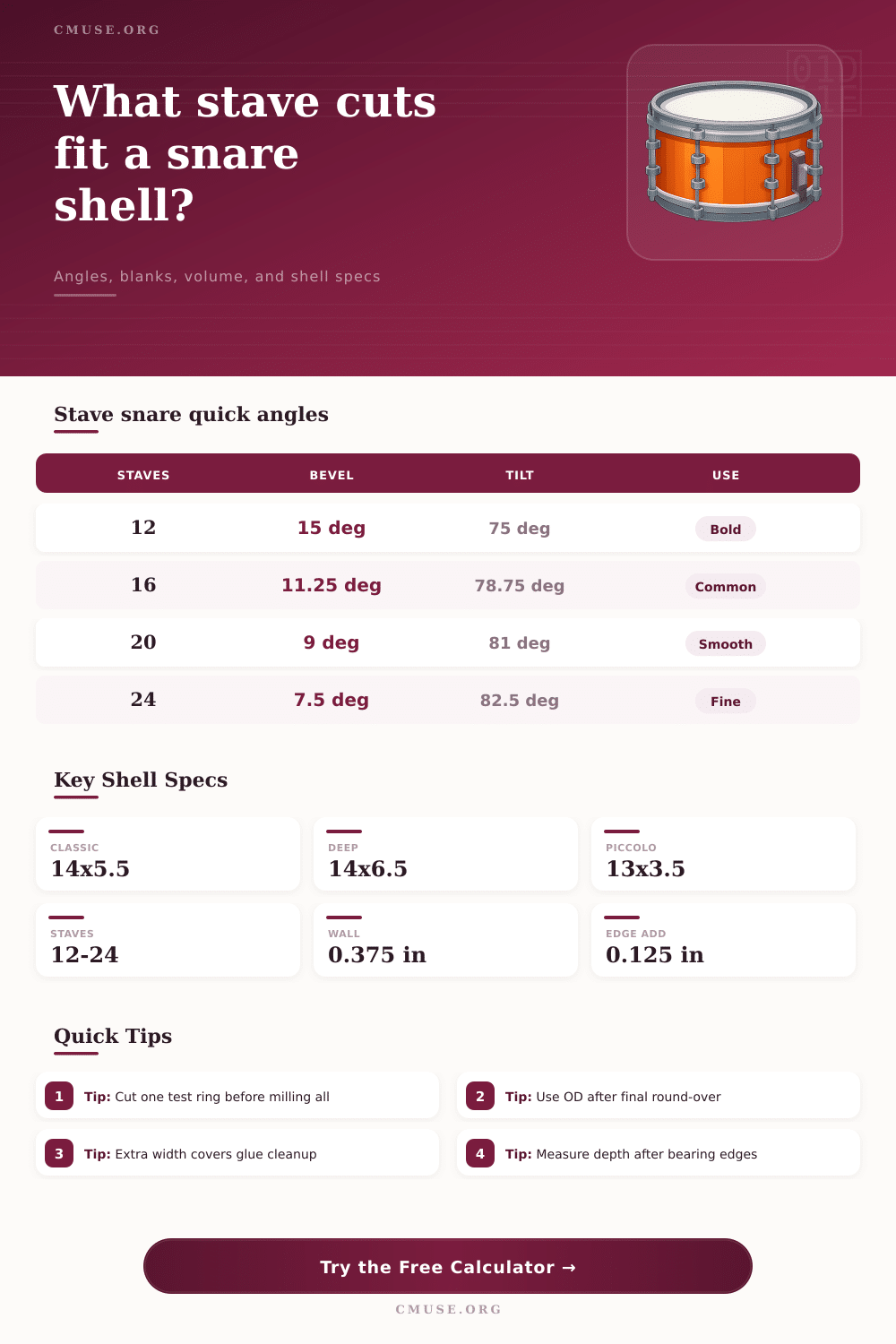
📊 Stave Count Angle Reference
| Stave Count | Edge Bevel Per Side | Saw Blade Tilt | Typical Shell Use |
|---|---|---|---|
| 10 | 18° | 72° | Bold faceted look, wide pieces, more rounding waste. |
| 12 | 15° | 75° | Good for chunky single-species snares and thick walls. |
| 16 | 11.25° | 78.75° | Common compromise for 13 and 14 inch stave snare shells. |
| 20 | 9° | 81° | Smooth turning, moderate blank width, frequent studio choice. |
| 24 | 7.5° | 82.5° | Narrow staves, smooth outside curve, more glue joints. |
| 32 | 5.625° | 84.375° | Fine segmented work where stock is narrow and milling is precise. |
🥁 Snare Shell Preset Comparison
| Preset | Diameter x Depth | Staves | Wall | Best Read |
|---|---|---|---|---|
| Cherry Classic | 14 x 5 in | 20 | 0.35 in | Medium volume shell with a light finished weight. |
| Ash Articulate | 13 x 7 in | 18 | 0.42 in | Deep but focused shell with a smaller head area. |
| Mahogany Warm | 14 x 6 in | 16 | 0.40 in | Warmer material density and fewer, wider staves. |
| Beech Orchestral | 15 x 5 in | 24 | 0.36 in | Large head size with narrow, refined stave layout. |
| Piccolo Tight | 13 x 3.5 in | 20 | 0.32 in | Small air volume and short raw stave length. |
| Deep Hybrid | 14 x 8 in | 24 | 0.50 in | Large depth, high blank count, strong volume contrast. |
📐 Blank Thickness and Bearing Edge Guide
| Finished Wall | Useful Raw Blank | Edge Allowance | Shell Builder Note |
|---|---|---|---|
| 0.25 in / 6.4 mm | 0.38 to 0.50 in | 0.08 in per side | Light shell; check lug screw bite before final sanding. |
| 0.35 in / 8.9 mm | 0.50 to 0.63 in | 0.10 in per side | Common snare range with comfortable turning margin. |
| 0.50 in / 12.7 mm | 0.63 to 0.75 in | 0.13 in per side | Thicker stave tone; confirm throw-off and vent hardware reach. |
| 0.75 in / 19.1 mm | 0.88 to 1.00 in | 0.16 in per side | Heavy shell; inside diameter and air volume fall quickly. |
💡 Builder Tips
Stave snare shell construction involve gluing together a series of tapered wood blanks to form a ring, then rounding the outside of that ring and hollowing out the inside of the ring to form a snare drum. Cutting bearing edges into the stave shell will complete the creation of the snare drum shell. Each dimension of the shell will have an impact upon the resulting snare drum.
For instance, each of the dimensions of the shell (wall thickness, stave counts, blank width, and depth) can interact with each of the other dimensions of that shell; selecting one dimension incorrectly can impact other aspects of that snare shell, such as it’s weight, air volume, or amount of rounding require to form that shell. Many snare shell builder begin with a choice of the outside diameter and depth of the shell. The outside diameter must match the snare head that the shell is to be used with.
What to Measure When Making a Stave Snare Drum Shell
However, depth can also have an impact upon the functionality of the snare shell; shells of greater depth will move more air within the shell than those shells of lesser depths. Calculators can help snare shell builders calculate each of these dimension; the calculator can help the shell builder determine the inside diameter of the snare shell after accounting for the bearing edge of the snare shell. The thickness of the shell walls contribute to the mass and volume of the snare shell.
Thick walls will produce a snare shell with more mass than shells with thin walls. Additionally, thick walls will increase the fundamental pitch of the snare shell and decrease its decay. Thin walls will produce snare shells with less mass than thick walls, and thin walls will allow snare heads to move more air inside the snare shell.
Snare shells with a 0.35-inch wall thickness will have a different thickness than those with a 0.50-inch wall thickness, for instance. Additionally, shell builders that wish to produce a light snare shell often select thin walls, while those who wish to produce a snare shell with more greater projection select thick walls. The count of the staves can impact the tone of the snare shell.
Additionally, the stave count can also impact the milling process required to create those staves. For instance, if the stave count is low, each blank will be wide. However, if the stave count is high, each blank will be narrow.
For instance, a snare shell with a 16-stave count and a 14-inch outside diameter will be noticeably polygonal in shape unless a significant amount of wood is removed from each stave; shells with higher stave counts will be closer to a rounded shell and will waste more sawn wood during the rounding process. For instance, shell counts of 24 may allow the builder to avoid cutting flat spots on the staves of the snare shell, but will require more precisely bevels on the edges of each stave. In addition to each of the dimensions of the snare shell, the bearing edge allowance of the shell and the glue cleanup allowance also have an impact upon the dimensions of the finished snare shell.
An allowance for the bearing edge of each stave adds a few millimeter to each end of each stave. Additionally, an allowance for the glue cleanup allows for the glue that squeeze out of the edges of each stave to be cleaned up to the desired dimension of the snare shell. If these allowances are not made during the construction of the snare shell, the snare shell may end up with the wrong diameter or length once the bearing edges are cut.
The density of the wood that is used to create the snare shell is also a variable that will impact the shell. For instance, two snare shells may have the same outside dimensions and wall thickness, but the difference in the wood species will lead to different weights for those two shells. For instance, cherry and white oak has different densities; each of these wood types will impact the weight of the snare shell.
A snare shell builder can calculate that weight, and the calculator can override the density of the wood from the default density. The air volume of the snare shell can be calculated once the inside diameter and depth of the snare shell are known. This air volume can be used to determine the amount of air that will be moved by the snare head within the snare shell.
Changes in thickness will change the air volume of the snare shell, and the air volume will have an impact upon the sound that is created by the snare shell. Calculators can be used to determine air volume by subtracting the volume of the internal hardware of the snare shell; the resulting volume is the air volume that will be utilized by the snare heads. Each of the variables for creating a snare shell should be made during the design of the snare shell.
Variables including the measurement of the wood stock, the amount of wood to be removed, and the stave count that will best utilize each wood blank can be accounted for during this stage. Additionally, calculations made during the design stage can help snare shell builders to test each of these variables without creating test rings of snare shells. The use of a snare shell diameter calculator will ensure that each of these variables end up with the same number for the wood stock and the desired snare shell, allowing the snare shell builder to minimize the number of modifications to the snare shell during its creation.