Frequency to Note Converter
Convert any frequency in Hz into the nearest musical note, octave, MIDI number, exact equal-tempered pitch, cents error, and written transposition.
🎵 Named Tuning and Reference Presets
⚙ Frequency and Note Inputs
The core formula is MIDI = 69 + 12 x log2(frequency / A4). The nearest MIDI note sets the note name, and the fractional remainder becomes cents sharp or flat.
📊 Pitch Conversion Spec Grid
🔎 Comparison Grid
Most tuners, DAWs, and MIDI instruments use A4 = 440 Hz unless changed.
Raises the whole note map by 7.85 cents against A440 reference.
About one modern semitone lower than A440, common for early-music work.
Use semitone offset to compare concert frequency with transposed parts.
🎼 Generated Nearby Note Table
| Note | MIDI | Exact Frequency | Difference From Input | Cents From Note |
|---|
🎚 A4 Reference Preset Table
| Reference | A4 Hz | Cents vs A440 | Typical Use |
|---|---|---|---|
| A440 Standard | 440.000 Hz | 0.00 cents | General tuning, MIDI, DAW sessions, default tuner maps |
| A442 Orchestra | 442.000 Hz | +7.85 cents | Many modern orchestras and brighter ensemble tuning |
| A443 Bright Hall | 443.000 Hz | +11.76 cents | Some European orchestral settings and high concert pitch |
| A438 Choir | 438.000 Hz | -7.89 cents | Lower choral or warm ensemble reference |
| A435 Diapason Normal | 435.000 Hz | -19.79 cents | Historic French pitch reference context |
| A432 Verdi Style | 432.000 Hz | -31.77 cents | Lower reference pitch comparison |
| A415 Baroque | 415.000 Hz | -101.27 cents | Early-music pitch near a semitone below A440 |
| A392 Low Baroque | 392.000 Hz | -203.91 cents | Low historical reference near modern G4 |
| C256 Scientific Pitch | 430.539 Hz | -37.62 cents | System where middle C is exactly 256 Hz |
📐 Common Note Frequency Table at A440
| Note | MIDI | Frequency | Instrument Context | Octave |
|---|---|---|---|---|
| C1 | 24 | 32.70 Hz | Deep organ, low bass reference | Contra |
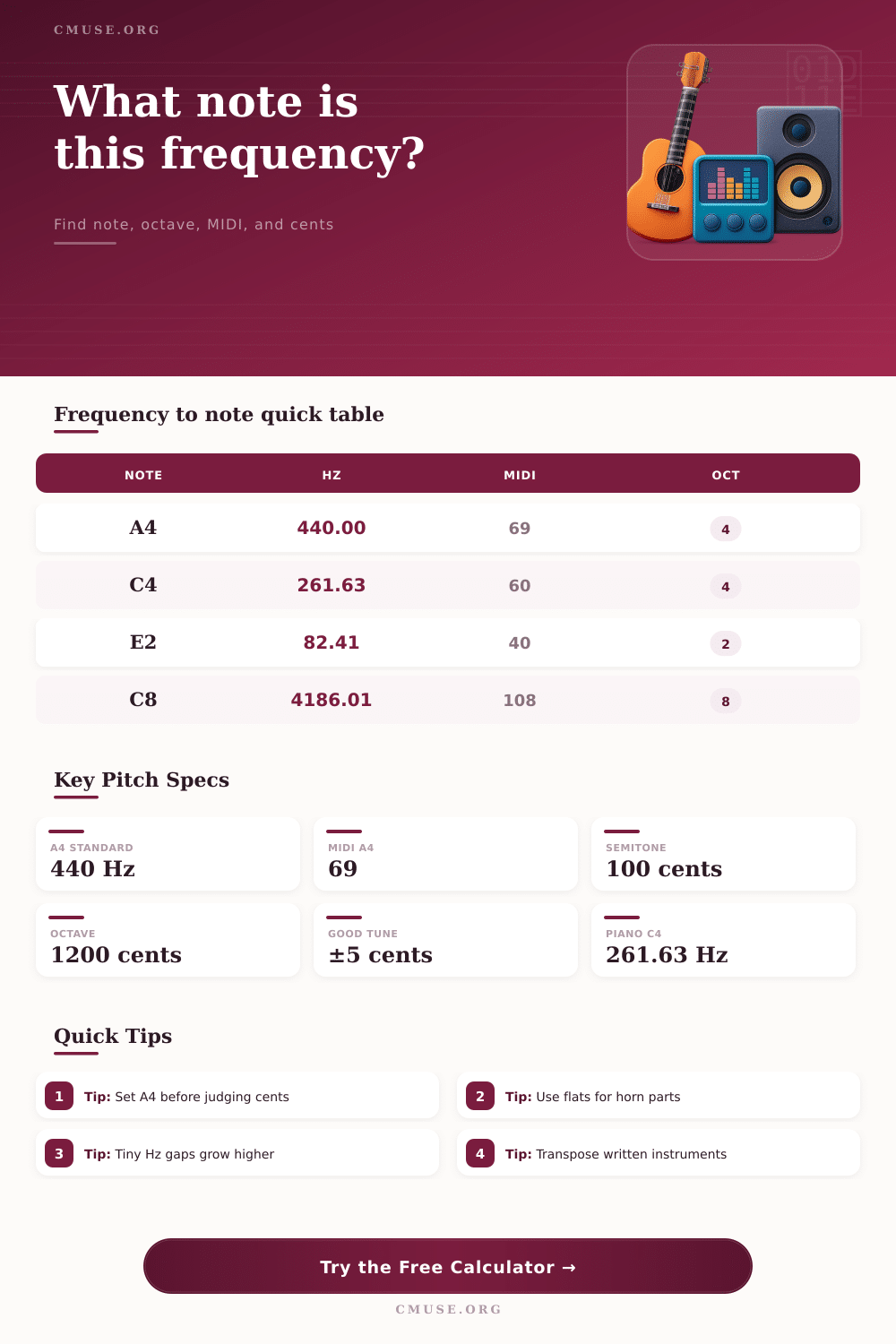
| E2 | 40 | 82.41 Hz | Lowest standard guitar string | Bass / guitar low |
| A2 | 45 | 110.00 Hz | Guitar fifth string and bass tuning check | Low |
| C4 | 60 | 261.63 Hz | Middle C in scientific pitch notation | Middle |
| A4 | 69 | 440.00 Hz | Concert tuning fork reference | Treble |
| C5 | 72 | 523.25 Hz | Octave above middle C | Upper middle |
| A5 | 81 | 880.00 Hz | One octave above concert A | High |
| C8 | 108 | 4186.01 Hz | Top C of an 88-key piano | Very high |
🧮 Tuning Tolerance Table
| Cents Error | Status | Frequency Ratio | Practical Meaning |
|---|---|---|---|
| 0 to 2 cents | Excellent | Up to 1.00116 | Very close for exposed unisons and careful tuning passes |
| 3 to 5 cents | Good | Up to 1.00289 | Usually acceptable for many instruments and ensemble checks |
| 6 to 10 cents | Noticeable | Up to 1.00579 | May sound sharp or flat in sustained notes and close harmony |
| 11 to 25 cents | Clearly Off | Up to 1.01455 | Audible detuning, useful for intentional pitch-bend color only |
| 26 to 50 cents | Near Quarter Step | Up to 1.02930 | Approaches the halfway point to the neighboring semitone |
A frequency-to-note converter take a measurement in hertz and turns that value into a musical note. People uses this tool because it is difficult for them to understanding the relationship between hertz values and the notes. The frequency-to-note converter use mathematics to determine the relationship between the two values.
The mathematical equation the frequency-to-note converter use include three values: the reference pitch, cents, and the spelling of the note. The reference pitch for most frequency-to-note converters is the A note at 440 Hz. Many orchestra use A at 442 Hz.
How a frequency-to-note converter works
Some musicians uses A at 415 Hz. If the user change the reference pitch, every other note will change as well. Most frequency-to-note converters allows people to input their chosen reference pitch to calculate the proper musical note.
Cents are a unit of measurement that allow for small difference in pitch to be described. One semitone are equal to 100 cents. An octave is equal to 1200 cents (12 semitones).
Cents allow for small pitch differences to be represent that is more smaller than a musical semitone. Using cents is far more practical than using Hz as an unit of measurement for a few reason. Using cents, a person can easy understand the pitch that must be made.
Using Hz, a person would have to perform mental arithmetic to understand the scale of the error of the given note. Most musical notes can be spelled in two different ways: using sharps or flats. Brass and woodwind musicians typically prefers using flats.
String and guitar players prefers using sharps. Changing the spelling preference do not change the actual frequency of the note or the MIDI number associate with that note. However, it does ensure that the persons instrument match the musical score being played.
Frequency-to-note converters can display musical notes in both spelling to help people with musical scores that uses flats or sharps. There are two different octave naming system for musical notes. Scientific pitch notation label the middle C on a musical keyboard as C4. However, many MIDI manual and keyboard brands label the same note as C3. Depending on the musical device in use, a person may need to change the octave naming system that the frequency-to-note converter select.
This ensure that the device and the instrument matches with one another. The setting for transposition within a frequency-to-note converter is used for musical device that may play a musical note that is not the same as the note that is wrote for the musician. For instance, a clarinet player might play a written C but play a sounding Bb.
This is known as a transposition of two semitones. By entering this value into the frequency-to-note converter, the device will calculate the sounding note and the written note. If this function is not used, the cents error will display with an incorrect value for the musical device, even if it is properly tune.
The tolerance for musical device is another setting for frequency-to-note converters. Most musicians will allow up to five cents of deviation between the target and actual note when playing in an ensemble with other. For solo instrument, musicians may require a smaller tolerance.
This setting does not change the raw hertz measurement of the note. It does, however, change the outcome of the frequency-to-note converter to the person using the device. A frequency-to-note converter can be of great use to musicians.
The raw data from the device allow people to make a decision about an instrument. For example, if the cents error display as a certain value, a person can make an adjustment to the instrument, such as moving the bridge or changing the pitch bend. A frequency-to-note converter provide a measurement of the error of the note.
This measurement allow people to make an adjustment to their instrument. Depending on the type of instrument that is being use, many factor can display a difference in the frequency of the note. For instance, the temperature of the air in which the instrument is playing can change the pitch of the note.
The humidity of the playing environment can change the pitch. The embouchure of the musician can change the pitch of an instrument. Because of these factor, the frequency-to-note converter can only provide a snapshot of the frequency of the musical note at a specific moment.
However, it will provide a person with an accurate description of the note at that moment. Additionally, the tolerance setting will allow a person to understand if that deviation from the target frequency are significant enough to require adjustment of the instrument.