Harmonic Series Calculator
Calculate harmonic frequencies, partial ratios, octave-reduced intervals, cents values, nearest equal-tempered notes, and overtone tables from any fundamental pitch.
🎼 Named Fundamental Presets
⚙ Fundamental And Partial Inputs
📊 Harmonic Spec Grid
🎵 Generated Harmonic Frequency Table
| Partial | Frequency | Raw Ratio | Reduced Ratio | Cents | Nearest Note | 12-TET Offset | Relative Level |
|---|
📐 Interval And Cents Relation Table
| Partial | Reduced Ratio | Common Name | Exact Cents | Nearest 12-TET | Cents Difference |
|---|
🔀 Overtone Ratio Reference
| Partial Group | Signature Ratios | Musical Color | Practical Use |
|---|---|---|---|
| 1 to 4 | 1/1, 2/1, 3/2, 4/1 | Stable octave and fifth frame | Drone tuning, brass pedal tones, open-string checking |
| 5 to 8 | 5/4, 3/2, 7/4, 2/1 | Pure third plus harmonic seventh | Barbershop chords, horn writing, just-intonation checks |
| 9 to 12 | 9/8, 5/4, 11/8, 3/2 | Bright seconds and 11-limit color | Spectral voicing, flute multiphonics, synth partial design |
| 13 to 16 | 13/8, 7/4, 15/8, 2/1 | Dense high-overtone tension | Microtonal mapping, bell spectra, additive synthesis |
📋 Comparison And Spec Grid
Low Fundamentals
Mid Fundamentals
High Fundamentals
Upper Partials
📚 Common Fundamental Examples
| Source | Fundamental | Partial To Check | Harmonic Frequency | Typical Reason |
|---|---|---|---|---|
| Pipe organ pedal | F1 - 43.65 Hz | 8th | 349.23 Hz | Find speaking upper tone and octave frame |
| Low guitar string | E2 - 41.20 Hz | 5th | 206.02 Hz | Locate pure major-third overtone color |
| Cello A string | A2 - 110.00 Hz | 7th | 770.00 Hz | Hear harmonic seventh against equal temperament |
| Middle C | C4 - 261.63 Hz | 3rd | 784.88 Hz | Compare pure fifth to keyboard G |
| Concert A | A4 - 440.00 Hz | 11th | 4840.00 Hz | Map 11-limit color for spectral harmony |
The harmonic series is a collection of frequencies that exist within every sustained sound. When a sound begin, energy spreads out as a series of higher frequencies known as partials. These partials are not optional for sounds; each sound has these partials that determine the timbre of a sound.
The timbre of a sound can tell you whether a sound is rich or thin and how well it will sit beside other instruments in a song. You can use a calculator to calculate the math behind the harmonic series if you provide it with the frequency of the fundamental frequency of the sound you are analyzing. The fundamental frequency of a sound is the frequency that determine all of the frequencies within the harmonic series.
The Harmonic Series and How to Use the Calculator
Each partial is a multiple of the fundamental frequency. Thus, if you change the fundamental frequency of a sound, each partial will shift within the harmonic series model. A fundamental frequency of 43 Hz will produce partials that land in the vocal range, but a fundamental frequency of 580 Hz will land in the high range of the singer’s comfortable range.
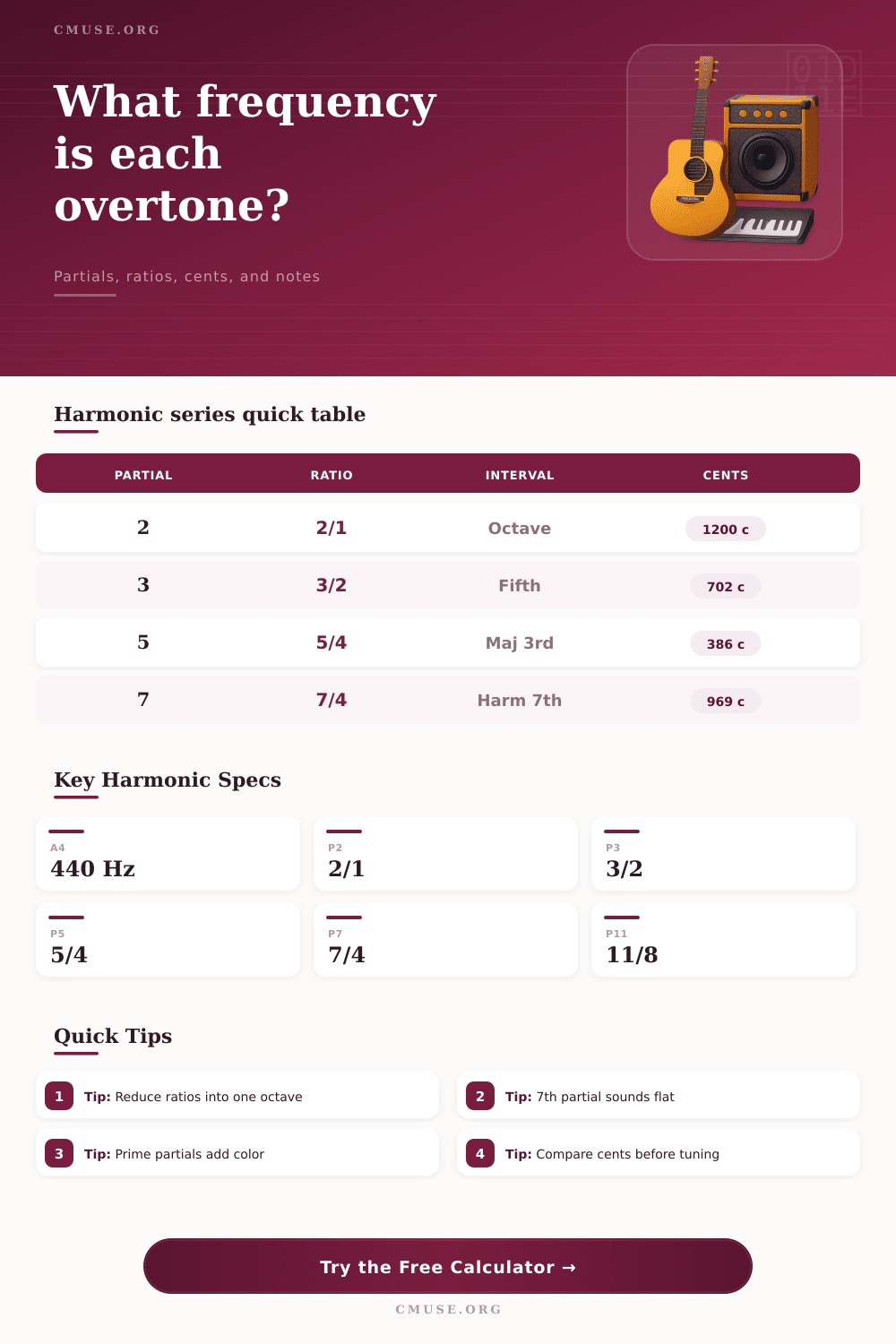
This calculator allow you to analyze both low and high fundamental frequencies. The color of an interval is the distance between the partials of a chord. The third partial of a chord will create a pure fifth.
The fifth partial of a chord will produce a major third, but it will be slightly lower than a major third played on an equal-tempered keyboard. These differences in the partials becomes audible when multiple voices sing a chord, and they become audible when the chord is allowed to ring. The calculator returns the cent offset of each of these partials so that you can determine if the color of the partials enhance the harmony or if it clashes with the harmony of the chord.
The amplitude models show the energy that each of the partials contains within a sound. The higher the partial, the less energy it usually contains. The inverse model show the energy that each partial contains.
The squared model also shows the energy that each partial contains. However, neither the inverse model nor the squared model are correct for all instruments. The amplitude of the partials for any given instrument creates its own unique curve.
The shape of the bore of the instrument, the thickness of the string that creates the sound, and the technique with which the musicians play the instrument create these curves. These amplitude models provide a reference point from which you can assess the relative importance of each of the partials within a chord. By using octave reduction, you can locate each of the partials within a specific span of frequencies.
For instance, the raw thirteenth partial will be located at a higher frequency than the fundamental frequency. However, the reduced thirteenth partial will fall within the minor sixth range of the chord. Thus, the reduced partial tells the musician the distance of the partial from the fundamental, while the raw partial tells the musician the actual acoustic height of the sound.
A keyboard with equal-tempered pitches will have the same size interval between each key. However, the harmonic series does not use the same size interval between each of its partials. This difference between the harmonic series and the equal-tempered keyboard is why certain intervals will sound vivid or sour to a listener when played on a piano.
The calculator determines the offset of each of the harmonic partials in cents so that you can choose to bend the note, retune a string, or leave it as is. The interactions of sound with the acoustics of a room introduces another layer of complexity into the harmonic series that a calculator cannot account for. A sound with a low fundamental frequency will excite the modes of the room, which will reinforce and cancel certain harmonic partials.
Thus, a strong bass note in a room may sound good according to the harmonic series calculator but may boom in some areas of the room and vanish in others. While the calculator is a helpful tool that allows musicians and composers to determine the frequencies of a chord, it returns only the frequencies of the sound that will be create within a room. For composers using just intonation, the harmonic series is a map of the sounds that they will create.
Each composer makes a choice of which partials will become prominent within their composition and which partials will remain in the background. These reference tables allows musicians to quickly find which partials will create intervals of a fifth and which partials will create other intervals. Thus, when voicing a chord, the partials will be easily found within this table.
The same logic that applies to chord analysis also applies to additive synthesis. Additive synthesis allow you to control the level of each of the partials of a chord. If you know the cent offset and the reduced ratio for a partial, you can use that information to decide if a partial should lock into the pitch keys on a keyboard or whether it should be allowed to float to a sharp or flat pitch.
This calculator returns these values quickly so that you can focus on the other aspects of sound design. One of the first applications of this tool will be analyzing a single drone of a sound. If you know the pitch to which the drone will play and you want to know which of the upper partials will reinforce the target note of your melody, you can use this tool.
By entering the fundamental frequency and the target partial into the tool, the tool will return the frequency of that partial and the distance that it is from the target note. This tool can be used quickly so that you can experiment with the upper partials. Using this tool will eventually change the way that you hear ordinary sounds.
A bowed note, for example, contains a series of partials. While the numbers that this tool returns are temporary, the ability to analyze a sound for its partials is a skill that will last a lifetime.