Sound Wavelength Calculator
Calculate sound wavelength from frequency, medium, and temperature, then translate it into half-wave spacing, quarter-wave acoustic depth, period, phase distance, and room-mode relevance.
🎶Named Frequency Presets
⚙Acoustic Inputs
📊Current Acoustic Snapshot
🎚Instrument, Audio, and Spec Comparison Grid
📐Reference Tables
| Named Audio Band | Frequency | Air Wavelength at 20°C | Half Wave | Acoustic Relevance |
|---|---|---|---|---|
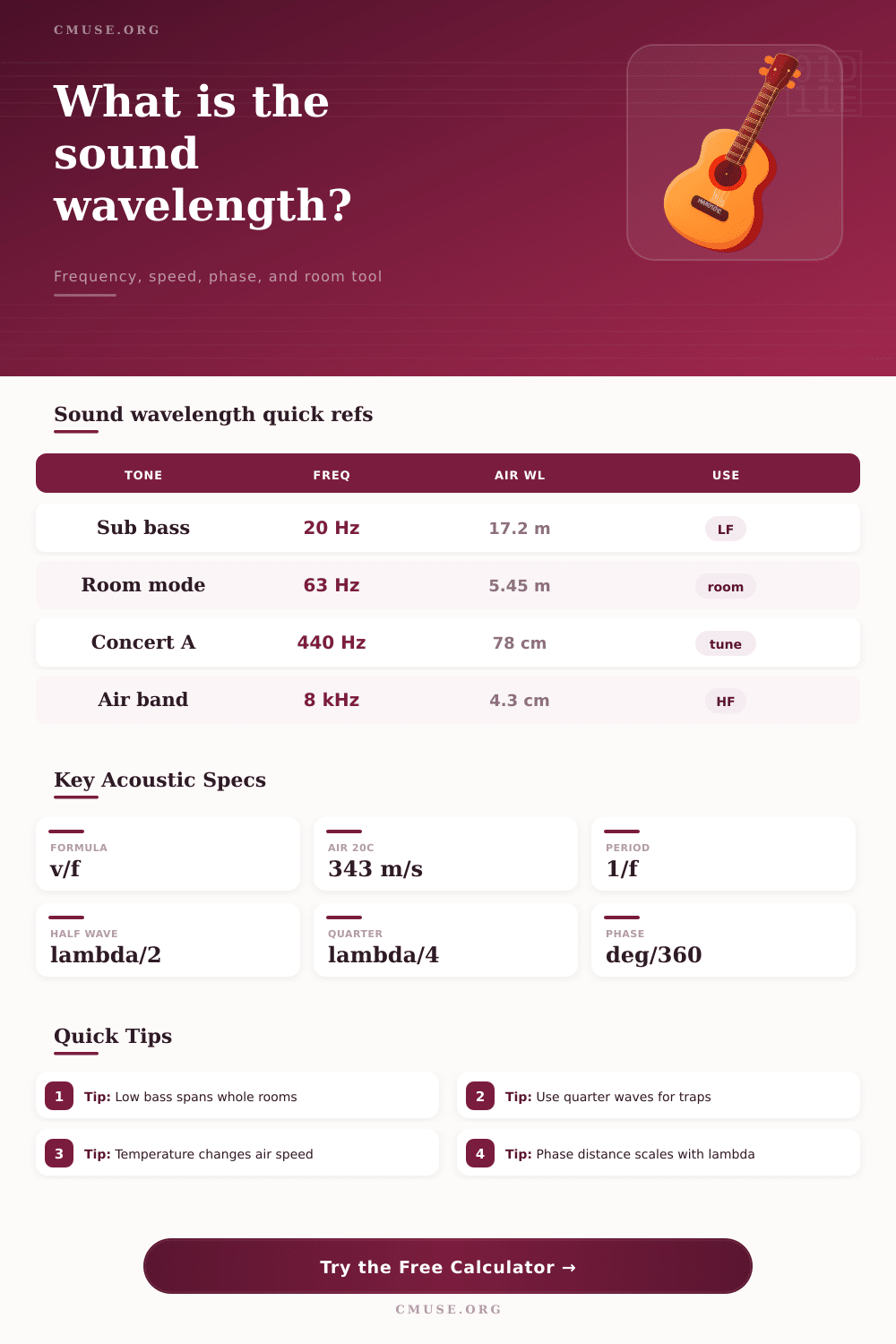
| 20 Hz Sub Bass | 20 Hz | 17.17 m / 56.33 ft | 8.59 m / 28.16 ft | Long enough to involve entire rooms, stages, and sub arrays. |
| 63 Hz Room Mode Band | 63 Hz | 5.45 m / 17.88 ft | 2.73 m / 8.94 ft | Often close to small-room axial dimensions and bass buildup. |
| 125 Hz Bass Control | 125 Hz | 2.75 m / 9.01 ft | 1.37 m / 4.51 ft | Boundary placement and thick treatment begin to matter strongly. |
| 440 Hz Concert A | 440 Hz | 0.78 m / 2.56 ft | 0.39 m / 1.28 ft | Useful for tuning pitch, instrument scale comparison, and reflections. |
| 8 kHz Air Band | 8 kHz | 4.29 cm / 1.69 in | 2.15 cm / 0.84 in | Tiny offsets can create audible comb filtering and image changes. |
| Medium | Reference Speed | 20 Hz Wavelength | 1 kHz Wavelength | Use Context |
|---|---|---|---|---|
| Air at 20°C | 343.4 m/s | 17.17 m | 34.34 cm | Rooms, speakers, microphones, and normal listening. |
| Helium | 1007 m/s | 50.35 m | 100.7 cm | Lab demonstrations where wave speed is much higher than air. |
| Fresh water | 1482 m/s | 74.1 m | 148.2 cm | Hydrophones, underwater acoustics, and tank measurements. |
| Wood | 3300 m/s | 165 m | 3.3 m | Instrument bodies and structural vibration estimates. |
| Steel | 5960 m/s | 298 m | 5.96 m | Strings, frames, rails, and mechanical acoustic paths. |
| Formula Item | Equation | Meaning | Audio Use |
|---|---|---|---|
| Full wavelength | lambda = v / f | Physical length of one complete pressure cycle. | Speaker spacing, modal scale, resonance comparison. |
| Period | T = 1 / f | Time for one cycle of the waveform. | Delay, LFO-rate comparison, and measurement timing. |
| Half wavelength | lambda / 2 | Distance for 180 degree phase reversal. | Polarity checks, array spacing, strong cancellation points. |
| Quarter wavelength | lambda / 4 | Distance for 90 degree phase shift. | Boundary nulls, quarter-wave tubes, absorber depth reference. |
| Phase distance | lambda x degrees / 360 | Distance that corresponds to a chosen phase angle. | Mic offset, driver alignment, comb-filter interpretation. |
| Room Dimension | Axial Mode Formula | Example at 20°C | Comparison Clue | Practical Meaning |
|---|---|---|---|---|
| Length 4.5 m | v / (2L) | 38.2 Hz | 20 Hz is below first length mode | Sub bass may pressurize the room unevenly. |
| Width 3.6 m | v / (2W) | 47.7 Hz | 63 Hz sits above first width mode | Listening position and side-wall spacing affect bass. |
| Height 2.5 m | v / (2H) | 68.7 Hz | 63 Hz is near a height mode | Floor-ceiling interaction can shape kick and bass notes. |
| Quarter wave gap | v / (4f) | 68.7 cm at 125 Hz | Depth shrinks as frequency rises | Deep treatment is needed for true low-bass absorption. |
Sound travels as pressure waves through the environment, and the distance that a pressure wave moves from one rise to the next is the wavelength. The wavelength of a sound wave determines things like how bass accumulate within a room, how far apart two microphones should be to avoid the cancellation of sound waves from each microphone, and even if a quarter-wave trap will reach the desired frequency of sound that the quarter wave trap should absorb. Thus, thinking in terms of wavelengths rather than frequencies allows people to make better decisions within there studios or live sound environments.
Sound travels at different speeds through different mediums. For instance, in air at room temperature, sound travels at approximately 343 meters per second. However, the speed of sound changes with changes in the temperature of the air.
Sound Wavelengths and Room Size
For example, warmer air cause the sound waves to travel at a faster rate than cooler air, which means that warmer air will result in a longer wavelength for each sound frequency. In water, sound travels at approximately 1480 meters per second, which means that a 100 Hz sound tone will have a fifteen meter wavelength in water rather than the three meter wavelength that it has in air. Such a relationship between the two mediums are important to understand, especially when traveling from a control room to an underwater environment or from a vocal booth to a space filled with helium.
The calculator included in this project allows the user to input the medium through which the sound is traveling, as well as the temperature of that medium, to calculate the speed of sound within that specific medium. The frequency and wavelength of sound have an inverse mathematical relationship. Specifically, as the frequency of a sound wave increase, the wavelength of that sound wave and its distance from one rise in pressure to the next decreases.
For instance, a frequency of 8,000 Hz has a wavelength of only a few centimeters, but a frequency of 20 Hz has a wavelength of longer than seventeen meters. Problems with high frequencies are typically caused by movements of only a few centimeters, but problems created by low frequencies have to do with distances of many meters, such as the distance between walls and floors in a listening area. For any given frequency, the calculator will provide both the wavelength of that frequency and its quarter wavelength, both of which is important measurements in relation to the physical size of the areas in which the sound is to be heard.
The period of a sound wave is the length of time it takes for one cycle of that sound wave. The frequency can determine the period of a sound wave. For instance, a frequency of 440 Hz has a period of approximately two milliseconds, meaning that the length of time between each cycle of that frequency is two milliseconds.
This short period means that the time delay between left and right sound channels will affect how the listener images the sound in three dimensional space. However, a frequency of 20 Hz have a period of fifty milliseconds, indicating that the length of time between cycles of that frequency is fifty milliseconds, which is long enough for a listener to walk several steps in distance during a single cycle. The calculator directly provides the period to the user.
Phase distance is the distance along a sound wave that relates to a chosen angle. For instance, a phase distance of 90 degrees at a frequency of 1,000 Hz is approximately eight and a half centimeters, but ninety degrees at 100 Hz is eighty-five centimeters. Thus, comb filtering (caused by small movements of a sound reflecting or radiating source) occurs at high frequencies but much larger movements are required to cause comb filtering at low frequencies.
Thus, the angle, frequency, and distance calculations provided by the calculator can determine the phase distance of a sound wave. Room modes are created when the wavelength of a sound reflect off two planes in an area, such as a room. For instance, within a room that is 4.5 meters in length, the first axial mode will be near 38 Hz.
If the sound source in the room is near 63 Hz, the calculator will indicate that the mode is close to the source of the sound, indicating that the position of the listener in the room is important. The same calculations can also determine the depth of a sound absorber, such as a quarter wave trap. For instance, if the sound absorber is intended to absorb 125 Hz, the trap has to be approximately 69 centimeters in depth to ensure that it will effectively absorb the 125 Hz sound frequency.
Sound speed increases by 0.6 meters per second for every degree in temperature increase. Therefore, a 10 degree rise in temperature will increase the wavelength of each sound frequency by nearly 2%. This change in sound speed due to a change in temperature can have a significant impact on the placement of sound nulls or peaks in precision measurement of sound or sound treatment in resonant acoustic devices.
The temperature field in the calculator allow for the user to test the impact of temperature change on sound wavelength. One of the main values of calculating wavelengths is that it transforms the abstract idea of frequency into a physical measurement. This physical measurement allows individuals to compare that wavelength to the dimensions of a sound studio or live sound environment, and to make decisions regarding the treatment of that space according to the physical measurement of that wavelength.
You’ll find that this helps alot when working on moddern acoustics. It is more better than guessing based off feeling. You should of used the calculator to find the exact measurement before you start installing any furnitures.
Dont forget that the rooms size is vital. Its better to be precises than to be wrong. You should of checked the wavelength before you start.
Its actualy quite simple if you follow the steps. The wavelength is more important then the frequency when you are looking at room size. The calculator helps you recieve the right data.
You should use it to avoid any error that dissapears later. It makes the process more comfortabley. You cant go wrong if you use the tool.
Based on the data, the wavelength is determined by the frequency. The user can find the answer easy. If you want to succeed, you should of listened to the advice.
You’re going to love how it works.