Frequency Resonance Calculator
Estimate resonant frequency, wavelength, Q bandwidth, damping behavior, and modal spacing for strings, tubes, Helmholtz cavities, and mass-spring systems.
🎼 Named Resonance Presets
⚙ Resonance Inputs
Choose the physical model first. The calculator keeps the relevant fields active and carries the same Q, damping, wavelength, and modal analysis across every model.
Tube and Pipe Geometry
String Length, Tension, and Linear Density
Helmholtz Cavity and Neck Geometry
Mass-Spring Parameters
📊 Resonance Spec Grid
🔀 Comparison Grid
Open Tube
Closed Tube
String
Cavity
📐 Resonance Formula Table
| System | Primary formula | Inputs that matter most | Mode behavior |
|---|---|---|---|
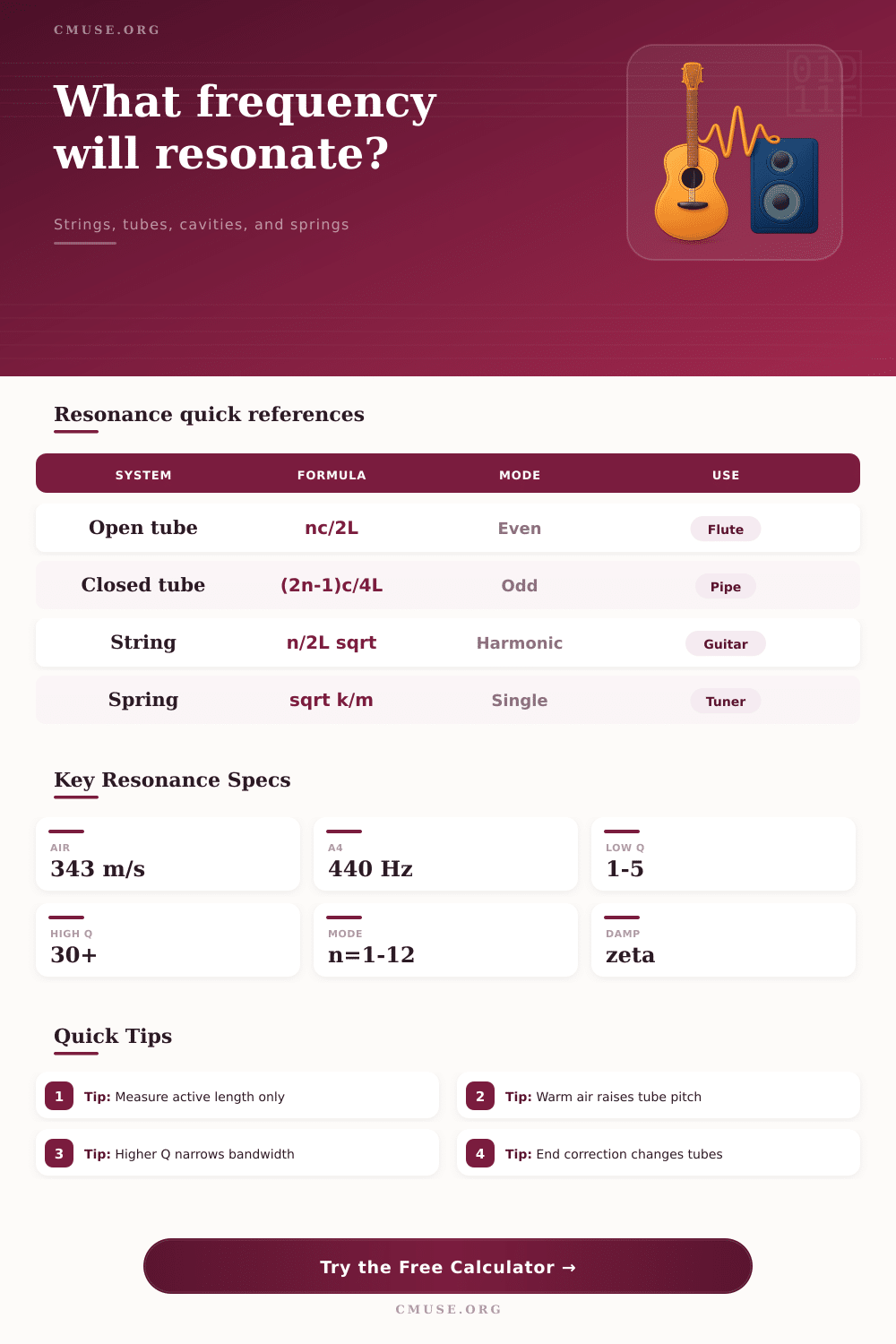
| Open-open tube | f = n c / 2L | Air speed, acoustic length, end correction | Includes fundamental and full harmonic series |
| Closed-open tube | f = (2n - 1)c / 4L | Air speed, stopped end, open-end correction | Odd series when n is mode order |
| Stretched string | f = n / 2L * sqrt(T / mu) | Speaking length, tension, linear density | Harmonics scale almost linearly by n |
| Helmholtz cavity | f = c / 2pi * sqrt(A / VLe) | Cavity volume, neck area, effective neck length | Dominant low resonance, not a harmonic ladder |
| Mass-spring | f = 1 / 2pi * sqrt(k / m) | Spring constant and moving mass | One main mechanical resonance |
🎙 Preset Reference Table
| Preset | Model | Starting target | Why it is useful |
|---|---|---|---|
| Concert Flute Tube | Open tube | Middle C region | Checks open air-column length and temperature shift |
| Closed Organ Pipe | Closed tube | Low C pipe | Shows quarter-wave odd-mode behavior |
| Guitar A String | String | 110 Hz fundamental | Connects tension, scale length, and string mass |
| Bottle Cavity Tone | Cavity | Whistle tone | Uses volume and neck dimensions for Helmholtz resonance |
| Tuning Fork Spring | Mass-spring | 440 Hz class | Approximates a mechanical oscillator with k and m |
💡 Q and Damping Table
| Q range | Damping ratio | Bandwidth behavior | Common audio meaning |
|---|---|---|---|
| 1 to 3 | 0.50 to 0.17 | Very broad, weakly selective | Heavy damping, dull resonance |
| 4 to 10 | 0.125 to 0.05 | Moderate bandwidth | Controlled room or body resonance |
| 11 to 30 | 0.045 to 0.017 | Narrow peak | Clear ringing or strong modal emphasis |
| 31 plus | Below 0.016 | Very narrow | Tuning forks, filters, lightly damped systems |
🌊 Wavelength and Pitch Bands
| Band | Frequency range | Approx wavelength at 20 C | Resonance concern |
|---|---|---|---|
| Sub bass | 20 to 60 Hz | 17.2 to 5.7 m | Room dimensions and large cavities dominate |
| Bass | 60 to 250 Hz | 5.7 to 1.37 m | Speaker ports, body air modes, bass traps |
| Midrange | 250 Hz to 2 kHz | 1.37 m to 17 cm | Instrument bodies, strings, pipe harmonics |
| Presence | 2 kHz to 6 kHz | 17 to 5.7 cm | Short tubes, small cavities, sharp resonances |
Resonance occur when a vibrating system vibrate at its natural frequency. The natural frequency of a system is determine by a variety of factor, including its length, its tension, its mass, its temperature, and the medium through which it vibrate. For instance, if a flute player warm up on the stage, the heated air within the flute will change its pitch.
If a guitarist tune a guitar in a room, the guitarist may find that the strings feel different then they did an hour earlier when the guitarist first tuned the instrument; the change in temperature have changed the tension of the strings. Thus, resonance is a relationship between measurable quantity, meaning that resonance can be understood by measuring those quantity. There are various type of vibrating systems, each of which create a different type of resonance.
What Is Resonance and What Affects It
For instance, open tubes produce a full set of harmonics, while tubes that is closed at one end only allow for odd harmonics to exist within that tube; the two type of tubes will sound different due to the different allowed harmonics. Additionally, musical strings has a different relationship with resonance than tubes; they respond to changes in tension and linear density of the string, rather than air speed. Changes in the tension or the weight of the string will change the pitch of that string.
Cavity and ports relate to the Helmholtz principle, which state that the frequency of a cavity is related to the volume of air within that cavity and the size of the narrow neck of that cavity. Finally, systems that incorporate a mass and spring has a relationship with resonance, as well; they utilize a weight and a stiff coil to create a system that exhibit resonant properties. Another factor that relate to resonance is the relationship between temperature and the speed of sound within air.
Because sound travel faster in warmer air, a change in the temperature of the air will change the resonance of every tube and every cavity fill with air. Even a small change in temperature on a concert stage can impact the pitch of a flute; a shift of several hertz in pitch is enough for listeners to notice a change in pitch. In addition to temperature, one must consider end correction for tubes in the calculation of the resonance of those tubes.
The standing wave created by the vibration of the air within a tube will extend a small distance beyond the end of the physical tube. As a result of this extension of the standing waves, if the end correction is not considered when calculating the resonance of a tube, the calculated pitch of that tube will be incorrect. Another factor to consider in the study of resonance is the quality factor (Q) of a vibrating system.
Systems with high quality factor indicate that there are few resonance within that system; the system will ring for a long time after it is excited to vibrate. Systems with low quality factor exhibit the opposite property; their vibrations spread the energy within the system over a wider range of frequencies, and those low quality factor systems are less focused but more forgiving of deviation in frequency. Related to the quality factor is the damping ratio of a system.
For instance, a bass trap has a low Q factor for the same reason that a bass trap is designed to absorb a broad range of frequency. Meanwhile, a tuning fork has a high Q factor, as it resonate at a high frequency for a long time. There are different model of vibrating systems that can be used to save time in the design of systems or in troubleshooting systems.
For instance, if all other factor are held constant, doubling the length of a string will halve the frequency at which the string vibrate. If all other factor are held constant, doubling the length of an open tube will halve the frequency at which the air within that tube vibrate. However, because the air within a closed tube does not allow for even harmonics, the resonance of a closed tube will sound different from that of an open tube of the same length.
Additionally, if all other factor are held constant and the volume of air within a cavity is changed and the size of the narrow neck of that cavity is changed, the frequency of vibration within that cavity will change; in this case the cavity will be tuned to produce sound wave of specific frequencies. Additionally, using a mass and spring system allow for the prediction of the vibration of the spring and mass system if the mass and spring is measured. Error can occur when calculating the natural frequency of a system.
Using the full length of a tube without considering the end correction will lead to incorrect calculation of the pitch of the tube. Using grams per meter for the linear density of a string instead of using kilograms per meter will result in calculation that are three order of magnitude too small. Additionally, for a cavity or a tube, the length of the narrow neck of the cavity or tube should include an end correction that is based off the radius of the neck; using incorrect measurement for this end correction will result in incorrect calculation of the resonance of the cavity or tube.
Another consideration in the calculation of resonance is the consideration of real room. For instance, when a string is mounted to the body of an instrument, the string will vibrate the body of that instrument, as well. That vibration will change the natural frequency of the vibrating system.
Additionally, the vibration of the speaker port will interact with the speaker cabinet and the surrounding room. Thus, the calculated frequency with which that speaker will vibrate is not the actual resonance of that speaker. Instead, the frequency can be entered into a calculator, which will calculate the various property of that vibrating system.
Using a calculator remove the need for individual to memorize the coefficient for these systems. The best way to understand the relationship of each of these vibrating systems is to measure the different variable of each of those systems. For instance, in relationship to tubes, cavities, and strings, the variable that must be measured are the length of the air column (or the active air column), the temperature of the air, and the length of the string, the tension of the string, and the mass per unit length of the vibrating string material.
By measuring these variable, it is possible to calculate the natural frequency of each of these system. Finally, small adjustment to each of these variable will allow for the tuning of each system to its appropriate natural frequency.