Car Audio Time Alignment Calculator
Convert measured driver-to-seat distances into delay milliseconds, DSP samples, arrival times, and subwoofer phase references with temperature-adjusted speed of sound.
🚗 Named Vehicle Presets
Pick a cabin starting point, then replace every distance with your own measurements from the listening ear to each speaker's acoustic center. The delay values are intended for DSPs that delay nearer speakers until they match the farthest arrival.
⚙ Driver Distances and DSP Settings
📊 Calculated Channel Delay Table
| Channel | Measured Distance | Arrival Time | Add Delay | DSP Samples | Round To Step |
|---|---|---|---|---|---|
| Calculate to fill the channel table. | |||||
🎧 Alignment Spec Grid
📝 Sample Rate Conversion Table
| Sample Rate | 1 ms | 0.1 ms | 1 ft Gap | Current Max |
|---|---|---|---|---|
| Calculate to update sample conversions. | ||||
🌡 Speed of Sound and Distance References
| Cabin Condition | Approx Speed | 1 ft Delay | 6 in Delay | Use Case |
|---|---|---|---|---|
| Cold cabin, 32 F | 1087 ft/s | 0.92 ms | 0.46 ms | winter startup checks |
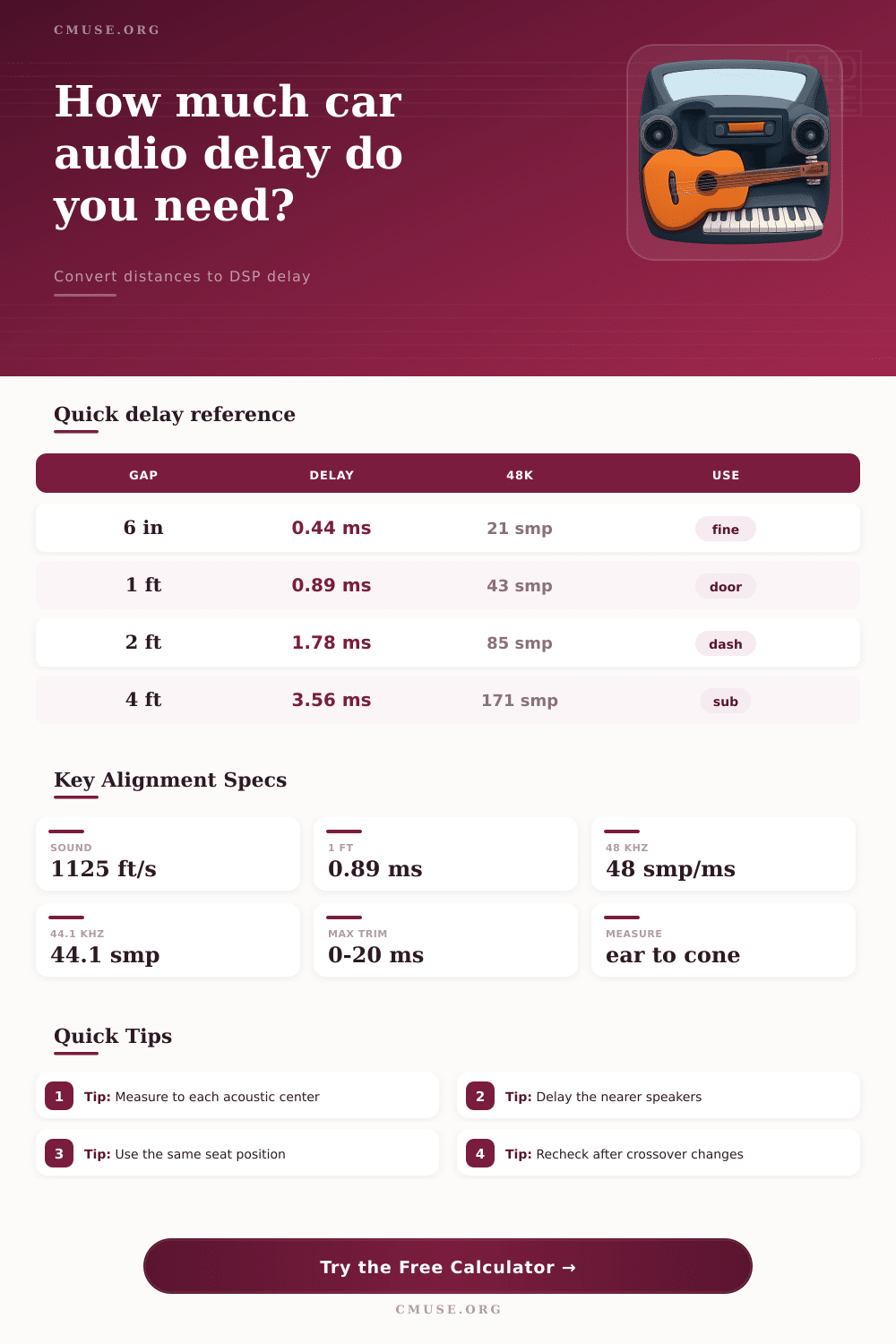
| Normal cabin, 68 F | 1125 ft/s | 0.89 ms | 0.44 ms | typical tuning baseline |
| Warm cabin, 86 F | 1143 ft/s | 0.87 ms | 0.44 ms | sun-heated interior |
| Hot cabin, 104 F | 1160 ft/s | 0.86 ms | 0.43 ms | show or summer setup |
🚗 Vehicle Preset Comparison
| Preset | Front L / R | Rear L / R | Sub Distance | Typical Focus |
|---|---|---|---|---|
| Compact Hatch Driver | 30 / 53 in | 43 / 62 in | 76 in | driver seat imaging |
| Sedan Daily Driver | 32 / 54 in | 46 / 64 in | 78 in | front stage balance |
| SUV Front Stage | 35 / 59 in | 58 / 78 in | 102 in | cargo sub blend |
| Pickup Crew Cab | 31 / 57 in | 51 / 70 in | 61 in | under-seat sub |
| Soundoff SQ Tune | 34 / 60 in | 56 / 75 in | 92 in | precise driver seat |
🔍 Alignment Target Table
| Target | What It Does | Watch For | Useful Metric |
|---|---|---|---|
| Auto farthest | Delays every nearer channel to the farthest measured driver. | Usually easiest for DSP entry. | max delay range |
| Front pair first | Centers the left and right image before adding rears or sub. | Door midbass acoustic centers can differ from tweeters. | front delta ms |
| Subwoofer blend | Compares sub arrival with the rest of the system reference. | Crossover slope and polarity can shift acoustic phase. | phase at Hz |
| Center channel | Checks whether a dash center needs delay to avoid pulling vocals upward. | Keep it lower in level if it narrows stereo width. | center delay ms |
Car audio time alignment is a process of adjusting the timing of the sound from each speaker in the car audio system to make it sound like all of the speaker are playing at the same time. Sound travel at a fixed speed through teh air. Because sound travels at a fixed speed, the speakers that are closer to your ears will output sound wave that reach your ears prior to the speakers that are positioned further away from your ears.
As a result, if the audio system isnt time-aligned, the sound will seem to emanate from the closest speaker. Car audio time alignment fix this problem by adding a delay to the audio that is played through the speakers that are closer to your ears, thus making it so that all of the speakers in the car audio system output sound waves that reach your ears at the same time. The timing difference with car audio time alignment are very small.
How to Time Align Your Car Speakers
For example, one foot of distance between a sound source and your ears is equal to approximately zero point nine milliseconds of time difference. Zero point nine milliseconds is enough to change the perceived location of a voice or a drum beat in the music that is playing through the speakers. Thus, when you measure the distance from each of your ear to each speaker in the car audio system, you will find that the distance to each type of speaker is not the same.
You can use a calculator to determine the amount of delay that each of the speakers should be set to. The amount of delay is calculated based off the distance between each speaker and your ears, the temperature within the car, and the sample rate at which the speakers output sound. Temperature can play a role in car audio time alignment because sound travels at different speeds through air of different temperatures.
For instance, dense air (cold air) allow sound to travel at a slower speed than air that is warmer and less dense. Thus, if the car audio system is calculated based upon thirty-two degrees of air within the car, the result will be different than if the car is calculated based upon eighty-six degrees within the car. The temperature should be measured at ear height when you perform the calculations for car audio time alignment.
Your seat position within the car can play a role in car audio time alignment. Most people do not sit in the center of the car when they are commuting or when they are driving to destinations. Thus, when you sit in one of the seats that are offset from the center of the car, one of the door speakers will be closer to you than the other door speaker.
You must take into account the distance between yourself and the center of the car, as well as the distance between yourself and the middle of the car. You must take into account these variable because your seat position will change the distance between your ears and each speaker. If you do not take into account your seat position, the delays for each of the speakers will not be correct to each of your ears.
Subwoofer timing is another specific part of car audio time alignment that relate to the subwoofer. Because low frequencies have a much longer wavelength than other frequencies, misaligning the low frequencies will not change the location of the sound as much as it will change the volume of the sound. If the subwoofer timing is incorrect, you will hear a dip or a peak in the volume of the sound at the crossover frequency between the subwoofer and the other speakers.
You can adjust the delay on the subwoofer to even out these dips and peaks in the volume so that the subwoofer begins to reinforce the midbass from the other speakers rather than canceling it. To determine the proper distance from each speaker to the acoustic center of the speaker, you must measure to the acoustic center of each speaker rather than to the grille of the speaker. The dome of a tweeter is often behind the mounting surface of the tweeter, and the cone of a woofer move when the woofer plays a note.
By measuring to the acoustic center of each speaker, you will ensure that your measurement are accurate. Using these accurate measurements, the time alignment calculator will provide you with the delay values for each speaker in milliseconds and in samples that you can enter into your audio processor. When you enter the delay values into the audio processor, the sample rates of your audio files are also important.
The same value in milliseconds for a delay will not always equal the same number of samples depending upon the sample rates of the audio files. For instance, a zero point five millisecond delay will equal twenty-four samples at a sample rate of 48 kilohertz, but will equal forty-eight samples at a sample rate of 96 kilohertz. The sample rate that you enter into the time alignment calculator should match the sample rate of your audio processor; any other sample rate will result in incorrect time alignment of the speakers.
After you enter these numbers into your audio processor, you must listen to the car audio system to complete the tuning process. The reflections of the sound waves from the glass and plastic panels in the car can impact the sound that reaches your ears. These reflections may impact the perceived time alignment of the speakers, so you may need to make small adjustment in the delay of the subwoofer.
The time alignment calculator will help to even out the sound in your car, but your ears are what will help to properly tune your car audio system. By properly completing the time alignment of your car audio system, your entire audio system will sound as if it is working together. The vocal will remain centered in the sound field even if you move your head to one side of the car from the other.
Furthermore, the subwoofer will blend into the other speakers rather than sounding like it is coming from behind you in the car. The time alignment of the speakers will allow the sound to be imaged properly so that you can hear the audio clearly from each speaker, without any of the speakers fighting for your attention.