Speaker Coverage Calculator
Estimate the listening footprint from speaker dispersion angle, mounting height, listener height, venue size, coverage overlap, and target layout density.
🎧 Venue Presets
Choose a venue starting point or enter your own dimensions. The calculator models the speaker pattern as an elliptical footprint at listener height, then applies overlap to estimate smooth coverage spacing and speaker count.
⚙ Venue and Speaker Inputs
Coverage Breakdown Table
| Coverage item | Calculated value | Meaning |
|---|
📊 Speaker Pattern Comparison Grid
📐 Dispersion Angle Reference
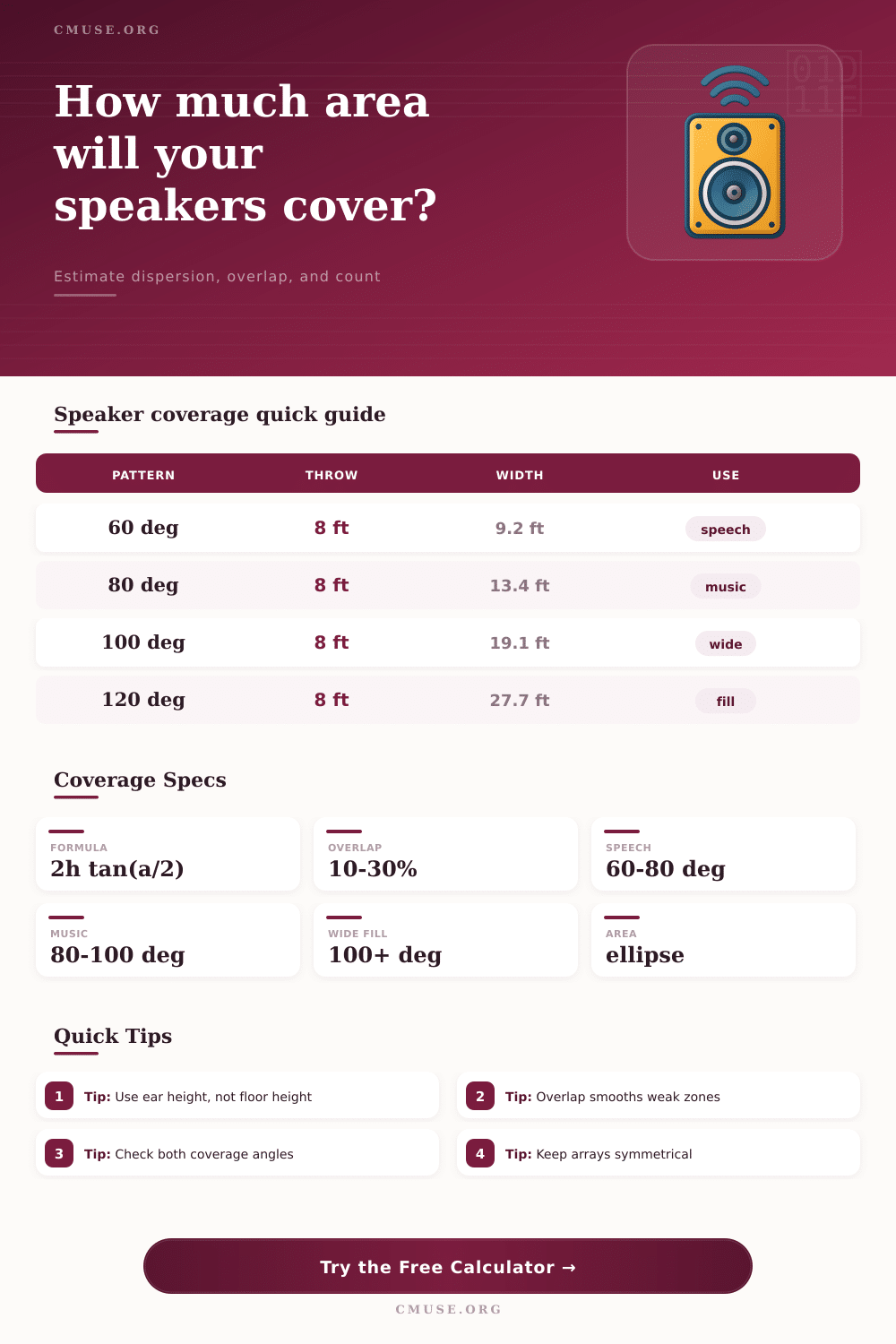
| Rated pattern | 8 ft throw width | Coverage character | Best use |
|---|---|---|---|
| 60 x 40 deg | 9.2 x 5.8 ft | Tight, controlled | Speech zones, long narrow seating, balcony delays |
| 80 x 50 deg | 13.4 x 7.5 ft | Moderate spread | Small halls, rehearsal rooms, lecture coverage |
| 90 x 60 deg | 16.0 x 9.2 ft | Balanced | Music rooms, small clubs, multipurpose venues |
| 100 x 80 deg | 19.1 x 13.4 ft | Broad | Short throw fills, ceiling speakers, wide seating |
| 120 x 90 deg | 27.7 x 16.0 ft | Very wide | Near-field lounge fill, patio coverage, ambient zones |
🏛 Common Venue Coverage Examples
| Venue preset | Listening area | Typical pattern | Coverage note |
|---|---|---|---|
| Vocal Rehearsal Room | 12 x 14 ft | 90 x 60 deg | One or two positions often cover the room evenly. |
| Coffeehouse Corner | 24 x 18 ft | 100 x 70 deg | Short throw and moderate overlap keep tables consistent. |
| Jazz Club Room | 42 x 28 ft | 90 x 60 deg | Front mains plus fills may need separate zones. |
| Lecture Theater | 52 x 36 ft | 80 x 50 deg | Speech priority favors tighter overlap and controlled spill. |
| Outdoor Patio Zone | 60 x 34 ft | 110 x 70 deg | Wind and open boundaries usually reward extra overlap. |
📏 Mounting Height and Footprint Table
| Mount height | Ear height | 90 deg footprint | 100 deg footprint |
|---|---|---|---|
| 8 ft | 4 ft | 8.0 ft wide | 9.5 ft wide |
| 10 ft | 4 ft | 12.0 ft wide | 14.3 ft wide |
| 12 ft | 4 ft | 16.0 ft wide | 19.1 ft wide |
| 16 ft | 4 ft | 24.0 ft wide | 28.6 ft wide |
| 20 ft | 4 ft | 32.0 ft wide | 38.1 ft wide |
🔍 Speaker Coverage Specification Table
| Coverage goal | Overlap range | Spacing cue | Result to watch |
|---|---|---|---|
| Speech intelligibility | 20 to 35 percent | Use tighter center spacing | Even coverage across seats |
| Live music support | 15 to 25 percent | Keep left and right zones symmetrical | Smooth audience handoff |
| Background music | 10 to 20 percent | Use broader patterns if height is low | Comfortable room fill |
| Stage monitoring | 5 to 15 percent | Keep coverage inside performer zones | Reduced unwanted spill |
Speaker coverage describe the shape of the sound pattern that emanates from the speaker cabinet. Speaker coverage determines how sound distribute itself within the room. Speaker coverage changes with the height of the speaker, the distance between the speaker and the listener, and the width of the horn or speaker driver.
By using the calculator located on this page, you can turn these variable into a speaker coverage footprint that helps to determine the number of speaker that are required to fill the room and the placement of those speakers. The distance between the speaker and the listener is the most important measurement to input into the speaker coverage calculator. This distance, referred to as the throw distance, is the measurement that the user multiplies by the dispersion angle of the speakers.
Speaker Coverage and How to Use the Calculator
A 90-degree dispersion angle at a throw distance of 12 feet will cover a larger area than the same dispersion angle at a throw distance of 8 feet. This footprint is based off the elliptical shape of the sound waves radiating from the speakers. The footprint for speaker coverage is calculated as the average of the width and depth of these sound waves.
The overlap between two adjacent speakers is the space in which their sound waves begins to intersect. Overlap between the areas covered by each speaker is necessary to create smooth sound from each speaker. If there is not enough overlap between two speakers, there may be holes in the sound that are emitted from each speaker.
If there is too much overlap, however, money and speaker can be wasted. The user can set the percentage of overlap between each speaker in the speaker coverage calculator. The shape of the room in which the speakers will be used will affect the way in which they are to be used.
In a long and narrow room, the speakers should have tight vertical sound waves to avoid sound from bouncing off of the lateral walls of the room. In a wide and shallow room, the sound waves can have a broader dispersion angle horizontally. These presets can be used to quickly adjust to the most common room shapes.
The dimensions of the room should be adjusted to reflect the actual dimensions of the room to recieve the best recommendation for speaker placement. Each room may contain the same square footage, but the use of the area may differ. A lecture theater may require speakers to emphasize speech over music, while a small club may require the speakers to emphasize music.
These differing requirements have an impact upon the overlap between speakers and the total number of speaker that will be required to effectively fill the room. Finally, the environmental variables of the room will impact the dispersion of the sound waves from each speaker. Variables like curtains and carpet absorbs some of the sound waves from the speakers.
These sound waves that the room absorbs reduce the effective area in which the speakers sound travels. The hard and parallel walls within a room will create reflections from the sound waves, which can help to widen the perceived coverage of a speaker’s horn. Additionally, the temperature and humidity of the environment in which the speakers are used will impact the loss of high frequencies over distance, again potentially contributing to the need for wider patterns of coverage to even partially compensate outside of indoor areas such as patios.
While the calculator will give you an idea of the sound pattern of the speakers that you intend to use, you will need to use your ears to understand how the room will impact the sound. The height at which you mount your speakers will impact both the distance that the sound will travel (the “throw”) as well as the footprint of the speaker coverage. By raising the speakers, you will increase the throw distance that the sound will travel, and an increased distance will lead to an increased footprint of the speaker coverage at ear level.
Additionally, raising the mounting height of the speakers will also increase the angle at which the sound travels towards the audience. Increasing the mounting height can work to even out the coverage of some rooms, yet can even create hot spots directly beneath the speaker in some other room configurations. You can use the tool to see how the footprint changes as a result, helping you to determine if any adjustments to the rigging of the speakers will be necessary.
The reference tables included on this page are yet another tool to help you build an intuition for speaker coverage. You can use them to compare the output of a 60 degree horn to a 120 degree horn, for instance. Horns with small angles are used to evenly focus the sound energy within a long room for speech, but wide patterns are used to provide even coverage to a larger area like a lounge.
These reference tables will likely become second nature to you after using the calculator some number of times for your projects. Many people make the mistake of measuring from the speaker to the floor rather than the distance from the speaker to the audience’s ears. However, the calculator helps to prevent this mistake by requiring the user to enter the height of the audience’s ears.
Similarly, many people also make the mistake of treating the angle from which the speaker’s manufacturer rated the speakers as an absolute value. However, it is actualy a nominal value, as other factors like frequency can impact the angle at which the sound radiates from the speaker. Therefore, it is necessary to calculate the output of the speaker using both the rated angle as well as a slightly narrowed angle.
The goal of the speaker angle calculator is to help you to ensure that the audience wherever they may sit will experience the same listening experience. The calculator will help to remove the guesswork as to how many speakers you will need, where you will need to place them, and what manual adjustments you can make to the sound system with your ears. Thus, the sound system will provide even coverage throughout the listening area.