
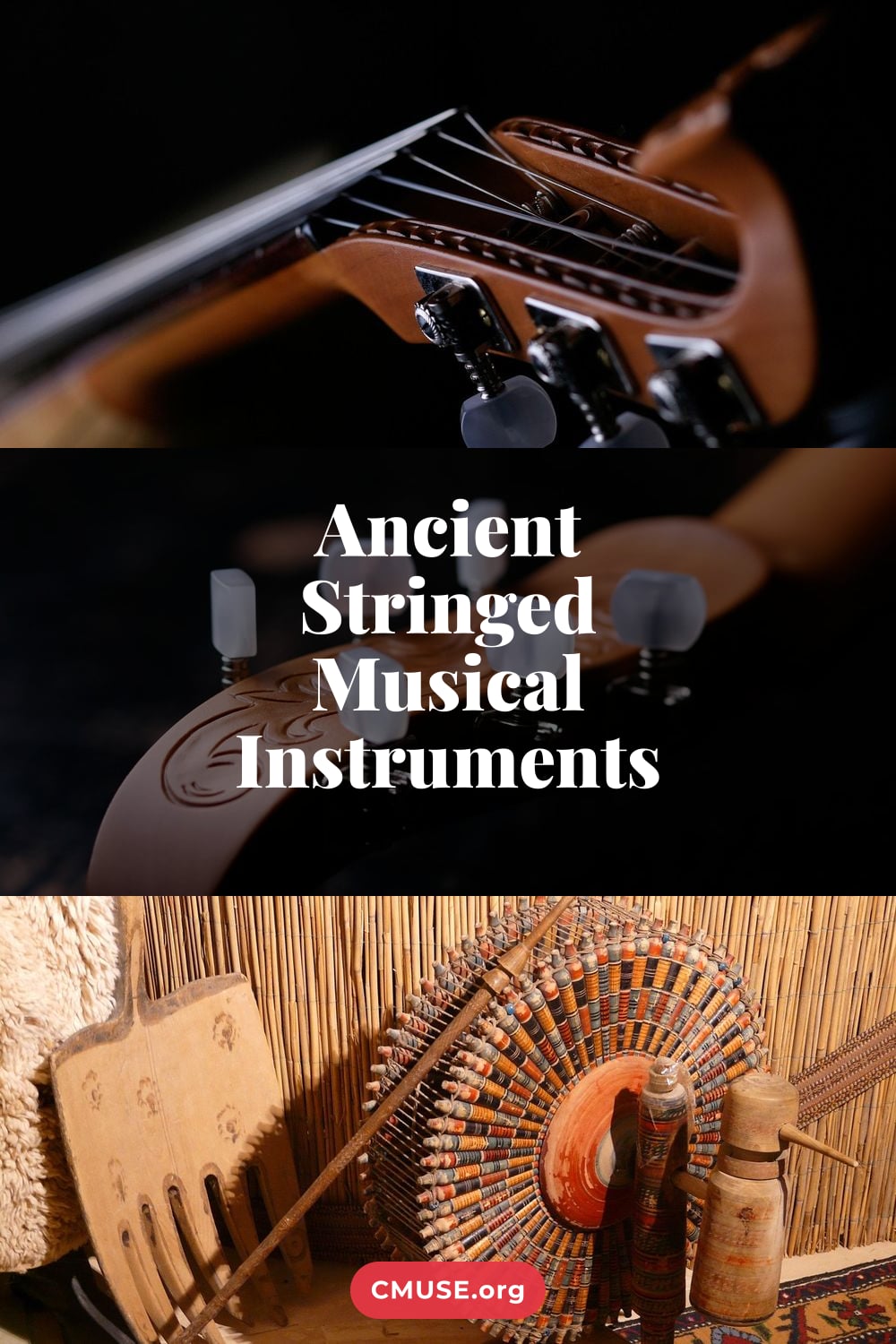
The plucked string has been singing since before history bothered to write anything down. Walk through any museum wing dedicated to ancient civilizations and you will see them: fragments of wood, bone bridges, and faint traces of gut or silk strings that once carried melodies across deserts, palaces, and temples. These instruments were never mere entertainment.
They accompanied kings to the afterlife, soothed warriors before battle, and helped storytellers remember epics that could last for days. Understanding them is like holding a cracked but still resonant window into how our ancestors organized sound, emotion, and power.
The instruments on this list represent pivotal moments in that long conversation between human hands and vibrating strings. Each one solved a different musical problem or reflected the values of its culture. Some are delicate and intimate.
Others were built to fill vast courtyards or march with armies. They range across three continents and nearly four thousand years. What they share is the fundamental idea that stretching something tight between two points and then disturbing that tension can move the human spirit in ways words cannot reach.
Important Ancient Stringed Instruments From History
1. The Lyre
The lyre stands at the very beginning of the Western musical imagination. Picture a small wooden soundbox with two curving arms rising from it, joined at the top by a crossbar. Seven to eleven strings ran from the base to that yoke, each one anchored by a tuning peg or leather thong.
Players held the instrument against the body and plucked with both hands or a plectrum. In ancient Greece the lyre was so central to education that a freeborn boy who could not play it was considered only half-civilized. The instrument taught rhythm, mathematics, and moral discipline all at once.
Its soft, clear tone suited lyric poetry. The very word “lyric” still carries its DNA. That intimate connection between voice and strings explains why the lyre became the emblem of Apollo and why poets from Sappho to Shelley kept returning to its image long after the physical object had evolved into other forms.
2. The Angular Harp
Move east to Mesopotamia and you meet the angular harp, an instrument that looks like a hunter’s bow stood on its side and fitted with multiple strings. Sumerian players rested the harp on the ground or against the hip and ran their fingers across the strings in sweeping gestures. The sound was bright and penetrating, ideal for the open courtyards of temple complexes where music had to compete with the lowing of sacrificial animals and the murmur of crowds.
Reliefs from Ur show harpists performing alongside singers and reed pipes in ensembles that must have produced a rich, buzzing texture. The angular harp traveled trade routes and evolved. By the time it reached Egypt it had been joined by the arched harp, which curved gracefully like a question mark.
3. The Arched Harp
Egyptian tomb paintings depict these harps played by elegant musicians at banquets, their long strings allowing for wide intervals and dramatic glissandos that must have sounded otherworldly in torchlight.
4. The Kithara
The kithara was the professional upgrade of the lyre, larger, louder, and built for the stage rather than the classroom. Where the lyre had a light wooden body, the kithara used thicker wood and sometimes even bronze fittings. Its strings were heavier and the tone more commanding, perfect for accompanying the great dramatic choruses of Athenian theater.
Players wore it on a strap so they could move while performing. The extra volume came at a cost. Tuning the kithara was a finicky business that required both hands and occasionally a helper.
That practical complication is why the instrument never became a casual household object. It remained the tool of the virtuoso, the ancient equivalent of a concert grand piano carried into battle with rock-star swagger.
5. The Crot
Further north the Celts were developing the crot, a lyre-like instrument with a deep, bowl-shaped soundbox carved from a single piece of wood. Irish and Scottish legends speak of master musicians whose crot could make listeners laugh, cry, or fall asleep at will. The stories are exaggerated, yet the surviving examples suggest a rich, resonant tone that carried well across misty hillsides.
Unlike the bright Greek lyre, the crot favored lower pitches and sustained drones. Players used fingers rather than plectrums, producing a gentler attack that blended beautifully with the human voice in the long heroic recitations that defined Celtic culture. The instrument’s influence echoes today in the wire-strung harp tradition that still survives in Ireland, a direct descendant that carries four millennia of accumulated technique.
6. The Guqin
In ancient China the guqin occupied a place of almost sacred importance. This seven-string zither rests flat on a table. Its strings are silk, its body is lacquered wood shaped like a long, narrow rectangle with subtle curves that suggest a reclining scholar.
What sets the guqin apart is its playing technique. Musicians pluck with the right hand while the left hand presses the strings against the soundboard to create microtonal slides and harmonics. The instrument has almost no frets or bridges to interrupt the string’s full vibration.
Every nuance of finger pressure becomes audible. Confucian scholars prized the guqin precisely because it demanded decades of disciplined practice and produced a sound so subtle it could only be fully appreciated in quiet rooms away from the noise of the marketplace. A single wrong note was considered a moral failure as much as a musical one.
That austere philosophy shaped an entire aesthetic that still influences East Asian music.
7. The Veena
The Indian veena represents a different philosophical path. Its long neck carries frets, and its large gourd resonators amplify every vibration into a rich, vocal tone. Ancient texts describe several varieties, but the most enduring features a wide wooden body, two round resonators at either end, and sympathetic strings that hum beneath the main playing strings.
The veena was never just an instrument. It was personified as a goddess, Saraswati’s own form, and its playing technique emphasized continuous slides and ornaments that imitate the curves of the human voice. Where the guqin valued restraint, the veena celebrated expressive freedom within complex raga systems.
Listening to a master player even today feels like witnessing a conversation between string and breath that has been refined across centuries of temple and court performance.
8. The Oud
The Egyptian oud, ancestor of the lute and eventually the guitar, brought a new idea into the ancient world: a short neck, a pear-shaped body, and strings played with a plectrum rather than fingertips alone. Its sound is intimate yet incisive, capable of both delicate melody and rhythmic drive. Reliefs show oud players entertaining at royal feasts, their instruments tucked under the arm like a favorite companion.
The oud’s design allowed for rapid ornamentation and microtonal adjustments that suited the complex modal systems of the Near East. When Islamic civilization later spread the instrument across North Africa, Spain, and Central Asia, it carried with it not just a shape but an entire approach to musical time and decoration that still defines much of the world’s music.
9. The Morin Khuur
No tour of ancient stringed instruments would be complete without the Mongolian morin khuur, the horse-head fiddle whose scroll is carved into the shape of a horse’s head. Its two strings are traditionally made from horsehair, and its soundbox is often covered with horse skin. The instrument is played with a bow that never leaves the strings, creating a continuous, singing tone that mimics the steppe winds and the whinny of horses.
Every part of the morin khuur is meant to remind the listener of the relationship between the nomadic herder and his most valuable partner. The music it produces is not abstract. It is landscape made audible.
Even in recordings you can hear the vast open spaces that shaped its voice.
These instruments remind us that music technology did not begin with electricity or even with metal. It began the moment someone tied a string to a hollowed log and noticed that disturbing the string could disturb the soul. The lyre taught harmony, the harp taught drama, the guqin taught discipline, the veena taught expression.
Each solved a slightly different equation of materials, acoustics, and cultural need. Their descendants still surround us. When you hear a guitar on the radio or a violin in a concert hall, you are listening to technologies that were worked out by craftsmen whose names are lost but whose solutions proved durable enough to cross oceans and millennia.
The next time you see a street musician playing an acoustic instrument, pause for a moment. That simple act of stretching strings and setting them in motion connects you to a chain of human ingenuity that stretches back to the first campfires. The materials have changed.
The impulse has not. The string still waits for your touch, ready to turn vibration into meaning exactly as it has done since the beginning.