Guitar Saddle Height Calculator
Estimate how much to raise, lower, shim, or file a guitar saddle by combining scale length, 12th-fret action, neck relief, nut clearance, and intonation compensation.
🎸 Named Guitar Setup Presets
⚙ Scale, Action, Relief, and Saddle Inputs
📊 Current Setup Snapshot
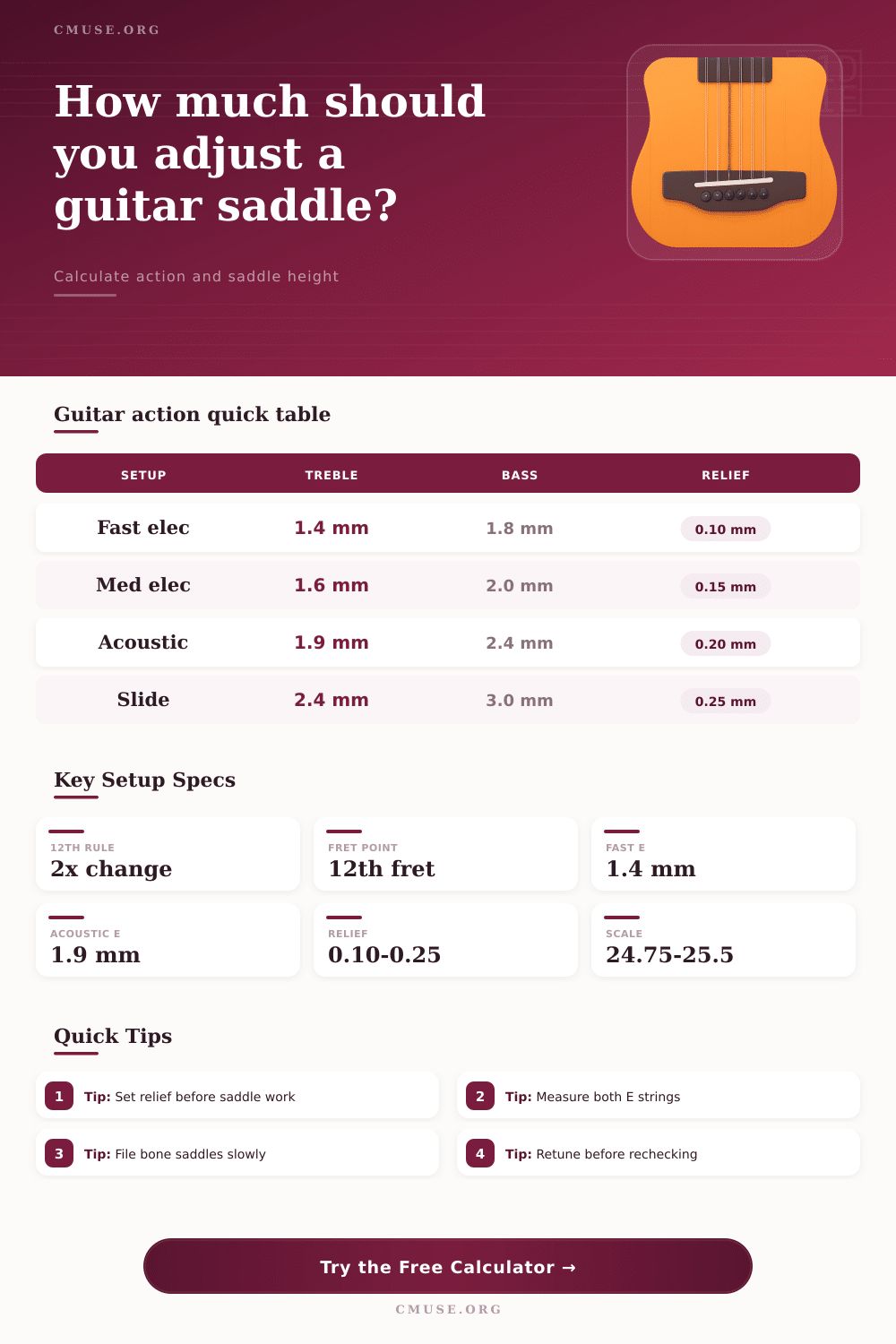
📏 Reference Action Targets
| Setup style | Treble E at 12th | Bass E at 12th | Relief range | Best use |
|---|---|---|---|---|
| Fast electric lead | 1.2-1.5 mm / 3.8-4.7 64ths | 1.6-1.9 mm / 4.0-4.8 64ths | 0.08-0.15 mm | Light touch, level frets |
| General electric | 1.5-1.8 mm / 4.7-5.7 64ths | 1.9-2.2 mm / 4.8-5.6 64ths | 0.10-0.20 mm | Most stage and studio work |
| Steel-string acoustic | 1.8-2.2 mm / 5.7-6.9 64ths | 2.3-2.8 mm / 5.8-7.1 64ths | 0.15-0.25 mm | Balanced strum and fingerstyle |
| Bluegrass acoustic | 2.0-2.4 mm / 6.3-7.6 64ths | 2.7-3.2 mm / 6.9-8.1 64ths | 0.18-0.30 mm | Hard flatpicking and projection |
| Classical nylon | 2.7-3.3 mm / 8.5-10.4 64ths | 3.5-4.2 mm / 8.9-10.7 64ths | 0.05-0.20 mm | Traditional nylon clearance |
| Slide guitar | 2.2-3.0 mm / 6.9-9.5 64ths | 2.8-3.8 mm / 7.1-9.7 64ths | 0.18-0.35 mm | Bottleneck sustain, fewer rattles |
🎵 Scale Length and Bridge Comparison
| Guitar family | Typical scale | 12th fret distance | Saddle response | Setup note |
|---|---|---|---|---|
| Short-scale electric | 24.75 in / 628.7 mm | 12.375 in / 314.3 mm | About 2.00x | Often wants slightly higher bass action |
| Long-scale electric | 25.5 in / 647.7 mm | 12.75 in / 323.9 mm | About 2.00x | Tighter string feel supports lower action |
| Steel acoustic | 25.4 in / 645.2 mm | 12.7 in / 322.6 mm | About 2.00x | Fixed saddles must be sanded evenly |
| Classical | 25.6 in / 650.0 mm | 12.8 in / 325.0 mm | About 2.00x | Higher action is normal for nylon strings |
| Baritone | 27.0 in / 685.8 mm | 13.5 in / 342.9 mm | About 2.00x | Low tuning benefits from extra clearance |
🔧 Saddle Change Rules
| Measured issue | 12th-fret correction | Saddle movement | Relief effect | Practical check |
|---|---|---|---|---|
| Action is 0.25 mm too high | Lower by 0.25 mm | Lower saddle about 0.50 mm | Subtract relief reduction first | Retune and measure again |
| Action is 1/64 in too high | Lower by 1/64 in | Lower saddle about 1/32 in | About 40% of relief change reaches 12th | Work in small passes |
| Relief drops 0.10 mm | Action may drop about 0.04 mm | Needs about 0.08 mm less filing | Relief first, saddle second | Check fretted buzz zone |
| Nut lowers 0.10 mm | 12th action may drop about 0.02 mm | Needs about 0.04 mm less filing | Nut mostly affects first position | Check open-string buzz |
📝 Compensation and String Set Reference
| String setup | Typical spread | Tension tendency | Height sensitivity | Recommendation |
|---|---|---|---|---|
| Electric 9-42 | 2.0-3.0 mm | Light | Lower | Good for low action, light touch |
| Electric 10-46 | 2.5-3.5 mm | Medium | Moderate | Baseline electric compensation |
| Electric 11-49 | 3.0-4.2 mm | Firm | Moderate-high | Allow more bass setback |
| Acoustic 12-53 | 3.0-4.5 mm | Firm | Moderate | Common slanted saddle target |
| Acoustic 13-56 | 3.8-5.2 mm | Heavy | Higher | Flatpickers may need more action |
| Nylon classical | 1.0-2.5 mm | Flexible | Different feel | Use higher action, less relief |
💡 Setup Tips
The guitar setup depend on a few small measurement on the instrument. One of these small measurement is the saddle height. The saddle is a piece of bone or plastic located under each of the guitar string.
The saddle height is the measurement of how far the strings are from the fret. If the saddle height is too low, the strings will hit the frets and cause buzzing on each of the string. Additionally, if the saddle height is too high, the player will find the instrument difficult to play.
How to Adjust Your Guitar Saddle Height
Each of these factor has an influence on the distance between the strings and the frets. Thus, there are several different variable that must be considered in adjusting the saddle height. One of the first variable to consider is the neck relief.
Neck relief is the amount of bow in the neck of the guitar; this allow space for the guitar strings to vibrate without hit the frets. If the truss rod is tightened, neck relief will decrease; less neck relief cause the strings to be closer to the frets. Thus, neck relief will change the action at the twelfth fret, and you must consider it prior to adjust the saddle height.
Nut height is a second variable that impact the action of the guitar. However, the influence of nut height is relatively small compared to neck relief. High nut will increase the distance between the strings and the frets at the twelfth fret.
Scale length is a third variable to consider. Scale length is the distance from the nut to the bridge of the guitar. Scale length impact the distance from the twelfth fret to the bridge.
Additionally, because the scale length is different on different guitar, changing the saddle height will have a different impact on each type of guitar. String choice and tuning are one additional variable that may impact the adjustment of saddle height. The heaviness of the guitar strings will impact the action of the guitar.
Additionally, changing the tuning will impact the adjustment of the saddle height. The calculator will provide a plan as to how to adjust each side of the saddle on the instrument. The calculator will indicate the movement of the saddle that you should make to the guitar to achieve the desired action on the strings once the neck relief and nut height have been adjusted to the desired setting.
However, there are a few limitation to this calculator; it cannot account for uneven fret or neck twist. Thus, because the frets may not be even on the guitar, the entire suggested change to the saddle should not be made at once. Instead, only half of the change should be made to the saddle; after reinstalling the saddle and retuning the guitar, the action can be measured again.
Small change should be made to the saddle to determine if the guitar can be played with easy. If the adjustment of the saddle height is rushed, it is possible that the resulting saddle will be too low or filed at the wrong angle. If the saddle is too low, the strings will be almost flat on the bridge.
Additionally, the break angle of the strings may dissapears. If the angle at which the saddle is filed is incorrect, the action of the guitar will be inconsistent, and there may be problem with the intonation of the strings. Thus, to avoid these problem, the calculator should only be used as a planning tool.
Finally, there are difference in how the saddle of an acoustic guitar relate to the top of the guitar compared to an electric guitar with an individual saddle. Additionally, classical guitars generally have a higher action than other type of guitars; this is due to the fact that the strings used on classical guitars have nylon string that require more space to move. Thus, relief, nut height, and action at the twelfth fret should be measured.
These measurement should be entered into the calculator, and the suggested movement of the saddle should be made in small increment.