Equal Temperament Calculator
Calculate N-EDO step ratios, cents per step, target interval error, and a frequency table from any reference pitch.
🎹 Named Temperament Presets
⚙ Temperament Inputs
📊 Octave Division Spec Grid
🎼 Generated Frequency Table
| Step | Label | Cents | Ratio | Frequency |
|---|
📐 Interval Approximation Table
| Interval | Target Cents | Nearest Step | EDO Cents | Error |
|---|
🔎 Equal Temperament Comparison Table
| System | Step Size | Fifth Step | Fifth Error | Common Use |
|---|---|---|---|---|
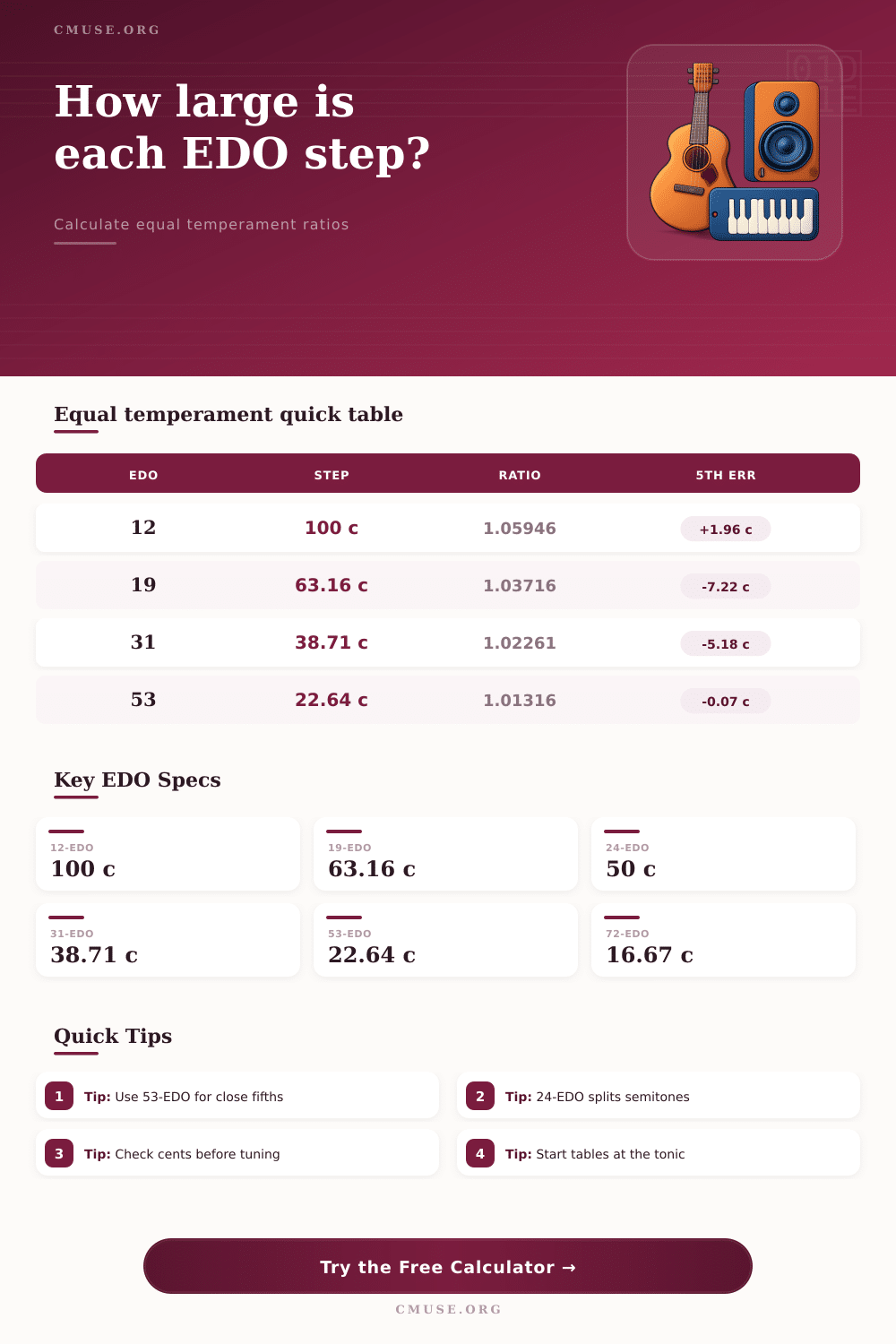
| 12-EDO | 100.000 cents | 7 | +1.955 cents | Piano, guitar, notation, DAW defaults |
| 19-EDO | 63.158 cents | 11 | -7.218 cents | Extra diatonic shades and altered thirds |
| 24-EDO | 50.000 cents | 14 | -1.955 cents | Quarter-tone composition and notation |
| 31-EDO | 38.710 cents | 18 | -5.181 cents | Meantone-like harmonic color |
| 41-EDO | 29.268 cents | 24 | +0.484 cents | Fine microtonal mapping |
| 53-EDO | 22.642 cents | 31 | -0.068 cents | Pythagorean commas and close fifths |
| 72-EDO | 16.667 cents | 42 | -1.955 cents | High-resolution pitch bends and scoring |
🧮 Octave Division Metrics
| Metric | Formula | Meaning | Why It Matters |
|---|---|---|---|
| Step ratio | 2^(1/N) | Multiplier between adjacent equal steps | Controls the frequency table and pitch-bend spacing |
| Step cents | 1200/N | Cents in each octave division | Shows how fine the temperament grid is |
| Interval fit | round(target/step) | Closest EDO step to a target interval | Reveals third, fifth, and seventh tuning error |
| Period return | ratio^N | Final ratio after N steps | Should equal the selected octave or period ratio |
Equal temperament exist due to the fact that pure interval do not line up well within an octave. If someone played perfect fifth in a loop, the notes would drift away from there starting place; instruments would need an impossible number of extra key to play all of these note. Equal temperament solve the drifting problem by dividing the octave into equal step.
Most instruments uses twelve steps because this is the division that most instrument use by default. While many believe this is a permanent standard, others have invented a variety of other division that trade one interval’s accuracy for another’s to achieve different musical color. The number of step that are used decides the size of each step between key and the accuracy of common interval to land on those step.
What Equal Temperament Is and How to Test It
Fewer step will result in a greaterer distance between each key. With more step, there is fine control over the notes that are played. The calculator does the math for you once you provide the number of divisions and the reference pitch.
The calculator will allow you to test interval for your instrument. One of the most common mistake is to consider a temperament a replacement for twelve tone equal temperament. Twelve tone equal temperament have errors that are small enough to almost always be ignored in most musical context.
Some division work to even out the errors in the fifths but produce error in the major third. Other division work to even out the errors in the major thirds yet introduce error into the fifths. Thus, the question that musician must ask themselves is which error is the least bothersome to their musical composition.
If a composer create music that uses many slow chord changes, the error in the thirds will be more noticeable. For music that change quickly from one scale to the next, the size of each step between key will be more important. The target interval field allow you to see if the temperament will work well for any specific interval.
By entering the size of the interval you desire in cents, you can see how many step come closest to that interval and how many cents of error there will be in tuning to that target interval. Those cents of error will tell you whether the interval sound out of tune or within normal playing variation. These error help to show the reason that some division appear in both historical and moddern experiments with temperaments.
For example, fifty-three tone equal temperament have a fifth error that is nearly zero yet introduce error into other interval that are important to other type of music. The frequency table are important for those playing the instrument. Once you know the ratio of each step, you can generate every pitch from one reference tone.
Thus, you can avoid having to measure each note. Furthermore, the frequency table will tell you how far the range of pitch extend from your starting pitch; this will help you to know the range of your sound synthesis or musical instrument. If you are working with electronic sound or you are retuning acoustic instrument, having the frequency of each pitch is an advantage; it avoid guesswork when tuning to these pitch.
Beyond the mathematics, there are some of the most important consideration for musician. For instance, pianos and other instrument with fixed pitch can only play one temperament at a time (unless using additional technique) yet guitars has further limitation with the addition of frets for new temperament. Furthermore, notation system for musical score are currently unable to notate division of pitch other than those within twelve tone equal temperament system.
Thus, composer often consider temperament that share at least some common tone to those in twelve tone equal temperament; this allow for them to write music that can be played without the alteration of any fingering. The comparison table on this page allow you to compare how division of temperament handle the fifth; one of the most important interval in music. When the fifth is as close to pure as possible, all other interval may drift away from their target pitch.
While some composer and musician may prefer this due to the flavor that this drifting create for each key, others want each key to sound the same; hence, the lack of drifting of the fifth from pure. Neither is inherently “better” than the other; yet, the calculator can help you to understand how each temperament will visually show the drifting of the fifth. Ultimately, you must make the choice of which temperament to use based off the type of music that you wish to play.
The mathematics will show you the distance between each note; but only through playing the notes will you understand if they are suitable for your music. After playing and comparing a few different temperament with the calculator, the remaining choice is musical rather than mathematical.