Pitch Class Set Calculator
Analyze unordered pitch-class collections with normal order, prime form, interval vector, complement, and Tn/TnI comparison checks.
🎼 Set-Class Presets
📝 Pitch-Class Inputs
📊 Current Set Spec Grid
🎵 Forte-Style Quick Reference
| Reference | Prime Form | Interval Vector | Common Label |
|---|---|---|---|
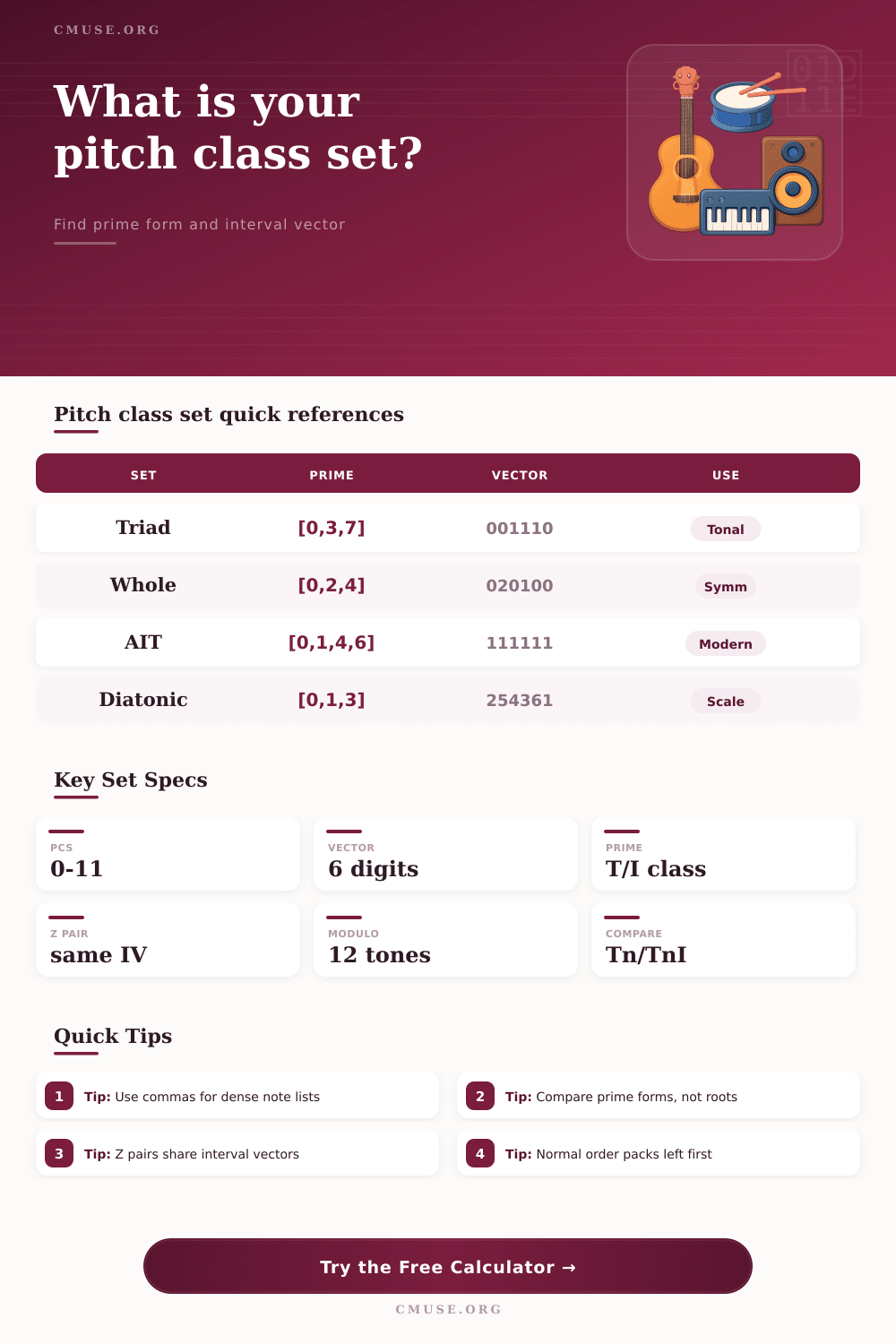
| 3-1 | [0,1,2] | <2,1,0,0,0,0> | Chromatic trichord |
| 3-6 | [0,2,4] | <0,2,0,1,0,0> | Whole-tone trichord |
| 3-11 | [0,3,7] | <0,0,1,1,1,0> | Major or minor triad class |
| 4-Z15 | [0,1,4,6] | <1,1,1,1,1,1> | All-interval tetrachord |
| 4-Z29 | [0,1,3,7] | <1,1,1,1,1,1> | Z-related all-interval set |
| 6-35 | [0,2,4,6,8,10] | <0,6,0,6,0,3> | Whole-tone hexachord |
🔢 Interval Vector Reading Table
| Vector Slot | Semitones | Common Sound | What A High Count Suggests |
|---|---|---|---|
| ic1 | 1 or 11 | Semitone | Chromatic pressure and close dissonance |
| ic2 | 2 or 10 | Whole tone | Scalar motion and whole-tone color |
| ic3 | 3 or 9 | Minor third | Diminished, pentatonic, or blues flavor |
| ic4 | 4 or 8 | Major third | Augmented and triadic brightness |
| ic5 | 5 or 7 | Perfect fourth/fifth | Quartal, tonal, or open sonority |
| ic6 | 6 | Tritone | Symmetry, dominant pull, or octatonic bite |
🔍 Preset Comparison Grid
| Collection | Example Input | Expected Prime Form | Analytical Use |
|---|---|---|---|
| Major triad | C E G | [0,3,7] | Tonal consonance baseline |
| Dominant seventh | C E G Bb | [0,2,5,8] | Compare tertian four-note sets |
| Chromatic tetrachord | 0 1 2 3 | [0,1,2,3] | Dense linear compression |
| All-interval tetrachord | 0 1 4 6 | [0,1,4,6] | Every interval class once |
| Whole-tone hexachord | 0 2 4 6 8 10 | [0,2,4,6,8,10] | Symmetric six-note field |
| Octatonic set | 0 1 3 4 6 7 9 10 | [0,1,3,4,6,7,9,10] | Diminished-scale reference |
⚙ Transformation and Specification Grid
| Operation | Formula | What Stays Fixed | Use Case |
|---|---|---|---|
| Transposition Tn | x + n mod 12 | Prime form and interval vector | Move a set to a new pitch center |
| Inversion TnI | n - x mod 12 | Prime form and interval vector | Find mirror-related collections |
| Complement | 12-tone aggregate minus set | Total chromatic coverage | Plan missing pitch-class material |
| Z relation | same vector, different prime | Interval-class content | Compare non-equivalent interval twins |
Pitch class sets is used to describe music that does not use a key. When using pitch class set notation, one doesnt think of chord in terms of a root note and qualities of the chord. Each note within a chord (or any musical passage) are represented as one of twelve different pitch classes, and those pitch classes are stripped of any ordering among themselves and stripped of their placement within octaves.
Such a set of notes is the object of study with pitch class set. This notation system is helpful in allowing individuals to compare different chord and fragments thereof, regardless of their tonal qualities. Such a comparison is made possible due to the elimination of the traditional characteristic of tonal music.
Pitch Class Sets and the Calculator
The calculator can perform mathematical operation upon the pitch class set that is entered. Before using the calculator, the user can enter the note name, or the integers of those notes can be entered. Furthermore, the pitch class set can be transposed prior to analyzing the set, or an inversion of the set can be test.
Transposing the pitch class set can help to reveal how that musical fragment can appear at a different pitch within its composition. Testing the inversion can help to reveal if that fragment have reflective properties regarding its composition within pitch class theory. The first value that is calculate is the normal order of the pitch class set.
The normal order of a pitch class set is the rotation of the set that minimize the span of the set, with any remaining open octave being added to the beginning of the pitch class set. This type of calculation is performed due to the relation of such a rotation to the way in which listeners hear those musical fragment. Following the calculation of the normal order, the prime form of the set can be calculated.
In order to calculate the prime form, both the pitch class set and its inversion must be test. The version of the pitch class set that begin with zero and displays the lexicographically smallest sequence is the prime form. This value is important as another means of describing the same pitch class set, as the prime form is invariant to transposition and inversion of the set.
The interval vector provide information regarding each of the interval classes within the set. Each of the six position within the interval vector describe the number of times that each of the interval classes exist within the pitch class set. Furthermore, each of these counts is independent of the specific direction of the intervals or the octaves upon which those notes are played.
The interval vector is a means of providing a “fingerprint” of each of the pitch class sets. Each of the different pitch class sets may have the same interval vector yet still be unrelated through transposition or inversion. Such a relationship is referred to as a Z-relation between the two pitch class sets.
The calculator can identify if two pitch class sets are related as Z-relations, as they are a means of describing relationship between musical fragments. The complement of a pitch class set is calculated as the remaining pitch class within the chromatic scale that are not represented by that pitch class set. This calculation is used to produce contrast between the original set and its complement.
Hexachordal music depends upon the use of the complement to the pitch class set, as such music depends upon the use of pitch class set that contain six notes. Thus, if the original pitch class set contains six notes, its complement will be represented by the remaining six note within the chromatic scale. The use of the complement can help composers to easily move between the original set and its complement.
The reference table are included on the page as means of allowing composers and analysts to relate each of the pitch class sets to information that already exists in the literature. Each of the pitch class sets has a Forte number, as well as a common name for that class. By knowing the Forte number of a pitch class set, individuals can access information regarding that pitch class set within existing music theory literature.
Furthermore, the reference tables indicate if the pitch class set has any other well-known relatives. For example, the dominant-seventh chord is used in both tonal and atonal music. The calculator is neutral in its calculations; whether the input was a jazz chord or an atonal pitch-class string, the calculator will compute the same result.
Thus, the calculator does not make any pre-existing judgments regarding the type of music that is being analyzed. Each of the fields within the calculator can be ignored, as their choice will not change the calculations performed. The comparison field allows for the testing of whether two pitch class sets are of the same class, which is required prior to the performance of any in-depth analysis of those sets.
Thus, each of these field may seem small and insignificant individually, yet each choice will have a major impact upon the outcome of the analysis of the pitch class set. The calculator is a means of encouraging individuals to think of musical fragment as collections of notes rather than as chords. Furthermore, by analyzing each of the interval classes within a pitch class set, individuals will be able to recognize the symmetry of that set.
Such a habit can be used when orchestrating musical instrument and arranging music for performance, as well as when writing a musical row. Furthermore, the numbers that the calculator calculate are a means of providing a shortcut to understanding the set described by those number.