Chord Name Calculator
Enter a pile of notes, include an optional slash bass, and identify likely chord names with interval recognition, enharmonic spelling, inversion labels, and ranked alternatives.
🎹 Named Chord Presets
🎼 Chord Name Inputs
Interval Breakdown
| Rank | Candidate | Intervals | Score |
|---|
📊 Recognition Spec Grid
📘 Common Chord Formula Table
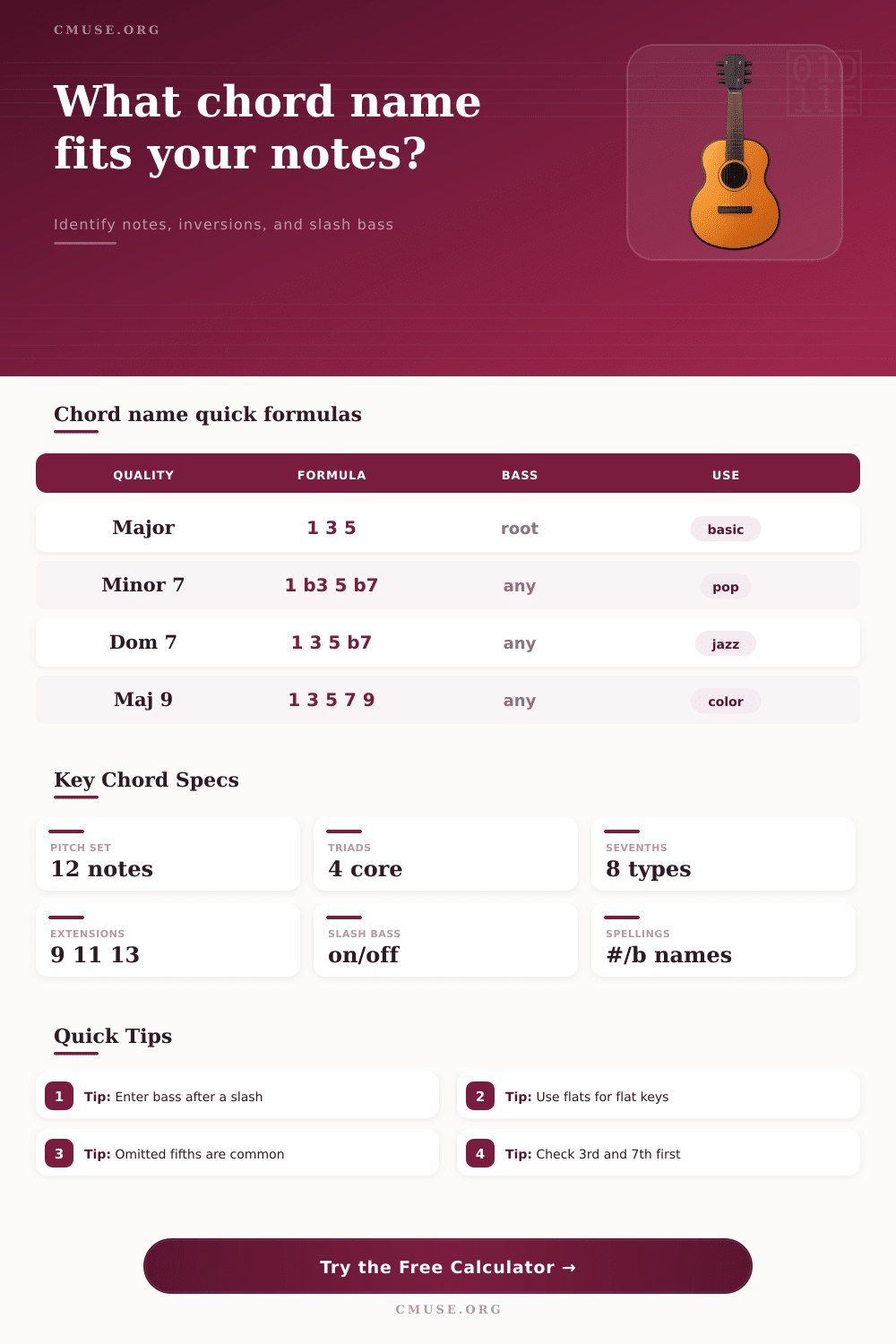
| Chord Type | Pitch-Class Intervals | Lead-Sheet Symbol | Recognition Note |
|---|---|---|---|
| Major triad | 0, 4, 7 | C | Needs root, major 3rd, perfect 5th. |
| Minor triad | 0, 3, 7 | Cm | Minor 3rd decides the quality. |
| Dominant seventh | 0, 4, 7, 10 | C7 | Major 3rd plus minor 7th. |
| Major seventh | 0, 4, 7, 11 | Cmaj7 | Major 7th gives the color. |
| Half-diminished | 0, 3, 6, 10 | Cm7b5 | Diminished 5th plus minor 7th. |
| Altered dominant | 0, 4, 10 plus b9/#9/b13 | C7alt | Perfect 5th is often omitted. |
🔄 Inversion and Slash-Bass Table
| Bass Interval | Example | Inversion Name | How Calculator Labels It |
|---|---|---|---|
| Root, 0 semitones | C E G / C | Root position | C or C/C if forced by input. |
| 3rd, 3 or 4 semitones | C/E or Cm/Eb | First inversion | Chord name plus slash bass. |
| 5th, 6 or 7 or 8 semitones | C/G or Cdim/Gb | Second inversion | Second inversion or altered fifth bass. |
| 7th, 9, 10, or 11 semitones | C7/Bb | Third inversion | Third inversion with seventh in bass. |
| Non-chord bass | C/D | Pedal or slash chord | Slash bass, outside chord tones. |
🎵 Enharmonic Spelling Table
| Pitch Class | Sharp Name | Flat Name | Context Choice |
|---|---|---|---|
| 1 | C# | Db | Sharp keys prefer C#, flat keys prefer Db. |
| 3 | D# | Eb | Minor keys and flat keys often use Eb. |
| 6 | F# | Gb | F# is common in G/D/A/E; Gb in Db/Gb. |
| 8 | G# | Ab | Ab is common in F/Bb/Eb/Ab contexts. |
| 10 | A# | Bb | Bb is the usual minor seventh spelling. |
🔎 Chord Name Comparison Table
| Same Notes | Likely Name | Alternate Reading | Best Context |
|---|---|---|---|
| C E G A | C6 | Am7/C | Name C6 in major tonic context. |
| C E G Bb D | C9 | Gm6/C without A | Name C9 when C functions dominant. |
| D F Ab C | Dm7b5 | Fdim add6 over D | Name half-diminished in ii-V progressions. |
| F A C G | Fadd9 | C6sus/F | Name add9 when the 7th is missing. |
| G B F Ab A# Eb | G7alt | Altered pitch collection | Name altered dominant before Cm or C. |
A chord name calculators is a tool that helps to provide name for groups of notes. A chord name calculator will help to identify the names of the notes that you are playing. When you play a group of notes on a piano or guitar, those notes doesnt have names associated with them.
However, a chord name calculator will help to find the names of those notes. Note name are important to musicians because they allow musicians to communicate with each other, to read musical charts, and to understand how that music will sound in the future. A chord name calculator will work by comparing the pitch of the notes that you provide to the calculator to a series of standard musical formula.
How a Chord Name Calculator Works
The calculator will then rank those musical formula according to the similarity of the pitches to the formulas. If you provide a bass note to the calculator, it will use that bass note to determine the inversion of the chord. An inversion is a chord that has a more different note than the original chord placed at the bottom of the chord.
A chord name calculator can calculate these inversion and display them for the musicians. For instance, a chord name calculator will recognize a chord with the following note names as an F/A chord. The chord name calculator takes into consideration other factor besides the pitches of the notes.
One of the factor that the calculator considers is the context of the chord. For instance, if you enter the chord name calculator into the context of a particular key, the chord name calculator will understand that certain spelling of a chord are more natural to certain keys than others. For instance, a saxophone player may require different spelling of a chord different than a guitarist.
Furthermore, the chord name calculator can also account for the fact that certain musicians may not use all of the notes within a chord. For instance, in jazz music, many musicians may omit the fifth note from a chord. A chord name calculator that allows musicians to allow for omitted fifth note will not reject a chord that contains an omitted fifth note.
Thus, a chord name calculator with this feature will be able to recognize a dominant ninth chord with an omitted fifth and a minor eleventh chord with an omitted fifth note. It is also possible that a group of pitches can be described by more than one name. In these case, the chord name calculator will display each of the names for that chord, ranked from the most likely name to the least likely.
For instance, a set of pitches may contain both the name of a C6 chord and an Am7/C chord. Because there can be more than one correct name for a chord, a musician must use factors like the bass note for the chord, the key of the music, the style of music that is being played, and the melody of the chord to select which name to use for that chord. The chord name calculator can help to display each of the possible name so that the musician can choose the best name for the musical chart that they are creating.
Finally, using a chord name calculator help to save musicians time when reading or writing music. Instead of spending time or effort to counting intervals between the different note in a chord, the musician can simply enter the notes into the chord name calculator to determine the name of the chord. Furthermore, by looking at the other suggestion of the chord name calculator of what that chord could be named, a musician can decide if they would like to use a simple name for the chord or a more complex name.
Thus, by using a chord name calculator, musicians save time and effort, and can focus upon other aspect of their music creation. Youll find it is much more comfortabley than doing it by hand. It actually helps alot when your trying to compose moddern jazz.