SATB Chord Calculator
Enter soprano, alto, tenor, and bass pitches to score chord-tone coverage, real choir ranges, upper-voice spacing, inversion fit, and doubling choices.
🎶 SATB Chord Presets
🎼 Chord and Voice Inputs
📊 SATB Comparison and Spec Grid
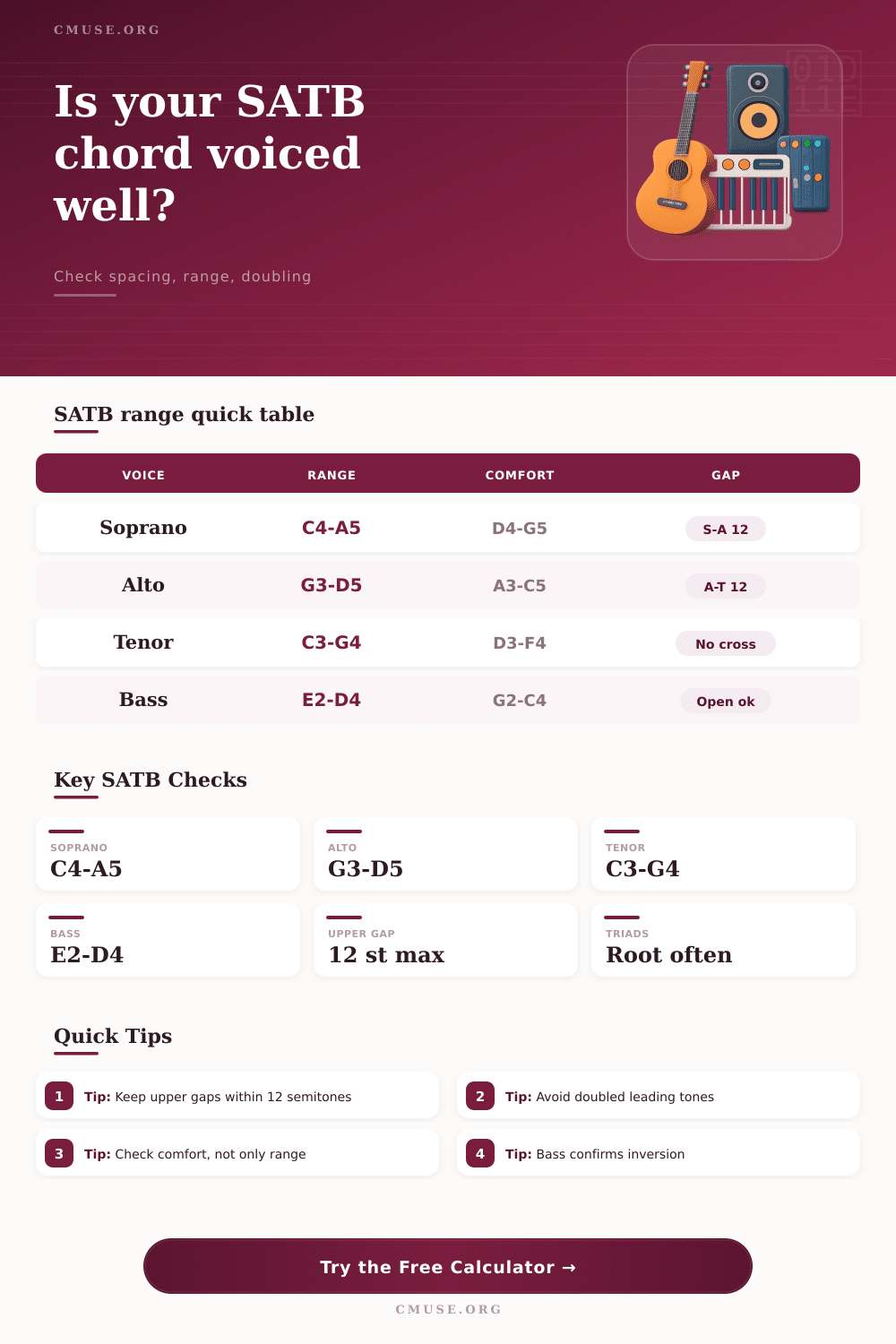
🎤 Real SATB Voice Ranges
| Voice | Standard Range | Comfort Range | Range Penalty |
|---|---|---|---|
| Soprano | C4 to A5 | D4 to G5 | Outside comfort adds points; outside range is severe. |
| Alto | G3 to D5 | A3 to C5 | Low alto and high alto notes are allowed but less stable. |
| Tenor | C3 to G4 | D3 to F4 | Tenor above alto counts as crossing, not just range risk. |
| Bass | E2 to D4 | G2 to C4 | Bass may sit wider below tenor, but extreme gaps add penalty. |
📏 Spacing Penalty Table
| Check | Ideal or Limit | Penalty Formula | Musical Meaning |
|---|---|---|---|
| Soprano to alto | 12 semitones max | Extra semitones multiply by strictness. | Prevents a detached soprano line. |
| Alto to tenor | 12 semitones max | Extra semitones multiply by strictness. | Keeps the inner voices blended. |
| Tenor to bass | Open spacing allowed | Only very wide gaps are penalized. | Bass can support the sonority from below. |
| Voice crossing | S above A above T above B | Each crossing adds a heavy penalty. | Crossing obscures part identity. |
🔀 Doubling and Chord-Tone Rules
| Chord Type | Preferred Coverage | Common Doubling | Penalty Trigger |
|---|---|---|---|
| Root-position triad | Root, third, fifth | Root doubled | Missing third or doubled leading tone. |
| First-inversion triad | Root, third, fifth | Bass or soprano note | Awkward third doubling in strict style. |
| Diminished triad | All three tones | Usually third doubled | Doubling the diminished root. |
| Seventh chord | Root, third, seventh | Complete preferred | Missing third or seventh, doubled seventh. |
📝 Preset Voicing Reference
| Preset | Chord | S-A-T-B | Teaching Focus |
|---|---|---|---|
| C I Root Chorale | C major | G4 E4 C4 C3 | Balanced root doubling. |
| G7 Cadence | G dominant 7 | F4 B3 D3 G2 | Complete seventh chord. |
| Bdim6 Leading | B diminished | F4 B3 D3 D3 | Third doubled, not leading tone. |
| D Minor Seventh | D minor 7 | C5 A4 F4 D3 | Open seventh-chord color. |
Writing four-part harmony involve many musical choice. Each musical choice have an impact on the total texture of the musical arrangement. The soprano voice will carry the melody of the music.
However, the alto and tenor singer should support the melody while avoiding any clash with the melody. The bass voice should support the chord and avoid dragging the music with too-large jump from other voices in the chord. The SATB chord calculator allow musicians to perform the mathematical calculation nesessary to determine if any voice is within a comfortable range for singing.
How the SATB Chord Calculator Helps
The SATB chord calculator will save musicians from guesswork when assigning part to singing voices by determining if any voices are stretched too far from others in the chord. The checks that are incorporated into the SATB chord calculator is important to ensure that singers can perform at the highest level. For instance, a soprano singer may be able to reach a particular high note in a chord.
However, if the soprano singer remain on that high note for extended musical phrases, the soprano singer may strain there voice. The ranges that the SATB chord calculator defines for each vocal part are narrower than the limits of that vocal part’s range capability. The SATB chord calculator will detect this and notify the composer that singers will perform at a better level if they dont stretch their vocal ability to such extremes.
This same rule apply to the alto and tenor singers’ ranges within a chord. The spacing of each voice in a chord is also important to consider. If the soprano and alto singers’ part are more than an octave apart, a listener will hear these two voices as separate entities in the chord.
The same problem can occur if the alto and tenor singers’ part are too far apart from each other. The SATB chord calculator assign penalties for this spacing because these distance will create problems for the blend of the voices. However, the tenor and bass singer can have more spacing between their voices because the bass singers naturally have lower voices than the other singer in the chord.
Another complex choice for writer of four-part harmony is the decision of which voice to double. Some chord type will require the root note of the chord to be doubled. For diminished and dominant seventh chord, however, different rule apply to the doubling of notes in these chords.
If the leading tone is doubled in a dominant seventh chord, the result will be parallel octave that fight the resolution of the chord. If the third note is not include in a seventh chord, the chord will sound hollow. The SATB chord calculator help writers of harmony to determine how many time each note in a chord is featured.
Based off the chord type that the composer select for the SATB chord calculator, the software will compare the frequency of each note to the requirements of that specific chord. The SATB chord calculator will not provide a finished arrangement for the composer to use. However, the SATB chord calculator will give writer an idea of which choice to make in the area of voice doubling to improve their chord arrangement before they assign any part to the singers.
The use of inversions in a chord add one more layer of complexity to four-part harmony. For instance, if the third note of a chord is in the bass, that is a first-inversion chord. A first-inversion chord have different rules for which note to double compared to the rules for root-position chords.
The SATB chord calculator compare the note in the bass to the inversion that the composer choose for that chord. Any discrepancy in notes between the bass and the selected inversion will result in a penalty in the SATB chord calculator result. This is done to ensure that the chord will have the behavior that it is suppose to when based on its specific inversion.
This is crucial for chord that are to close at the end of phrases, for instance. Finally, no software in the world can account for all the difference between choirs. Choirs have different vocal range.
For instance, every high school choir in the nation may not have the same vocal range as the professional in their choirs. Therefore, the SATB chord calculator allow choirmasters to adjust the strictness of the rule for the SATB chord calculator. The strictness setting for the SATB chord calculator can allow choirmasters to select between using the rule set for the classrooms versus the rules for choirs of all skill level.
The numbers assigned to each voice in the SATB chord calculator will change based on the strictness choice of the choirmaster. The result of the SATB chord calculator can be used to make improvement to the musical arrangement. If the score that the SATB chord calculator output is less than the composer had hoped, it is possible to determine which category have the most impact on the score.
For instance, the soprano singer may be required to stay in a range that is outside of their comfort range, or the alto and tenor singer may be too far apart from each other. By fixing one of these category, the overall score for the chord can be improved without having to rewrite the music for that chord entirely. As writer of four-part harmony gain experience in writing music for choirs, their mind will eventually recognize which chord require open spacing for the singers.
They will also recognize that certain seventh chord will require all of the chord note to be sung versus other seventh chord. The SATB chord calculator will help writer to learn these chord and rules because it make the unwritten rule visible to writers. The SATB chord calculator does not intend to replace singers’ ear, but it can aid writer in understanding how the voices should sound when the music is sung.