Secondary Leading Tone Chord Calculator
Build vii°, viiø7, and vii°7 chords to a temporary target, then inspect spelling, inversion, and tendency-tone resolution.
🎶 Applied Leading-Tone Presets
🎼 Secondary Leading-Tone Inputs
📊 Applied vii Spec Grid
🎹 Quality Comparison Grid
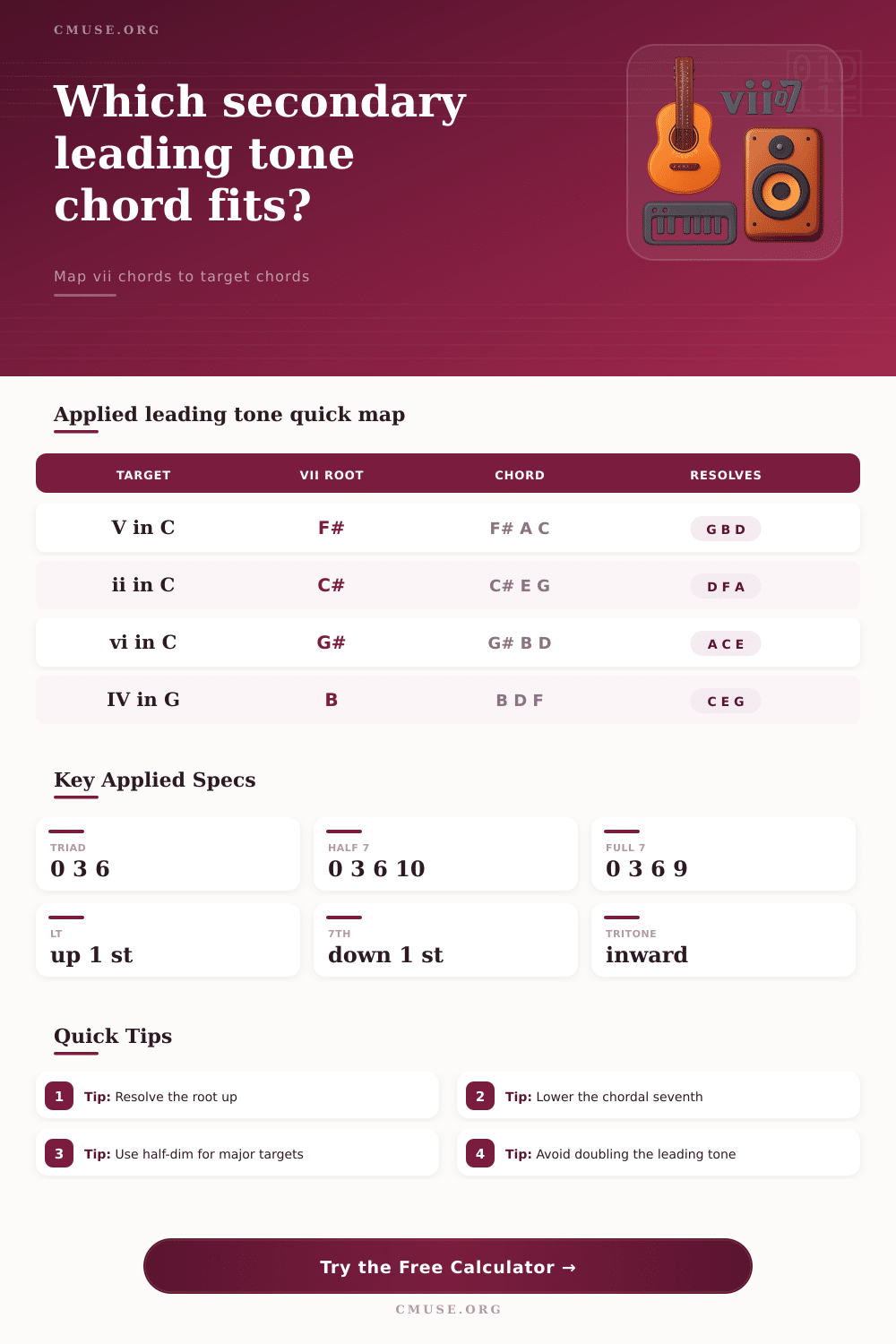
| Target in C Major | Target Chord | Applied Root | Common Applied Chord |
|---|---|---|---|
| I | C E G | B | vii°/I, normally heard as the home-key leading-tone chord |
| ii | D F A | C# | vii°/ii or vii°7/ii for strong pull to D minor |
| iii | E G B | D# | vii°/iii, often a chromatic approach to mediant harmony |
| IV | F A C | E | vii°/IV, diatonic in C but applied by function to F |
| V | G B D | F# | vii°/V, viiø7/V, or vii°7/V depending style |
| vi | A C E | G# | vii°/vi, a common chromatic push to A minor |
| Applied Quality | Interval Formula | Typical Target | Resolution Behavior |
|---|---|---|---|
| vii° | 0, 3, 6 semitones | Major or minor triad target | Root rises; diminished fifth usually resolves inward. |
| viiø7 | 0, 3, 6, 10 semitones | Major temporary tonic | Chordal seventh resolves down by step when possible. |
| vii°7 | 0, 3, 6, 9 semitones | Minor temporary tonic | Symmetric diminished seventh gives stronger chromatic pull. |
| Auto mode | Quality chosen from target quality | Major, minor, diminished, or augmented target | Major targets favor viiø7; minor targets favor vii°7. |
| Tendency Tone | Default Motion | Example vii°7/V in C | Target Result |
|---|---|---|---|
| Applied leading tone | Up one semitone | F# rises | G, the root of V |
| Chordal third | To target root or third | A moves to G or B | Completes the target triad |
| Diminished fifth | Usually down by semitone | C falls | B, the third of V |
| Chordal seventh | Down by step | Eb falls | D, the fifth of V |
| Preset | Applied Chord | Target | Specific Use |
|---|---|---|---|
| C: vii/V | F# A C | G B D | Dominant preparation in C major |
| C: vii°7/vi | G# B D F | A C E | Chromatic approach to vi |
| G: viiø7/IV | B D F A | C E G | Applied pull toward subdominant area |
| A minor: vii°7/V | D# F# A C | E G# B | Minor-key dominant intensification |
| Bb: vii°7/ii | B D F Ab | C Eb G | Chromatic predominant color |
A secondary leading tone chord are used to give a sense of direction to a piece of music. A secondary leading tone chord is used when a composer desire for one chord to move into another specific chord. Instead of using the leading tone of the key of the home chord to the tonic, a composer can use a borrowed leading tone to create movement to a different chord within that key.
The use of a secondary leading tone chord allows for the creation of a chromatic effect within the music. The use of a secondary leading tone chord is more effective when the voice leading of the chord is cleanly and appropriate for the style of music that is being created. The target chord within a chord progression is the most important consideration when using a secondary leading tone chord.
How secondary leading tone chords work
If the target chord is the dominant chord, the leading tone will be the note a semitone below the root of that dominant chord. If the target chord are the supertonic chord, the leading tone will be the note a semitone below the root of the supertonic chord. The chord calculator included on this page will calculate the math necessary for creating a secondary leading tone chord and will allow the composer to select the target chord, the home key, and the quality of the chord that is to be used.
The quality of the chord impact how it sounds and resolves. If a composer uses a fully diminished seventh chord, each interval within the chord will be either a minor or a diminished interval. In addition, a fully diminished seventh chord will contain a chordal seventh note that must resolve downward.
A half diminished seventh chord is less strong in its pull to the tonic than a fully diminished seventh chord. Furthermore, a half diminished seventh chord will contain one tone that is within the diatonic collection of the chord. A simple diminished triad can be used if the composer only desires the leading tone function of the chord without the complexity of a seventh chord.
Inversions of the chord impact in what way the chord is heard within the composition. The root position of the chord will make the leading tone very apparent in the bass line. Using the first or second inversion for the chord will make the bass line for the chord smoother.
Furthermore, the first and second inversion will allow the inner voices to contain the leading tone. Using the inversion calculator will allow a composer to test out different inversions of the chord to see which one sound best in the song. The spelling of the chord will change according to the key that is being used.
In flats keys, the chord will be spelled with flats. In sharps keys, the chord will be spelled with sharps. Choosing the spelling of the chord that matches the key will allow for the song to sound best and will reduce the need for double flats or double sharps to be used within the chord.
The resolution models determine the style of music that the chord progression will create. The chorale setting model requires that each tendency tone within the chord move by step and that the leading tone is not double. The classical practice model allow for some flexibility in the resolution of the seventh note of the chord if the target chord is complete.
The jazz model will allow for the chordal seventh note to be resolved like a suspension. These models can be tested to determine in what way the style of the music will change. There are some common mistake made in the use of a secondary leading tone chord.
Using the chord as if it is any diminished chord. A secondary leading tone chord can only be used if it is constructed on the pitch a semitone below the temporary root of the chord. Another common mistake is the doubling of the leading tone in four-part voicings.
The leading tone is strong in its pull to the tonic. Doubling it will cause problem in the voice leading, possibly creating parallel octaves. Tables on this page display the most common mappings for a leading tone chord.
These tables allow a composer or music student to check the work of another composer to ensure that they have correctly determined the chord that will provide leading tone function to the chord progression. These tables demonstrate that a single chord can have more than one quality of chord. Finally, the composer or music student should use their ear and musical intuition to make the final decision on the creation of the chord.
By playing the chord as calculated by the calculator, the composer can play the same chord progression using a different inversion or quality for the chord. One quality of chord may work better for the musical idea that the composer is developing than the other. By using the calculator, the composer can focus on the musical aspects of the chord rather than the mathematics behind its construction.