Negative Harmony Calculator
Mirror notes, chords, or short voicings around a selected pitch axis and identify the resulting negative-harmony sonority.
🎹 Negative Harmony Presets
⚙ Mirror Inputs
📊 Mirror Spec Cards
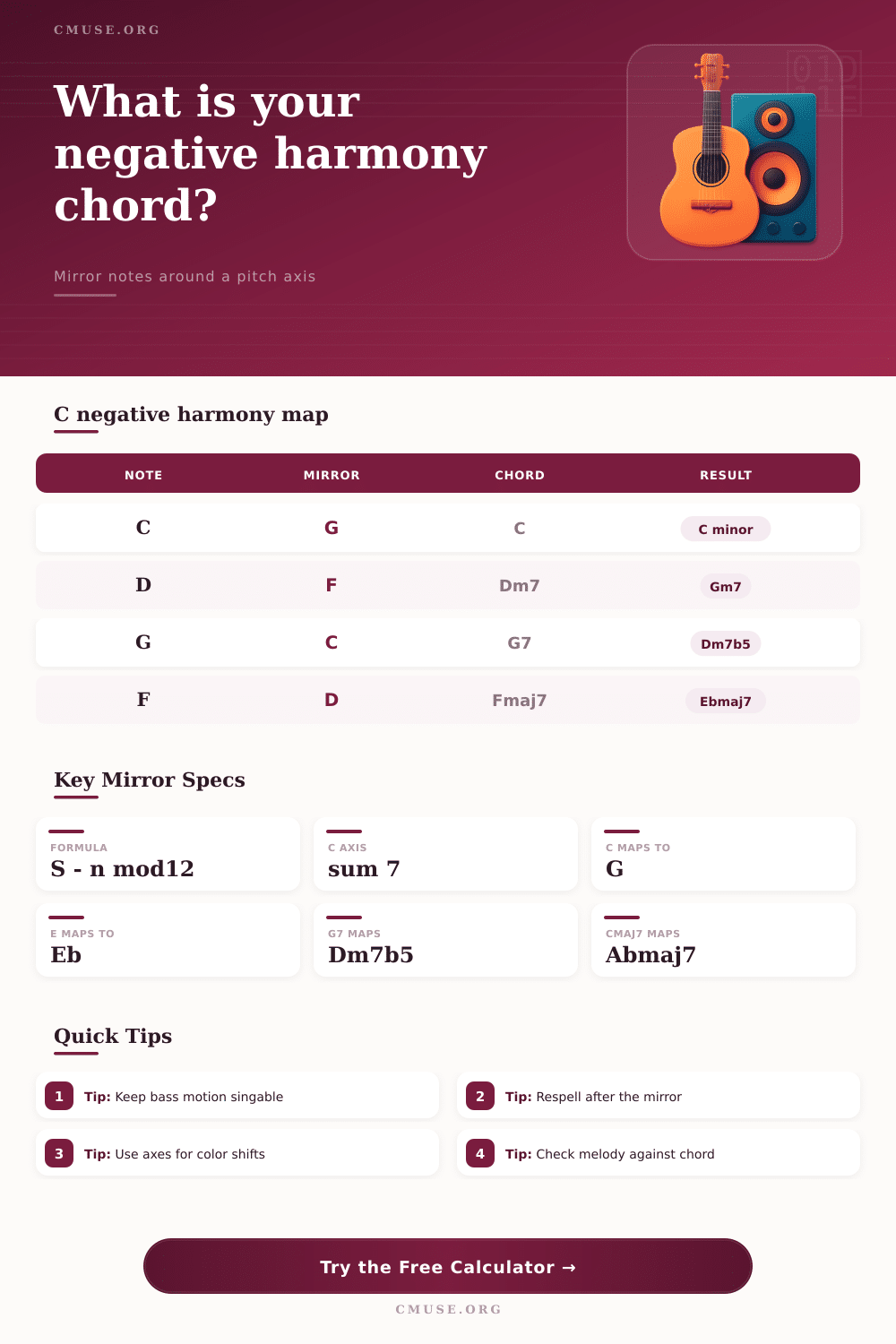
🗺 C Standard Negative Harmony Map
| Source Pitch | Pitch Class | Negative Pitch | Formula Check |
|---|---|---|---|
| C | 0 | G | (7 - 0) mod 12 = 7 |
| Db / C# | 1 | Gb / F# | (7 - 1) mod 12 = 6 |
| D | 2 | F | (7 - 2) mod 12 = 5 |
| Eb / D# | 3 | E | (7 - 3) mod 12 = 4 |
| E | 4 | Eb / D# | (7 - 4) mod 12 = 3 |
| F | 5 | D | (7 - 5) mod 12 = 2 |
| Gb / F# | 6 | Db / C# | (7 - 6) mod 12 = 1 |
| G | 7 | C | (7 - 7) mod 12 = 0 |
| Ab / G# | 8 | B | (7 - 8) mod 12 = 11 |
| A | 9 | Bb / A# | (7 - 9) mod 12 = 10 |
| Bb / A# | 10 | A | (7 - 10) mod 12 = 9 |
| B | 11 | Ab / G# | (7 - 11) mod 12 = 8 |
🎼 Chord Mapping Reference
| Source in C | Source Notes | Negative Notes | Common Result |
|---|---|---|---|
| C | C E G | G Eb C | C minor |
| Cm | C Eb G | G E C | C major |
| Cmaj7 | C E G B | G Eb C Ab | Abmaj7 |
| C7 | C E G Bb | G Eb C A | C minor 6 |
| Dm7 | D F A C | F D Bb G | Gm7 |
| G7 | G B D F | C Ab F D | Dm7b5 |
| Fmaj7 | F A C E | D Bb G Eb | Ebmaj7 |
| Am7 | A C E G | Bb G Eb C | Cm7 |
⚖ Axis Comparison Grid
| Axis Model | Axis Sum Formula | C Example | Typical Use |
|---|---|---|---|
| Tonic + Dominant | 2T + 7 | sum 7, C maps G | Common negative harmony |
| Tonic + Fourth | 2T + 5 | sum 5, C maps F | Plagal mirror color |
| Tonic + Minor Third | 2T + 3 | sum 3, C maps Eb | Dark chromatic color |
| Tonic + Tritone | 2T + 6 | sum 6, C maps Gb | Symmetric tension |
| Custom Sum | User chooses S | any 0 to 11 | Film, modal, or reharm tests |
🔎 Preset Spec Comparison
📘 Functional Degree Mapping in C
| Scale Degree | Major Pitch | Negative Pitch | Function Color |
|---|---|---|---|
| 1 | C | G | Tonic support becomes dominant root color |
| 2 | D | F | Supertonic tension becomes subdominant color |
| 3 | E | Eb | Major third turns into minor third |
| 4 | F | D | Subdominant color becomes supertonic color |
| 5 | G | C | Dominant root returns to tonic center |
| 6 | A | Bb | Major sixth becomes lowered seventh color |
| 7 | B | Ab | Leading tone becomes lowered sixth color |
Negative harmony is a method that allows you to flip a note or a chord across a fixed pitch axis. Every pitch created reflect to another pitch at the same distance from the axis on the other side. When you do this with a set of notes that forms a chord, you typicaly get a different chord but one that makes musical sense.
Musicians use negative harmony when they want a new sound but within the same key. The pitch axis determine how each note within a chord reflects to another note in the same chord. If you use an axis between the tonic and the dominant, a C will reflect to a G and an E will reflect to an Eb.
How Negative Harmony Lets You Change Chords
If you change the pitch axis, the reflected notes will change accordingly. For example, a plagal axis between the tonic and the fourth will reflect the notes closer than the fourth. A tritone axis will split the octave in half.
A calculator can do the mathematical calculations once you have choose your key and pitch axis. Major chords will often reflect to minor chords when reflected over a pitch axis. Dominant chords will often reflect to half-diminished chords.
A C major chord will reflect to a C minor chord when reflected over a pitch axis. A G7 dominant chord will often reflect to a Dm7 flat five chord when reflected over a pitch axis. These new chords has a certain logic to them that makes them predictable for musicians to understand.
Voice leading is more important than the pitch classes created by the reflection process. Once you have reflected your chord, you must decide on the octaves for each note. You must also decide how the inner voices move within the chord as this will affect the sound of the chord.
A close-position voicing on piano may have to be spread out. A melody may need to be reordered. The calculator can show you the pitch classes and the average amount of semitones that each note will shift but the musician must decide the voicing.
One of the most important applications of negative harmony is in the reharmonization of chords. Reharmonization allows musicians to change the chords within a progression while keep the same movement of the chords. For instance, a ii V I progression in the key of C will change to a Gm7 chord, a Dm7 flat five chord and an Ab major seven chord.
The roots of the chords will remain the same but the function of each chord will change. Songwriters use negative harmony when they want to change the mood of the song in the middle verses or when they want to introduce ambiguity into the final verse of the song. Negative harmony can be used with modal writing which use specific scales to create certain moods in a chord progression.
For instance, in the key of D Dorian, a musician may want to borrow a few notes from the relative minor scale of D Aeolian without leaving the D Dorian mode. In this example, the tonic and third can be reflected over the mediant axis to create a chord with a lowered sixth and a major seventh. These notes give it an Aeolian color but the chord stays within the D Dorian mode.
The musicians make the choice of the pitch axis in this situation but also a matter of theoretical application of negative harmony. The way you spell the notes can affect the way that other musicians will read the new chord that is create through negative harmony. In the case of keys that use flats like C, using flats for notes such as Eb, Ab and Bb will make it easier for other musicians to understand the function of the chord.
Using sharps will work if the key uses sharps but it may hide the function of the chord. Common mistakes using negative harmony are to treat the reflected notes as if they are the final voicing for the chord. The mirror will provide pitch classes but the musician must figure out the new spacing between the chords for an instrument to play.
It is more important to make the bass line singable after the reflection than to keep all of the original intervals between the chord notes. Additionally, the musician should also look at the chord against the melody line. Checking the notes against the chord will prevent awkward leaps in the music that the mathematical calculations cannot prevent.
The tables of the key of C will show you the reflection of each scale degree of the chords. There are also tables that allow musicians to compare the differences of the pitch axes to help them decide which might be best for a particular chord progression. Once you have mastered the process of negative harmony you can begin to sketch out the negative version of chords on paper.
Once you have written them out you can enter them into the calculator to test them out. Beyond the calculator and its mathematical calculations for reflected pitches, the remaining decision are of the musician. Run your chords through the calculator and then adjust the parameters until they sound right for your song.
The mathematics will always work out but the musicians have to make the final musical decisions. This balance between machine and musician is the true value of negative harmony.