Four Part Harmony Calculator
Build SATB chord voicings, inspect voice ranges, spacing, doubling, inversion, and classroom-style part-writing risk from real harmony rules.
🎶 SATB Harmony Presets
🎼 Harmony Inputs
📊 SATB Spec Comparison Grid
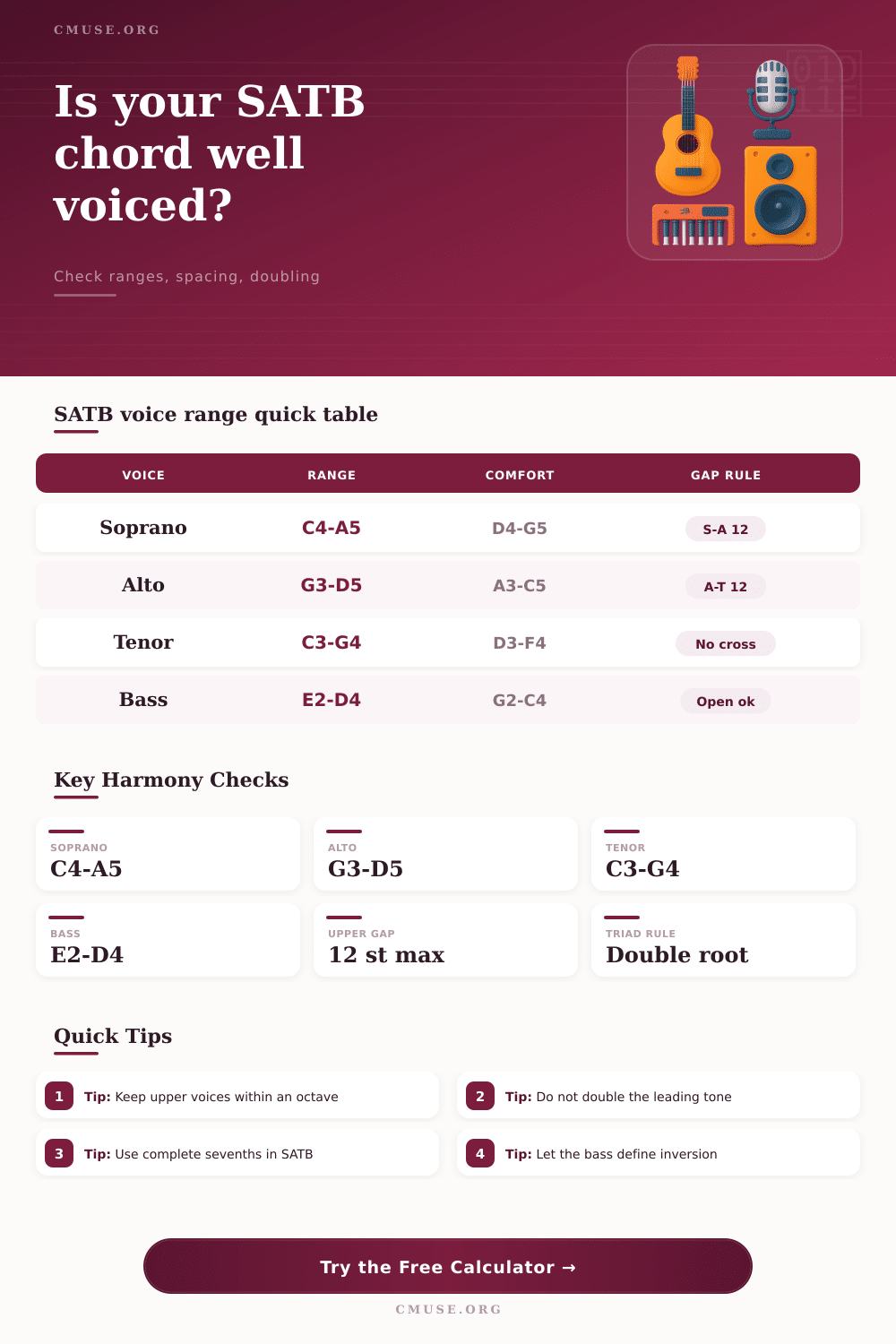
🎤 Voice Range Reference
| Voice | Standard Range | Comfort Range | Calculator Penalty |
|---|---|---|---|
| Soprano | C4 to A5 | D4 to G5 | Outside comfort adds 4 points; outside range is rejected. |
| Alto | G3 to D5 | A3 to C5 | Outside comfort adds 4 points; crossing soprano is heavily penalized. |
| Tenor | C3 to G4 | D3 to F4 | Outside comfort adds 4 points; crossing alto is heavily penalized. |
| Bass | E2 to D4 | G2 to C4 | The selected inversion fixes the bass chord member first. |
📏 Spacing and Part-Writing Rules
| Rule | Formula or Limit | Why It Matters | Score Effect |
|---|---|---|---|
| Soprano to alto | S-A <= 12 semitones | Upper voices should not sound detached. | Every extra semitone reduces the spacing score. |
| Alto to tenor | A-T <= 12 semitones | Maintains a blended inner-voice texture. | Every extra semitone reduces the spacing score. |
| Tenor to bass | Open spacing allowed | The bass may sit more than an octave below tenor. | Very wide gaps add only a small penalty. |
| Voice crossing | S >= A >= T >= B | Crossing hides the melodic identity of each part. | Crossing adds a major risk penalty. |
| Leading tone | Avoid doubling scale degree 7 | The leading tone normally resolves upward. | Doubling it raises the risk level. |
🔬 Chord Member and Doubling Data
| Chord Type | Required Members | Preferred Doubling | Special Check |
|---|---|---|---|
| Root-position triad | Root, third, fifth | Root | Missing fifth is less serious than missing third. |
| First-inversion triad | Root, third, fifth | Root or soprano | Third doubling is possible when melodic context supports it. |
| Second-inversion triad | Root, third, fifth | Bass fifth | Best used as passing, pedal, or cadential 6-4 context. |
| Seventh chord | Root, third, fifth, seventh | Complete chord | The seventh should be present and prepared where possible. |
| Diminished triad | Root, minor third, diminished fifth | Third | Avoid doubling the leading-tone root. |
⚖ Voicing Method Comparison
| Method | Upper Spacing Target | Best Use | Tradeoff |
|---|---|---|---|
| Chorale balanced | 5 to 9 semitones per upper gap | Classical SATB writing and homework checks. | May avoid bold keyboard-style spreads. |
| Close upper voices | 3 to 6 semitones per upper gap | Compact cadences, hymn texture, easy inner motion. | Can crowd alto and tenor around the same register. |
| Open upper voices | 7 to 12 semitones per upper gap | Broad choir color and strong soprano projection. | More likely to violate the octave spacing rule. |
| Mixed choir texture | Balanced with looser bass gap | Practical choir reductions with wider bass support. | Less strict than classroom chorale grading. |
| Keyboard reduction | Small upper gaps, compact hands | Piano sketching before vocal editing. | May not preserve singable independent lines. |
🎹 Common Harmony Presets Table
| Preset | Function | Expected Bass | Main Rule Watch |
|---|---|---|---|
| C Major I Root | Tonic stability | Root in bass | Root doubling is usually strongest. |
| C Major V7-I Pull | Dominant seventh | Seventh-chord inversion | Keep third and seventh present. |
| D Minor iv6 | Predominant color | Third in bass | Do not over-emphasize the doubled third. |
| G Major V64 | Cadential or passing 6-4 | Fifth in bass | Second inversion needs a clear context. |
| B Minor vii dim6 | Leading-tone sonority | Third in bass | Avoid doubled leading tone. |
Four-part harmony involve four vocal ranges: soprano, alto, tenor, and bass. When composing four-part harmony, a composer must make various decisions about the range of each voice. Such a decision can have a great impact on the listener, as choosing poorly for any voice can make the harmony sound strained.
Part of writing four-part harmony involve ensuring each singer can comfortabley sing their part, and it also involves ensuring the inner voices do not create any conflicts for the singers. To calculate four-part harmony, a composer must select the key for the composition, the Roman numeral for the chord, the inversion for the chord, and the desired spacing of each voice part. For instance, choosing a first inversion for a chord mean that the third of the chord will be in the bass.
How to Write Four-Part Harmony
For this reason, the composer will have to arrange the other voices differently in relation to the voice in the bass. Similarly, a second inversion will place the fifth in the bass. This arrangement typically only occurs in specific context within a composition, such as a passing moment between chords.
For each of these parameter, the calculator will test the voicing of the chord and score it according to the range of each voice part and the spacing between them. Each voice part has specific ranges that is required of each singer. For instance, sopranos will lose warmth and control over there notes if they are required to sing below middle C. Additionally, sopranos will sound thin if they are required to sing above the A above the staff.
Both altos and tenors has overlapping vocal ranges, so care must be taken when assigning both of these parts to ensure that they do not cross into one another. The bass part does not have any specific range requirement for the other parts; however, the upper three parts work best if they remain within an octave of one another. The high risk score from the calculator is an indicator of when the composer has pushed one of these range too far.
Another consideration for four-part harmony is the doubling of certain voices. For instance, in a simple triad chord, the composer can double the root of the chord for the bass and soprano parts. In a seventh chord, however, the third and seventh of the chord are the notes that define the chord and its direction of resolution.
In this case, if either of these notes are missing, the chord will lose its identity. The calculator will automatically calculate whether these notes are account for in the composition of the chord. Spacing between the voices follows the same logic as the doubling of voices.
For instance, if the soprano and alto parts are spaced more than an octave apart, it will sound disconnected. Similarly, if the alto and tenor voices are too far apart, it will create a “hole” in the middle of the chord. The calculator calculates the spacing in semitones and will penalize any spacing that goes beyond the normal limit of chords sung by choirs.
This value isnt a law of four-part harmony, but it does reflect how the singers will blend in relation to one another when they are sitting or standing in the same spot. Another factor to consider when writing four-part harmony is the context in which the chord is to be sung. For instance, a dominant seventh chord will have the third and seventh note sung so that it can resolve to another chord.
A predominant chord, such as a ii7 or a IV chord, will resolve to the dominant chord. For this reason, a composer will typically want to ensure smooth motion between the two chords, which occur when the singers maintain some of the same voice parts. The calculator allows a composer to tag the musical situation in which the chord is to be sung so that the calculator understands why the chord will resolve to the next chord in the composition.
The output from the calculator will not be the final answer for a composer, but rather the starting point for the composition of four-part harmony. For instance, the calculator will give a composer a good sense of the range and spacing of each part of the chord. However, no calculator can hear how the singers will even be able to balance the chord when they are singing it.
Thus, the real rehearsal of the composition is the final test that should of been performed before the composer releases the composition. The reference tables included in this assignment will help inform a composer of the various trade-offs in four-part harmony. The reference tables include charts of the range of each voice part and the spacing between them.
If the calculator returns a high risk or moderate risk score, the reference tables will help inform the composer of the reason for that risk level. Four-part harmony requires attention to detail because details can quickly become overwhelming for the composer. For instance, a small gap between voices will not be a problem for the composer, but many small gap will cause problems for the singers.
The calculator will track the number of small gaps in the harmony between the four parts. The goal of four-part harmony is not perfection on paper for the composer, but rather that the chord works well for the singers.