RASTI Calculator
Estimate rapid speech intelligibility from 500 Hz and 2 kHz modulation transfer data.
| Step | Formula | Use | Notes |
|---|---|---|---|
| Noise factor | 1 / (1 + 10^(-SNR/10)) | Reduces MTF for noise | Per band |
| Effective MTF | m x noise factor | Each modulation input | Clamped 0.01-0.99 |
| Apparent SNR | 10 log10(m / (1-m)) | Maps MTF to dB | Clamped -15 to +15 |
| Transmission index | (mean SNR + 15) / 30 | Band TI | Clamped 0-1 |
| Band | Modulation frequencies | Input count | Typical sensitivity |
|---|---|---|---|
| 500 Hz | 1, 2, 4, 8 Hz | 4 ratios | Low-mid clarity and room bloom |
| 2 kHz | 0.7, 1.4, 2.8, 5.6, 11.2 Hz | 5 ratios | Consonants and announcement detail |
| Equal balance | Average both bands | 2 band TIs | General room comparison |
| Speech balance | 40% 500 / 60% 2 kHz | 2 band TIs | PA and spoken-word checks |
| RASTI range | Rating | Speech outcome | Likely next check |
|---|---|---|---|
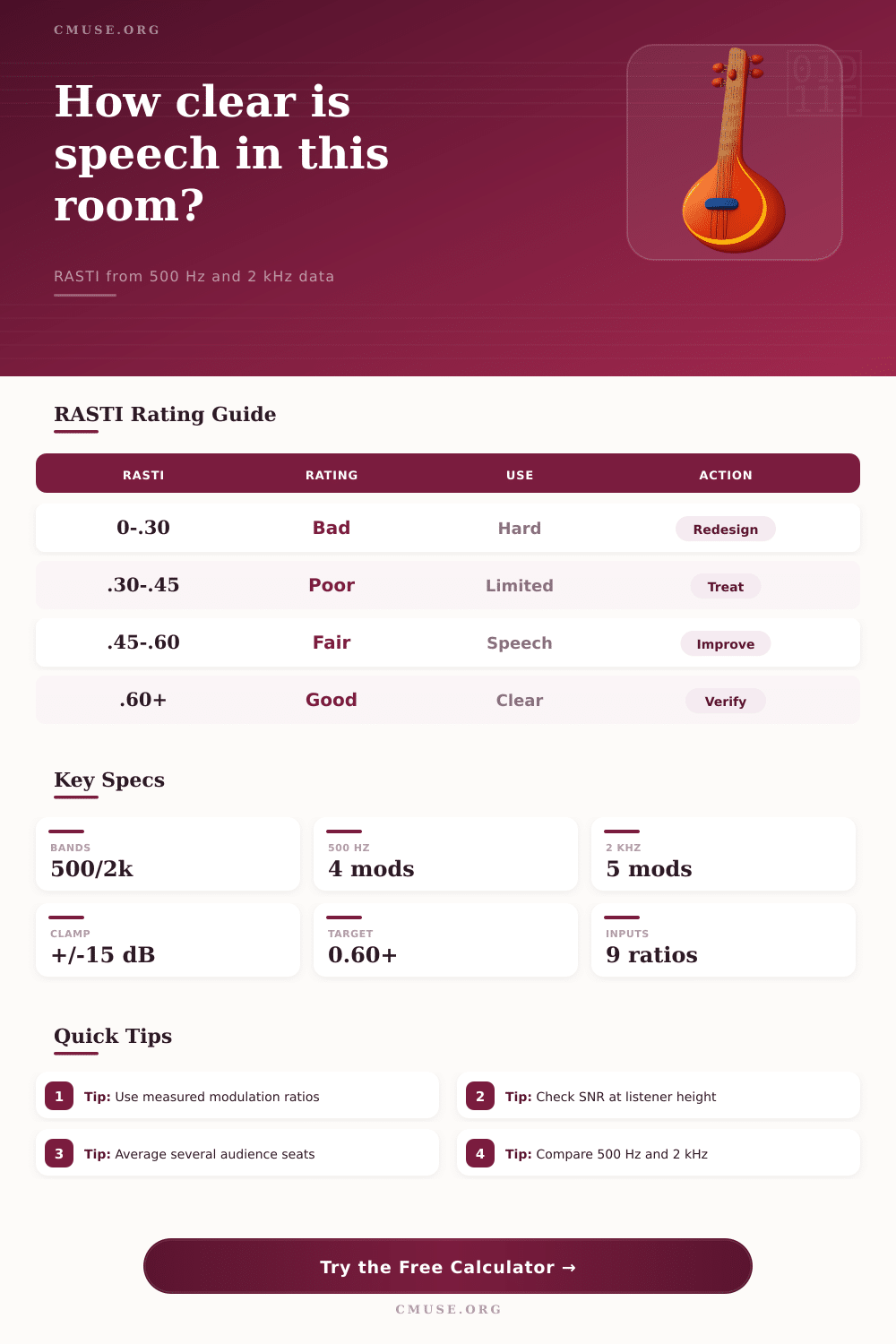
| 0.00 - 0.30 | Bad | Speech is often unusable | Reverberation, coverage, noise |
| 0.30 - 0.45 | Poor | Frequent repeat requests | Source level and treatment |
| 0.45 - 0.60 | Fair | Useful with attentive listeners | Improve weakest band |
| 0.60 - 0.75 | Good | Clear speech for most seats | Verify coverage consistency |
| 0.75 - 1.00 | Excellent | High intelligibility margin | Maintain level and noise control |
| Preset | Dimensions | Expected RASTI | Weak point |
|---|---|---|---|
| Classroom speech | 30 x 24 ft / 9.1 x 7.3 m | 0.65 - 0.75 | HVAC noise |
| Church nave | 100 x 45 ft / 30.5 x 13.7 m | 0.35 - 0.50 | Long decay |
| Control room talkback | 18 x 14 ft / 5.5 x 4.3 m | 0.80 - 0.90 | Speaker position |
| Sports hall PA | 140 x 85 ft / 42.7 x 25.9 m | 0.30 - 0.48 | Echo and noise |
When a person find themselfes standing at the back of a large room and are unable to understand every word that the speaker is speaking, there are often issue related to the clarity of the sound that is radiating from the loudspeaker. While the sound may reach the ears of the person who is sitting at the back of the room, the consonants and vowels that is spoken may not be as easily understood due to the lack of clarity of the sound that is emanating from the loudspeaker. Speech intelligibility measurement are performed to determine this lack of clarity.
One specific measurement of speech intelligibility is the RASTI method. The RASTI method measure the sound in two specific bands of octaves, 500 Hz and 2 kHz. The system utilizes these two bands because they contain the majority of the information that is contained within the spoken word.
How RASTI checks speech clarity
The RASTI method measures the survival of the natural amplitude change of the voice that the loudspeaker emits to the listener. The measurement produces a single score for the loudspeaker system that can be used to determine if the audience will be able to understand the majority of the words that the speaker speaks without the audience having to pay any extra attention to the speaker. The various inputs that is entered into the calculator will determine the RASTI score.
The length of the room and the width of the room will determine the size of the area in which the audience member are to hear the voice. The size of the listening area impact the amount of build up of the reverberant sound that the loudspeaker produces. The distance from the loudspeaker to the farthest seat will impact the amount of direct sound that reach the audience as well as the amount of reflected sound that is reaching the audience members.
The reverberation time of the room will impact the length of time that the sound of the voice is reflected within the room. Longer reflection times can cause the previous syllable of the speaker to begin to overlap with the next syllables that are spoken. Signal to noise ratio allow for the level of noise in the listening area to be entered into the measurement.
Background noise in the listening area is often loud speakers that are playing music, outside noise, HVAC system, or other type of background noise. A voice may be strong and powerful in reaching the audience, yet it can be unintelligible if the level of background noise is too high. Within the calculation of the RASTI score for a loudspeaker is also incorporated the modulation ratio of the voice.
The modulation ratios measure the amount of strength in the voice that is reflected back to the audience members. Speech contains amplitude change at a rate between one and twelve time per second. These amplitude changes are reflected in the voice.
If the sound energy within the loudspeaker system damps these amplitude changes, the audience will not be able to differentiate between words that the speaker spoke. The loudspeaker system calculates four modulation ratios at 500 Hz and five modulation ratios at 2 kHz. These specific modulation ratios are those that relate to speech.
These ratios are calculated using a test signal and sound wave that mimic the speech that is to enter the loudspeaker system. The four and five modulation ratios is entered into the calculation. Within the calculation, the system calculates the transmission index for each band of sound that is to exit the loudspeaker system, as well as the overall RASTI score.
The overall RASTI score range from 0 to 1. If the RASTI score is below 0.45, audience member will miss words that is spoke by the speaker. If the score is within the range of 0.45 to 0.60, the audience will have to pay extra attention to the speaker to follow along with the speech.
If the score is above 0.60, the audience will be able to understand the speaker if the speaker speaks at an adequate rate and utilize appropriate pronunciation. If the score is above 0.75, the system allow for various types of speakers and various level of background noise. Within the loudspeaker system and calculation of speech intelligibility, the system calculates the two scores for each band of sound instead of just the single score of the overall RASTI score.
The single RASTI score is a general score for the loudspeaker system. If the 2 kHz measurement is much lower than the 500 Hz measurement, the consonants in the speech are likely lacking in intelligibility. This occurs in rooms with long reverberation time.
The high frequencies within speech decay quickly, yet they are masked by the lingering energy of the low and mid frequency sound. The 500 Hz sound measurements reflecting lower sound energy than the 2 kHz measurement indicates that there is excessive warmth or bass within the room. The loudspeaker system allows for the presets of the type of room to be set to significantly speed up the calculation of the RASTI score.
Room presets may be established for classrooms, lecture hall, gymnasiums, sports halls, and more. Each preset will have different distance and background noise level. By changing the presets, the measurement can be performed without having to enter each measurement again.
After obtaining the initial RASTI score for the room, the loudspeaker system can be adjusted to allow for actual measurement of each variable within the room. Averaging the measurement from several different seats will produce the most accurate calculation for the room or loudspeaker system. The loudspeaker system can calculate the effect that certain change to the variables of the room will have on the RASTI score.
For example, increasing the signal-to-noise ratio by three decibels will increase each of the modulation ratios, thus increasing the RASTI score. Decreasing the reverberation time will likewise increase the RASTI score. These different condition can be tested within the loudspeaker system by inputting each condition and calculating the RASTI score that is created by that change.
The RASTI score is a value that is calculated at a specific time with the loudspeaker system in a specific state. If the microphone is moved closer to the loudspeaker, the RASTI score will increase. If the audience is added to the room, the RASTI score will increase due to the additional absorption of sound by the audience.
This value is best use as a means of comparing the loudspeaker system under two different set of conditions. By calculating the RASTI score with the loudspeaker system in its current state and then calculating the score with the loudspeaker system in a proposed state, it is possible to determine if the proposed state would of been worth the cost to implement such change. The loudspeaker system and the RASTI score can be used to make decisions regarding the loudspeaker system.
Each of the variables within the loudspeaker system have the potential to impact the intelligibility of the speech that is projected from the loudspeaker system. Thus, any decision regarding the loudspeaker system can be evaluated with regard to the potential impact that they will have upon the RASTI score.