Strength G Acoustic Calculator
Estimate acoustic strength G from room constant and distance, measured SPL versus sound power, or impulse energy against the 10 m free-field reference.
Room estimate inputs
Measured SPL inputs
Impulse energy inputs
| Strength range | Energy ratio vs 10 m reference | Typical impression | Common music/audio context |
|---|---|---|---|
| Below -6 dB | Less than 0.25× | Weak received energy, very dry or distant. | Close-treated booth with low playback level or far source. |
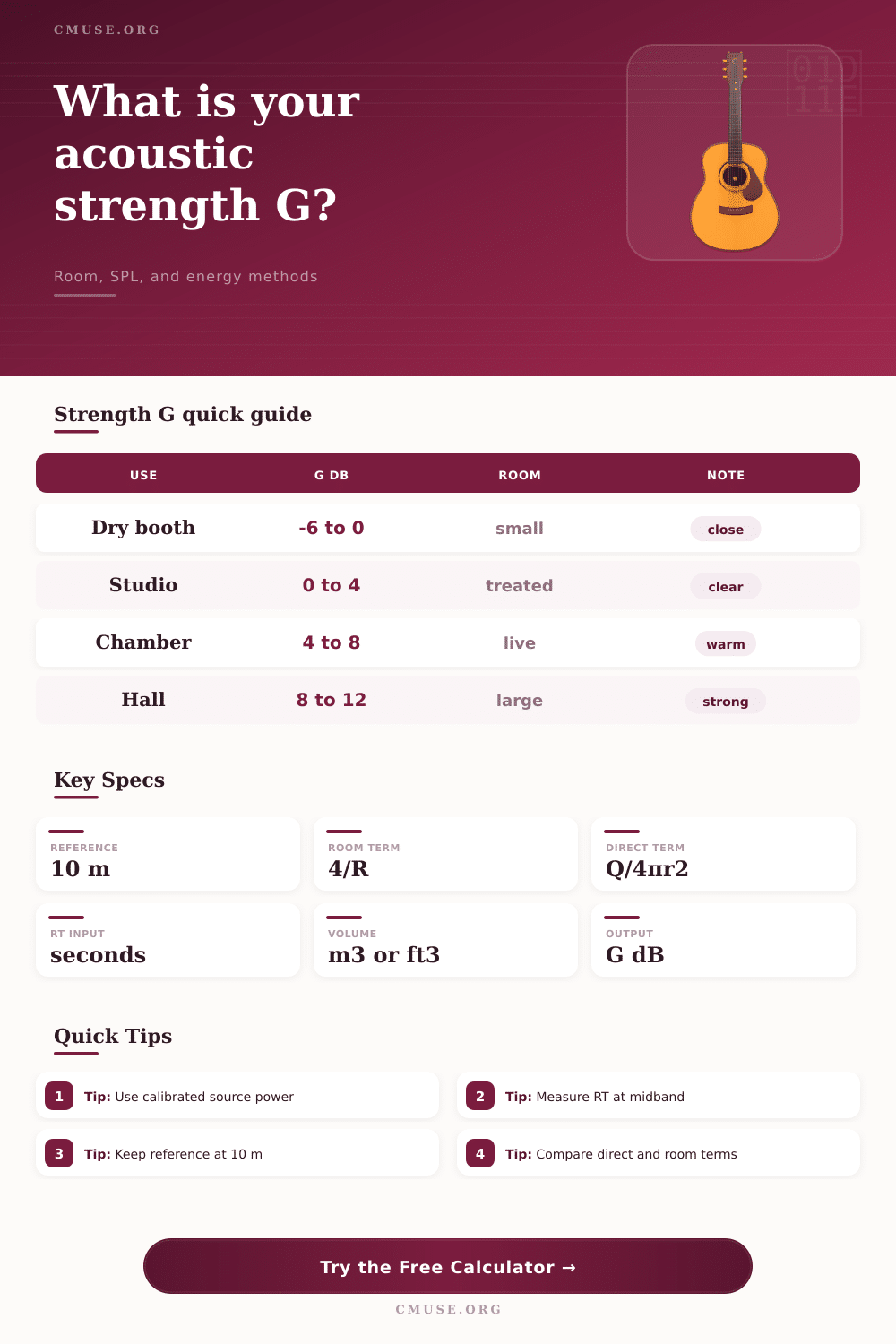
| -6 to 0 dB | 0.25× to 1.0× | Controlled, modest loudness support. | Small studio, podcast table, damped room measurement. |
| 0 to +4 dB | 1.0× to 2.5× | Clear source with useful room support. | Nearfield control room, rehearsal capture, small ensemble space. |
| +4 to +8 dB | 2.5× to 6.3× | Strong acoustic presence and room lift. | Live room, recital room, medium stage area. |
| Above +8 dB | More than 6.3× | Very strong sound field, often reverberant. | Hall, church, chamber, high-output directional source. |
| Method | Formula used | Best input source | Use when |
|---|---|---|---|
| Room estimate | G = 10log10(Qdref²/r² + 16πdref²/R) | Room volume, RT60, distance, Q | You are planning or comparing a room before measurement. |
| Measured SPL | G = Lp - Lw + 10log10(4πdref²) | Calibrated SPL and source sound power | You know the source power level and measured receiver level. |
| Impulse energy | G = 10log10(Emeasured/Eref) | Integrated impulse response energy | You have measured or exported band energy from an acoustic analysis. |
| Direct distance check | Gdirect = 10log10(Qdref²/r²) | Distance and directivity only | You want the free-field part separated from room support. |
| Room type | Approx volume | Typical RT60 | Strength G note |
|---|---|---|---|
| Vocal booth | 110 to 250 ft³ / 3 to 7 m³ | 0.12 to 0.25 s | High absorption lowers reverberant support, but close distance can keep G usable. |
| Home studio | 800 to 1,600 ft³ / 23 to 45 m³ | 0.25 to 0.50 s | Nearfield listening often has strong direct G and moderate room G. |
| Practice room | 500 to 2,000 ft³ / 14 to 57 m³ | 0.45 to 0.90 s | Higher RT increases the room term and can make loud sources feel stronger. |
| Live room | 2,000 to 8,000 ft³ / 57 to 227 m³ | 0.55 to 1.20 s | Strength depends heavily on source distance and how much absorption is installed. |
| Small hall | 10,000 to 35,000 ft³ / 283 to 991 m³ | 0.90 to 1.80 s | Larger volume reduces strength unless the source is close or directional. |
| Preset | Room or distance | Primary inputs | Expected use |
|---|---|---|---|
| Home Studio Nearfields | 12×10×8 ft, 5 ft receiver | RT60 0.45 s, Q 2 | Estimate monitor strength at a compact mix position. |
| Vocal Booth Mic | 6×5×7.5 ft, 1.5 ft mic | RT60 0.18 s, Q 1 | Check close vocal capture against a 10 m reference. |
| Practice Room Amp | 8×8×8 ft, 6 ft receiver | RT60 0.65 s, Q 4 | Compare amplified source strength in a square room. |
| Control Room Midfield | 18×14×9 ft, 8 ft receiver | RT60 0.30 s, Q 6 | Separate direct monitor strength from room support. |
| Small Recital Hall | 55×40×18 ft, 35 ft receiver | RT60 1.20 s, Q 8 | Estimate hall strength for a directional source. |
Acoustic strengths, also known as G, compares teh energy of a sound source within a room to the energy of the same source in an open space. The energy of a sound in a specific room can be determined using acoustic strength. The energy of a sound that reach the ears or an microphone compared to the energy of a sound source that is ten meters away in an open field is used to calculate acoustic strength.
The open field is also referred to as the free-field reference. In calculating acoustic strength, a variety of factor can be considered. The factors include the distance between the sound source and the listener, the directivity of the speakers, the reverberation time of the room, and the total absorption that occur in the room.
What is acoustic strength?
If the calculated value of acoustic strength is a positive number, it means that the room is adding energy to the sound. If the calculated value of acoustic strength is a negative number, it means that the room is removing energy from the sound. Overall, then, acoustic strength allows for the determination of whether the room will make the sound feel louderer or softer.
The two factor that contribute to the direct sound contribution to acoustic strength are the distance between the sound source and the listener and the directivity of the speakers. As the distance between the listener and the sound source increase, the contribution of the direct sound decreases. The directivity of the speakers refers to the way that the speakers focuses the sound.
Thus, the direct sound contribution will increase with an increase in the directivity of the speakers. One can make an increase in the directivity of the speakers, for instance, by changing to a loudspeaker that emits most of its sound in a narrow beam, or by placing the loudspeaker cabinet against one of the boundaries of the listening rooms. The other factor in acoustic strength is the room term.
The room term works in the opposite direction of the direct sound contribution. The room term is determined by the reverberation time of the room and the size of the room. Rooms with small sizes and short reverberation times will have low room terms, and rooms with large sizes and long reverberation times will have high room terms.
Small rooms with short reverberations will tend to cause the acoustic strength to decrease. Large rooms with long reverberations will tend to make even modest instruments sound strongly. The absorption of sound within the room will also impact the room term.
One can use the absorption coefficient of different area within the room to calculate the total absorption of sound in the room. Thus, adding acoustic panels to a room will impact the acoustic strength of that room. There are a variety of method for calculating the acoustic strength of a room.
One method is the use of a room-estimate method, which is used when planning a room with a specific size and reverberation time. Another method for calculating acoustic strength is by using the measured sound pressure level method, which can be used if there is a sound source and microphone at the listening position. Another method is using the impulse energy approach, which is used if there is a measurement file for the sound in the room.
These three methods will arrive at similar number for acoustic strength, which allows for the comparisons between rooms. With any calculation of acoustic strength, it is important to remember that the acoustic strength of a room can change. Changes to the distance between the sound source and the listener and the listener and the speakers will change the acoustic strength.
Changes in the directivity of the speakers or the addition of absorption to the rooms will also change the acoustic strength. By calculating the change in acoustic strength, it is possible to determine if the current sound system is reliant upon direct sound or reverberant sound. Thus, by determining which sound field is currently dominant within the room, it is possible to decide whether the listener should be moved, the loudspeaker changed, or the room treat.
In calculating acoustic strength, it is important to ensure that the frequency band are not mixed. The reverberation time of a room changes with frequency, as do the directivity of the sound source with frequency. Thus, if the acoustic strength is calculated at one kilohertz, for instance, but the absorption of the room differs at low frequencies, the acoustic strength of a vocal will not necessarily equal the acoustic strength of a bass guitar in that room.
Thus, it is important to ensure that the band of frequencies is consistent with the type of sound material being listened to for accuracy in the calculation. The final number calculated in the measurement of acoustic strength can help to determine the nature of the sound within the room. If the acoustic strength calculated is below -6 decibels, the conditions in the room are very dry or the sound source is very distant from the listener.
If the acoustic strength is between -6 decibels and 0 decibels, the room is not adding energy to the sound. If the acoustic strength is between 0 decibels and 4 decibels, the room is providing some level of support to the sound source. If the acoustic strength is above 4 decibels, the room is acting as a distinct contributor to the sound, and if the acoustic strength is above 8 decibels, the reverberant sound in the room is carrying the sound.
Overall, acoustic strength can help an individual to understand the difference between the sound that is expected within a room versus the sound that is actualy experienced. For instance, if an individual is planning to record a delicate instrument, it may be desirable for the direct sound contribution to be the dominant part of the acoustic strength. In contrast, if the individual is mixing for a live audience, it may be desired for the reverberant sound to contribute to the acoustic strength.
Thus, acoustic strength provides a means of determining what change may need to be made to the sound system or the treatment of the room.