Definition D50 Calculator
Calculate early sound energy, total energy, D50 percent, and C50 clarity from measured or estimated room-acoustic data.
🎛 Acoustic Presets
📐 D50 Inputs
D50 Result
📊 D50 Spec Grid
📘 D50 Interpretation Table
| D50 Range | C50 Equivalent | Acoustic Meaning | Typical Use |
|---|---|---|---|
| 80% to 100% | +6 dB and higher | Very strong early energy | Broadcast, close speech, control rooms |
| 67% to 80% | +3 to +6 dB | Clear and intelligible | Classrooms, theater dialogue, lectures |
| 50% to 67% | 0 to +3 dB | Balanced clarity and room support | Recital rooms, ensemble practice |
| 33% to 50% | -3 to 0 dB | Late energy becomes prominent | Music halls, reverberant rooms |
| Below 33% | Below -3 dB | Definition is weak or distant | Large churches, untreated lobbies |
🔀 C50 to D50 Conversion Table
| C50 | Early/Late Ratio | D50 | Reading |
|---|---|---|---|
| -6 dB | 0.25 : 1 | 20.1% | Very late dominated |
| -3 dB | 0.50 : 1 | 33.4% | Roomy or distant |
| 0 dB | 1.00 : 1 | 50.0% | Even early and late energy |
| +3 dB | 2.00 : 1 | 66.6% | Good speech definition |
| +6 dB | 3.98 : 1 | 79.9% | Strong direct clarity |
| +10 dB | 10.00 : 1 | 90.9% | Very dry and immediate |
⏱ RT60 Estimate Table
| RT60 | Pure Decay D50 | Pure Decay C50 | Likely Character |
|---|---|---|---|
| 0.30 s | 68.4% | +3.36 dB | Dry speech room |
| 0.50 s | 48.8% | -0.21 dB | Balanced small room |
| 0.80 s | 35.1% | -2.67 dB | Live practice room |
| 1.20 s | 25.0% | -4.77 dB | Chamber hall |
| 1.80 s | 14.7% | -7.64 dB | Large reverberant hall |
🏛 Common Space Reference
| Space | Typical D50 | Typical C50 | Primary Check |
|---|---|---|---|
| Vocal or voiceover booth | 75% to 95% | +5 to +13 dB | Dryness and articulation |
| Classroom or training room | 55% to 80% | +1 to +6 dB | Speech intelligibility |
| Drama theater audience seat | 50% to 75% | 0 to +5 dB | Dialogue clarity |
| Small recital room | 40% to 65% | -2 to +3 dB | Definition with musical blend |
| Concert hall mid-seat | 25% to 50% | -5 to 0 dB | Early support versus bloom |
| Church nave or stone lobby | 10% to 35% | -10 to -3 dB | Late reverberant dominance |
💡 Practical Measurement Tips
The Definition D50 are used to determine the difference between the early sound energy and the late sound energy. Early sound energy is the sound that reach the listener very quick after the direct sound. Late sound energy is the sound that reaches the listener after the early sound energy.
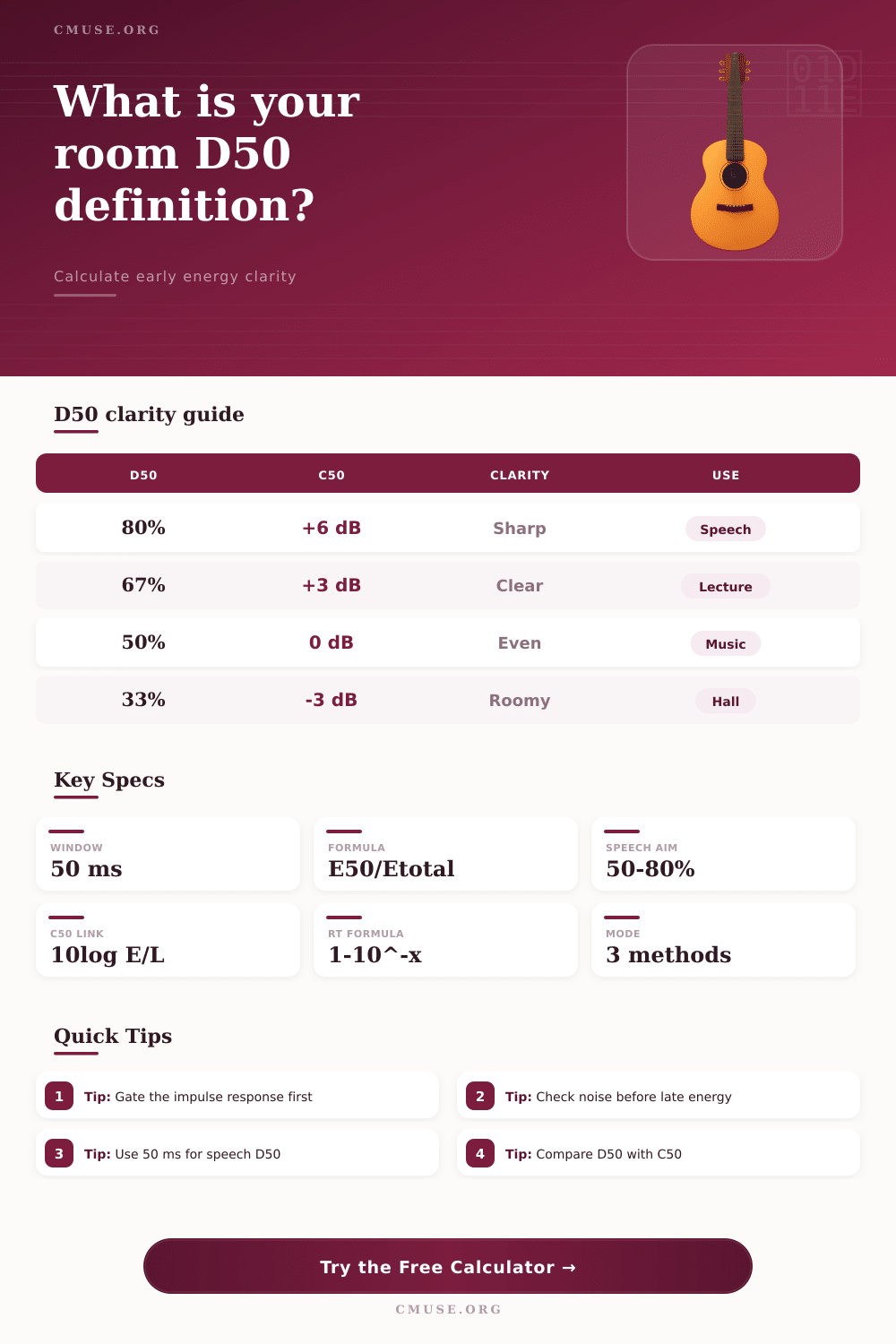
The Definition D50 measurement calculates the amount of sound energy that falls within the first 50 millisecond after the arrival of the direct sound. The human brain utilizes this 50 millisecond time frame to determine if speech sounds crisp or blurred. If a large amount of sound energy falls within this 50 millisecond time frame, the Definition D50 value will be high and the speech will be easily understood.
What is Definition D50 and how it affects speech
If a large amount of sound energy falls after this 50 millisecond time frame, the Definition D50 value will be low and the speech will be more difficultly to understand due to the smearing of the consonants. There are three different method to calculate the Definition D50 value with the calculator. One method is to enter the direct energy sum of the impulse response.
Another method is to enter the C50 value for the calculation of the Definition D50. The third method is to enter the RT60 decay time and the direct to reverberant ratio. Different individual can use each of these methods. For example, the field technician could use the first method by measuring the energy with a microphone, while the acoustical designer could use the third method by using the direct to reverberant ratio that is estimated from architectural drawings.
Thus, this calculator allows for the different individual in a team to calculate the same Definition D50 value. The Definition D50 value isnt an absolute property of the room. The Definition D50 value is a property of the listening position in the room.
For example, if an individual moves ten feet away from the sound source, the direct sound energy will decrease. At the same time, the reverberant sound energy will remain the same in the room. Thus, the Definition D50 value will fall if the listener move away from the sound source.
For these reason, the calculator also includes a distance field to remind the listeners that the Definition D50 value relates to one specific location in the room. The Definition D50 and the C50 measurement are often confused with one another. Definition D50 and the C50 value are simply two different measurement of the same ratio.
The Definition D50 is expressed as a percentage, while the C50 value is expressed in unit of decibels. A conversion table on the page describes the relationship between the two measurement. For example, a C50 value of 0 decibel equals a Definition D50 value of 50%, and a C50 value of 3 decibels equals a Definition D50 value of 2/3.
Thus, despite the difference between the two measurement, the ratio of early sound energy to late sound energy in a reverberant field is the same for both calculations. In order to calculate the Definition D50 value correct, it is important that the measurement technique are proper. If the tail of the impulse response falls into the noise level of the recording system, the recording system will measure the late sound energy to be higher then it truly is.
As a result, the Definition D50 will also be incorrectly calculated to be lower than the true value. Thus, it is important to gate the sound response at the direct sound energy, trim the tail noise before integrating the response. Additionally, it is also important to recognize that real room often change with time due to the addition of furnitures, the movement of individual in the rooms, and changes in the temperature within the rooms.
Thus, it is common for acoustical engineer to measure the Definition D50 at multiple times and to average the result of those calculations to ensure accuracy. They should of used more measurements to be sure.