Clarity C80 Calculator
Estimate music clarity from the 0 to 80 ms early energy window, late reverberant energy, RT60, listening distance, room volume, and source directivity.
C80 Result
Run the calculator to see the clarity reading.
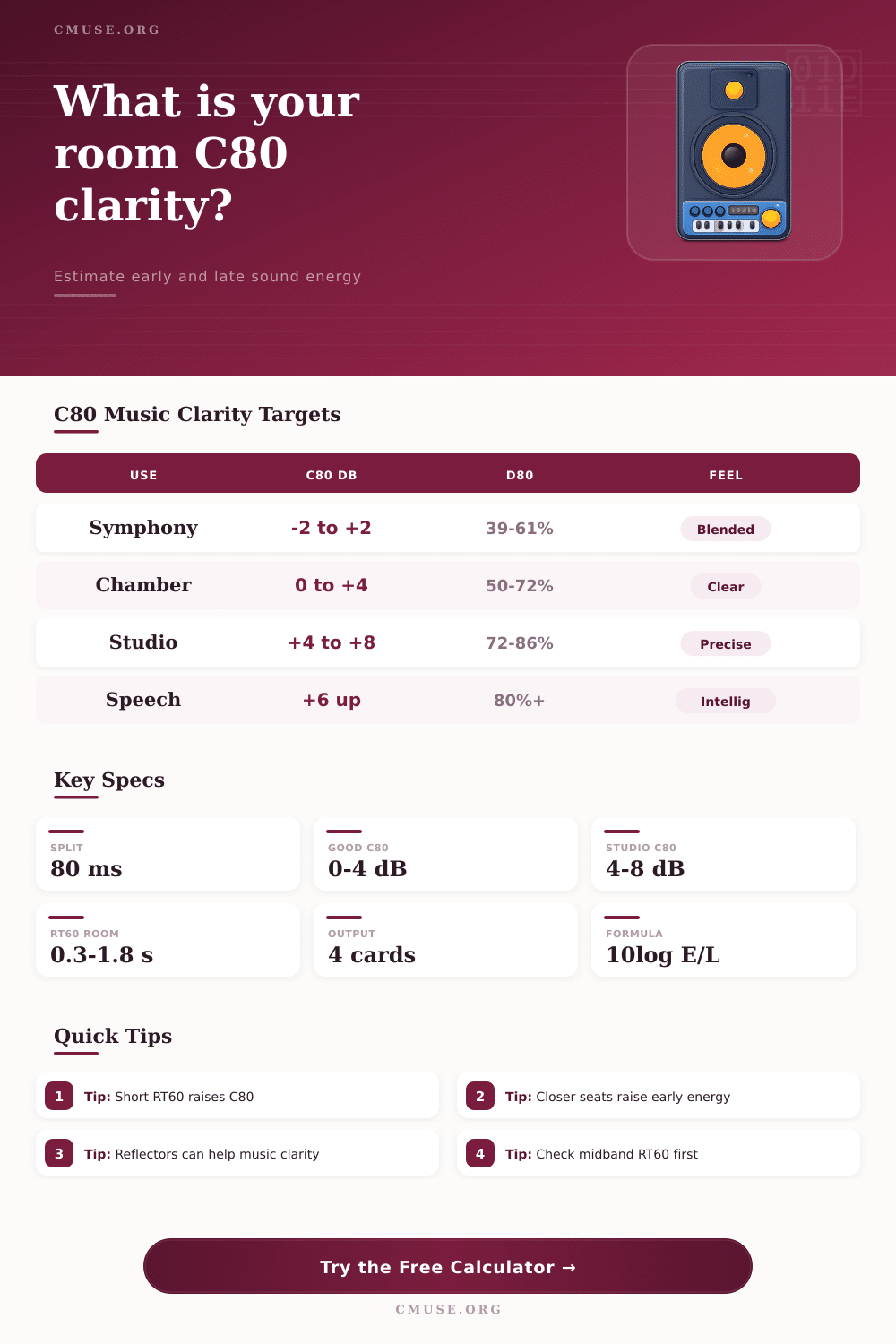
| Use Case | C80 Target | D80 Equivalent | Listening Impression |
|---|---|---|---|
| Symphonic or large ensemble blend | -2 to +2 dB | 39% to 61% | Integrated tone with less note-edge emphasis |
| Chamber music and recital rooms | 0 to +4 dB | 50% to 72% | Clear articulation while retaining musical warmth |
| Studio tracking and control rooms | +4 to +8 dB | 72% to 86% | Precise timing, editing, and balance decisions |
| Speech-led performance or lecture music | +6 dB and higher | 80% and higher | High intelligibility with reduced reverberant masking |
| Term | Calculator Formula | Meaning | Typical Lever |
|---|---|---|---|
| Decay rate | 13.8155 / RT60 | Converts 60 dB decay into exponential energy decay | Measured midband RT60 |
| Early diffuse energy | 1 - exp(-13.8155 * 0.08 / RT60) | Energy captured before the 80 ms boundary | Shorter RT60 increases this share |
| Late diffuse energy | exp(-13.8155 * 0.08 / RT60) | Energy remaining after 80 ms | Longer RT60 increases this tail |
| Direct energy | (critical distance / listener distance)^2 | Approximate direct-to-reverberant contribution | Move closer or use higher directivity |
| C80 | 10 * log10(early total / late energy) | Primary music clarity index in decibels | Balance early support against late decay |
| Room | Typical Size | RT60 Range | C80 Expectation |
|---|---|---|---|
| Vocal booth | 5 x 6 x 8 ft | 0.15 to 0.30 s | Very high clarity, often above +8 dB |
| Home control room | 12 x 10 x 8 ft | 0.25 to 0.45 s | Studio clarity, usually +4 to +8 dB |
| Chamber room | 30 x 22 x 14 ft | 0.7 to 1.1 s | Clear but still blended, near 0 to +4 dB |
| Recital hall | 70 x 45 x 28 ft | 1.2 to 1.8 s | Depends strongly on seat distance and reflectors |
| Church nave | 110 x 45 x 45 ft | 2.5 to 5.0 s | Low clarity unless seated close to the source |
| Change | C80 Direction | Why It Moves | Best For |
|---|---|---|---|
| Shorten RT60 | Raises C80 | Late energy decays faster after 80 ms | Studios, booths, amplified rooms |
| Move listener closer | Raises C80 | Direct energy grows with inverse-square distance | Practice spaces and small stages |
| Add useful early reflectors | Raises C80 moderately | More arrival energy lands before 80 ms | Recital rooms and ensemble shells |
| Increase source directivity | Raises C80 at aimed seats | More energy is sent toward the listener | PA, monitors, and focused sources |
| Increase listener distance | Lowers C80 | Direct energy falls while reverberant field dominates | Checking rear-seat blend |
This calculator uses a practical energy model for planning and comparison. Final room decisions should be checked with measured impulse responses when possible.
When you listen to music in a room, your ears performs two different functions. Your ear catches the energy that arrives at your ears prior to eighty milliseconds after the music begin, and your ear also catches the energy that arrives at your ears after those eighty milliseconds. The balance between these two form of energy determines whether a musical note sounds crisp to your ears or if it sound smeared.
The measurement of Clarity C80 measure this balance between early energy and later reverberant energy. More specifically, Clarity C80 compares the amount of energy that arrives at your ears before eighty milliseconds to the amount of energy that arrives after those eighty milliseconds. The eighty-millisecond window is used because the human brain treats any sound that arrive at your ears within this period as a portion of the original sound that was played.
Clarity C80: How Early and Late Sound Affect Music
Any sounds that arrive before this period are recognized as the original sound. Sounds that arrive after this period the brain recognizes as reverberant energy or “room tone.” The Clarity C80 measurement can be increased by shortening the reverberation time of the room in which the music is played. Additionally, moving the listener closer to the sound source of the music that is being played can increase the Clarity C80 measurement.
The calculator that is provided on this page can perform each of these calculations, as long as the dimension of the room, the decay time of the rooms midband frequencies, and the distance between the music source and the listener can be provided. The volume of the listening room plays a role in the Clarity C80 measurement. More specifically, large room are able to hold more reverberant energy than small rooms.
Thus, clarity is higher in small rooms, like a vocal booth, than in large rooms, like a large church nave. To achieve the same level of clarity in a large nave as is experienced in a vocal booth, the listener must sit closer to the choir. Additionally, another factor that influences Clarity C80 is the directivity of the sound source.
Sources that are directional, such as loudspeakers, will project more of their sound energy toward the listener before the walls of the room reflect that sound energy. Thus, using a directional loudspeaker will increase the amount of energy that arrives before eighty milliseconds relative to the total amount of energy released by the loudspeaker. Finally, another factor that can be accounted for in the model are the early reflections from the side walls or ceiling panels of the listening room.
These early reflections will contribute to an increase in the clarity of the music that is being played without altering the decay time of the room. These early reflections are especially useful if warmth is one of the acoustic characteristics of the listening room that is to be maintained. Depending upon the type of music that is to be played in the listening room, different target range for the Clarity C80 measurement can be used.
For example, the late reverberant energy that develops in large music rooms is beneficial for music that utilizes large orchestral ensembles, as this late reverberant energy helps the music sections blend with one another. In contrast, chamber music requires both early and late energy in the listening space; sufficient early energy is required for each musical line to be heard distinctly, but late energy is required to support the tonal qualities of the musicians. Control rooms that are used to mix music require high levels of Clarity C80 so that mixing engineer can focus on the details of the music.
Finally, for rooms that are used to play speech-driven media (documentaries, lecture halls, etc.), the highest levels of Clarity C80 are required so that consonants in speech are easily heard. The target bands for these different types of music or media is represented in the reference table that can be found on this page. The calculation of the Clarity C80 measurement utilizes an energy model for that calculation.
The reverberation time of the listening room is used to calculate the amount of total reverberant energy that arrives at the listener prior to eighty milliseconds. Additionally, the direct sound energy can be calculated from the critical distance of the room. Thus, the listener can compare the distance of the listener from the sound source to the critical distance to calculate the ratio of direct to reverberant sound energy.
This ratio is used in the calculation of the Clarity C80 measurement. The Definition of Clarity C80 (represented as D80) converts the early-to-total energy ratio into a percentage. Finally, a verdict line presents the listener with the determination of whether the calculated value for Clarity C80 is within, above, or below the target band that was selected for the listening space.
It is possible to make common mistake in the calculation of the Clarity C80 measurement. For example, one common mistake is to use a single measurement of Clarity C80 from a single seat within a room to represent the Clarity C80 of the entire room. Clarity change with distance from the sound source.
Additionally, the relationship between distance and clarity is not linear. For example, it is possible that moving a few meter closer to the source may move the listener into an acoustic comfort zone, even if the physical room is not altered. Another common mistake is to ignore the decay time of the rooms midband frequencies.
Clarity is most audible within the same frequency range that music and speech are heard. Thus, using a broadband value for clarity rather than a value that takes into account the decay time at 500 Hz and 1 kHz, for example, may lead to ignoring an issue with the room that can be addressed. Thus, the decay time must be entered into the calculator prior to calculating Clarity C80.
Real listening rooms has variables to the model that cannot be accounted for in the model.
For example, the placement of furnitures, the presence of individuals in the listening room, the absorption of sound by that furniture and by those individuals, the warming of the air within the room, the impact that air absorption at high frequencies can have on the reverberant tail of large rooms, and the impulse response of the listening room to different sounds are all variables that impact the actual Clarity C80 of a given music venue. Thus, impulse response can be used to determine the Clarity C80 of a room to the same precision as the calculation model. However, the model can be used to provide a reliable estimate of Clarity C80 without building or treating the room.
By calculating each of these value, one can focus upon the tools that can be used to change the room. For example, if the Clarity C80 measurement of a room is too low, there are several options for increasing the Clarity C80 of that space. Each of these options include shortening the decay time of the music, moving the listener closer to the sound source, increasing the directivity of the sound source, or adding early reflections to the room.
Each of these solutions involves trade-off that the listeners of the music must make. Thus, calculating the Clarity C80 allows the listeners to determine which solution will be the least costly (in terms of time, money, effort, etc.) to implement to achieve the highest level of Clarity C80. Thus, the calculator makes these comparisons visible so that listeners dont have to utilize an acoustic simulation software package to evaluate these trade-offs.