Critical Distance Calculator
Estimate where direct sound and reverberant sound are equal using room volume, RT60, source directivity, and listener distance.
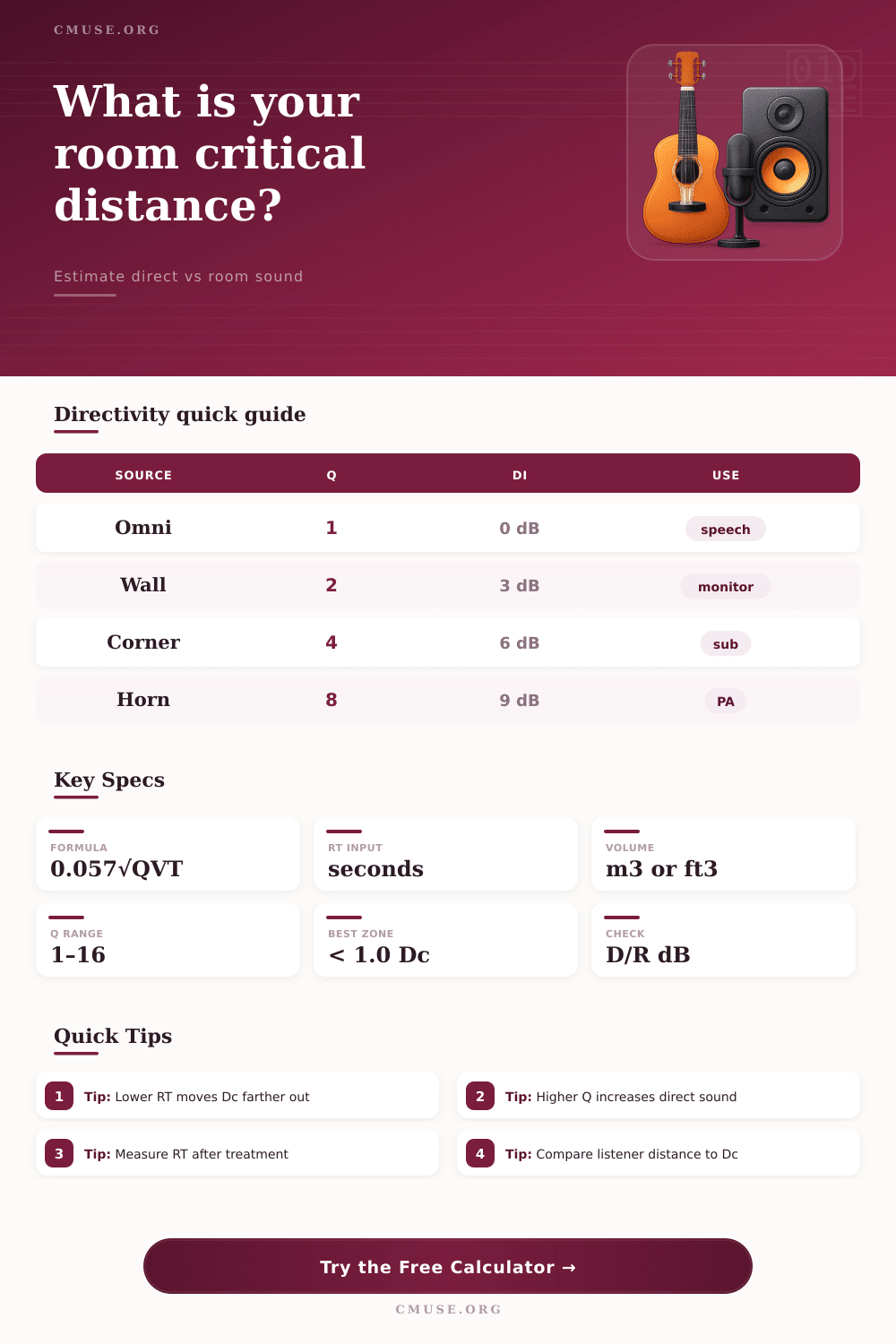
| Source condition | Q factor | Directivity index | Typical use |
|---|---|---|---|
| Omnidirectional source in open space | 1 | 0.0 dB | Voice, small acoustic source, measurement reference |
| Source near one large boundary | 2 | 3.0 dB | Monitor near wall, tabletop speaker, stage floor source |
| Source near two boundaries | 4 | 6.0 dB | Wall and floor placement, corner-adjacent monitors |
| Wide cardioid or controlled monitor | 6 | 7.8 dB | Nearfield or midfield speaker with useful pattern control |
| Directional loudspeaker | 8 | 9.0 dB | Small PA cabinet, focused instrument amplifier |
| Narrow horn or high-directivity array | 12 to 16 | 10.8 to 12.0 dB | Stage coverage, installed sound, long-throw source |
| Room type | Approx volume | Common RT60 range | Critical distance note |
|---|---|---|---|
| Vocal booth | 110 to 220 ft³ / 3.1 to 6.2 m³ | 0.12 to 0.25 s | Short RT can keep the direct field usable very close to the mic. |
| Small studio room | 800 to 1,500 ft³ / 23 to 42 m³ | 0.25 to 0.45 s | Nearfield listening often sits around or inside critical distance. |
| Practice room | 500 to 1,400 ft³ / 14 to 40 m³ | 0.35 to 0.70 s | Dense sources can exceed critical distance quickly if RT is high. |
| Control room | 1,800 to 4,000 ft³ / 51 to 113 m³ | 0.20 to 0.40 s | Lower RT and directional monitors extend the direct-sound zone. |
| Small hall | 10,000 to 35,000 ft³ / 283 to 991 m³ | 0.90 to 1.60 s | Critical distance may be several meters, but seats beyond it are reverberant. |
| Scenario | Dimensions | RT60 and Q | Approx critical distance |
|---|---|---|---|
| Home studio nearfields | 10×12×8 ft / 3.0×3.7×2.4 m | 0.45 s, Q 2 | 3.6 ft / 1.1 m |
| Treated vocal booth | 5×6×7.5 ft / 1.5×1.8×2.3 m | 0.18 s, Q 1 | 2.3 ft / 0.7 m |
| Practice room amp | 8×8×8 ft / 2.4×2.4×2.4 m | 0.65 s, Q 4 | 3.9 ft / 1.2 m |
| Control room monitors | 14×18×9 ft / 4.3×5.5×2.7 m | 0.30 s, Q 6 | 8.8 ft / 2.7 m |
| Small hall speech PA | 40×55×18 ft / 12.2×16.8×5.5 m | 1.20 s, Q 8 | 18.2 ft / 5.5 m |
| Listener position | D/R estimate | What it means | Common action |
|---|---|---|---|
| Less than 0.5× critical distance | More than +6 dB | Strong direct field, room is relatively low in level. | Useful for close miking or precise nearfield checks. |
| 0.5× to 1.0× critical distance | +6 to 0 dB | Direct sound still leads, with room becoming audible. | Often workable for monitors, speech, and controlled recording. |
| 1.0× to 2.0× critical distance | 0 to -6 dB | Transition zone where reverberant sound becomes competitive. | Check clarity before moving farther away. |
| More than 2.0× critical distance | Less than -6 dB | Reverberant field dominates the direct source. | Lower RT, move closer, or use a more directional source. |
Critical distance is the measurement that determine where the direct sound from a source becomes more quiet than the reflected sound in the room. Critical distance is important in that it determine at what point the room will begin to change the sound that is being heard. If the sound that is being evaluated is within the critical distance of the sound source, the direct sound will be the loudest portion of the sound.
However, if the sound that is being evaluated is located beyond the critical distance, the reflected sound will be the loudest portion of that sound. Critical distance can change with the size of the room, as well as with the reverberation time of that room. The two main factors that affect critical distance within a room are the volume of the room and it’s reverberation time.
What Is Critical Distance in a Room?
Rooms with greater volumes will have their critical distance measure farther from the sound source. Rooms with longer periods of reverberation will have their critical distance measured closer to the sound source. Thus, these two factor must be calculated together to determine the critical distance within a given room.
Another factor that play a role in critical distance is the directivity of the sound source. Sound sources with high levels of directivity will allow for the direct sound to travel further from that source without reflected sound reaching the listener. Places sound sources against a wall or in a corner to increase the directivity of those sound sources.
Increasing the directivity of sound sources will increase the critical distance. Sound sources that emit sound in each direction will have a critical distance that is shorter then sound sources with high levels of directivity. The fourth main factor that relates to critical distance is the distance of the listener from the sound source.
If the listener is positioned at a distance that is smaller than the critical distance, the direct sound will be the most prominent sound that the listener hear. However, if the listener is positioned at a distance that is larger than the critical distance, the reflected sound will be the most prominent sound that that listener hears. The most important area of a room for listeners is the area near the critical distance, as changes in either position or treatment to that room will have an impact on the sound that is created within that area.
One final factor that can impact critical distance is the absorption coefficient of the rooms surfaces. High absorption will lower the reverberation time of a room, which will increase the critical distance. However, adding more absorption to a room will yield diminishing returns for increasing the critical distance of that room.
Thus, measuring the reverberation time of the room can provide more accurate information regarding critical distance than reviewing the absorption coefficient of the materials within the room. The way that a room is to be used will play a major role in the critical distance of that room. For recording spaces, for instance, critical distance should of been measured to ensure that it is farther from the sound source than the distance that the musicians will be positioned within the room.
For live rooms, however, it may be beneficial for critical distance to be shorter, as the audience will be positioned farther from the sound source. Many people may make mistakes in their measurements of critical distance due to their assumption of a critical distance of that sound source. Both the furnitures and the individuals within a room may change the absorption of that room.
Changes to the absorption of the room will change its critical distance. Thus, as either the temperature or humidity within the room change, the critical distance of that room may change as well. Any changes to the room impact its critical distance.
Therefore, any changes to the room will require that the critical distance to be rechecked. Knowledge of critical distance will allow people to make decisions regarding the function of the room. For instance, people can choose to lower the reverberation time of the room to increase the critical distance of the sound source in that room.
Additionally, people can also choose to increase the directivity of the sound source to increase critical distance, or they can simply move the listener to be within critical distance of that sound source. Thus, knowledge of critical distance will help individuals understand which factor will have the greatest impact upon sound within there specific room.