1D Diffuser Calculator
Calculate QRD or PRD well width, well depth, usable bandwidth, panel count, and a build-ready depth schedule for studio acoustic diffusion.
🎚Studio Presets
📏Diffuser Area
🎵Acoustic Design Inputs
📊Live Spec Grid
🧮Calculated Well Depth Schedule
Depths are measured from the front face to each well back. The zero-depth slot stays flush.
| Well | Residue | Depth | Metric Depth | Build Note |
|---|---|---|---|---|
| 1 | 0 | 0 in | 0 cm | Flush reference |
📚Prime Size Reference
| Prime | Typical Use | Pattern Detail | Depth Demand | Best Placement |
|---|---|---|---|---|
| N7 | Speech and podcast rooms | Compact, broad lobes | Lowest | Small rear walls |
| N11 | Project studios | Good density for nearfield work | Moderate | Rear wall or ceiling strip |
| N13 | Mix rooms | Smoother lateral spread | Moderate plus | Behind listening position |
| N17 | Control rooms | Higher spatial detail | Deep | Wide rear wall arrays |
| N19 | Live rooms | Dense reflection pattern | Deep | Instrument wall zones |
| N23 | Large acoustic arrays | Very fine sequence spread | Deepest | Stage and hall panels |
📐Common 1D Diffuser Projects
| Scenario | Area | Suggested Prime | Target Band | Typical Module |
|---|---|---|---|---|
| Home studio rear wall | 40 sq ft / 3.7 m² | N11 or N13 | 700-4000 Hz | Two 4 ft panels |
| Practice room wall | 24 sq ft / 2.2 m² | N7 or N11 | 900-4500 Hz | Compact 3 ft panel |
| Drum room scattering | 56 sq ft / 5.2 m² | N13 or N17 | 600-3500 Hz | Four 4 ft panels |
| Control room back wall | 64 sq ft / 5.9 m² | N17 or N19 | 500-3200 Hz | Deep 4 ft panels |
| Ceiling cloud strip | 32 sq ft / 3.0 m² | N11 | 800-5000 Hz | Shallow long strip |
🧱Material And Build Specs
| Material | Approx Density | Strength | Best Use | Build Caution |
|---|---|---|---|---|
| Baltic birch plywood | 43 lb/ft³ / 690 kg/m³ | High | Durable touring or live rooms | Seal exposed edges |
| MDF sealed panels | 47 lb/ft³ / 750 kg/m³ | Very flat | Studio wall modules | Heavy at large depth |
| Hardwood slat assembly | 40 lb/ft³ / 640 kg/m³ | High | Visible architectural panels | Control seasonal movement |
| Rigid molded plastic | 34 lb/ft³ / 545 kg/m³ | Medium | Light modular arrays | Avoid flexible backs |
| Foam-core prototype | 8 lb/ft³ / 128 kg/m³ | Low | Temporary listening tests | Not a final rigid diffuser |
| Composite honeycomb | 18 lb/ft³ / 288 kg/m³ | Medium | Ceiling-hung arrays | Needs rigid face finish |
A one-dimensional diffuser is a tool that help to control the reflections of sound within a given room. A one-dimensional diffuser works by taking a flat wall and creating a series of wells of different depths within that wall. When sound reflect off of a flat wall, the sound often reflects back as a single burst of sound; however, the different depths of the wells within a one-dimensional diffuser cause the sound to reflect in a variety of different directions.
Thus, the different depths of the wells within the one-dimensional diffuser ensures that the reflected sound is scattered rather than reflect as a single hard sound that reflects off of the wall. A mathematical sequence forms the wells that comprise a one-dimensional diffuser. Such a mathematical sequence is required to ensure that the reflected sound from the one-dimensional diffuser occur within a specific range of frequencies.
How One-Dimensional Sound Diffusers Work and How to Build Them
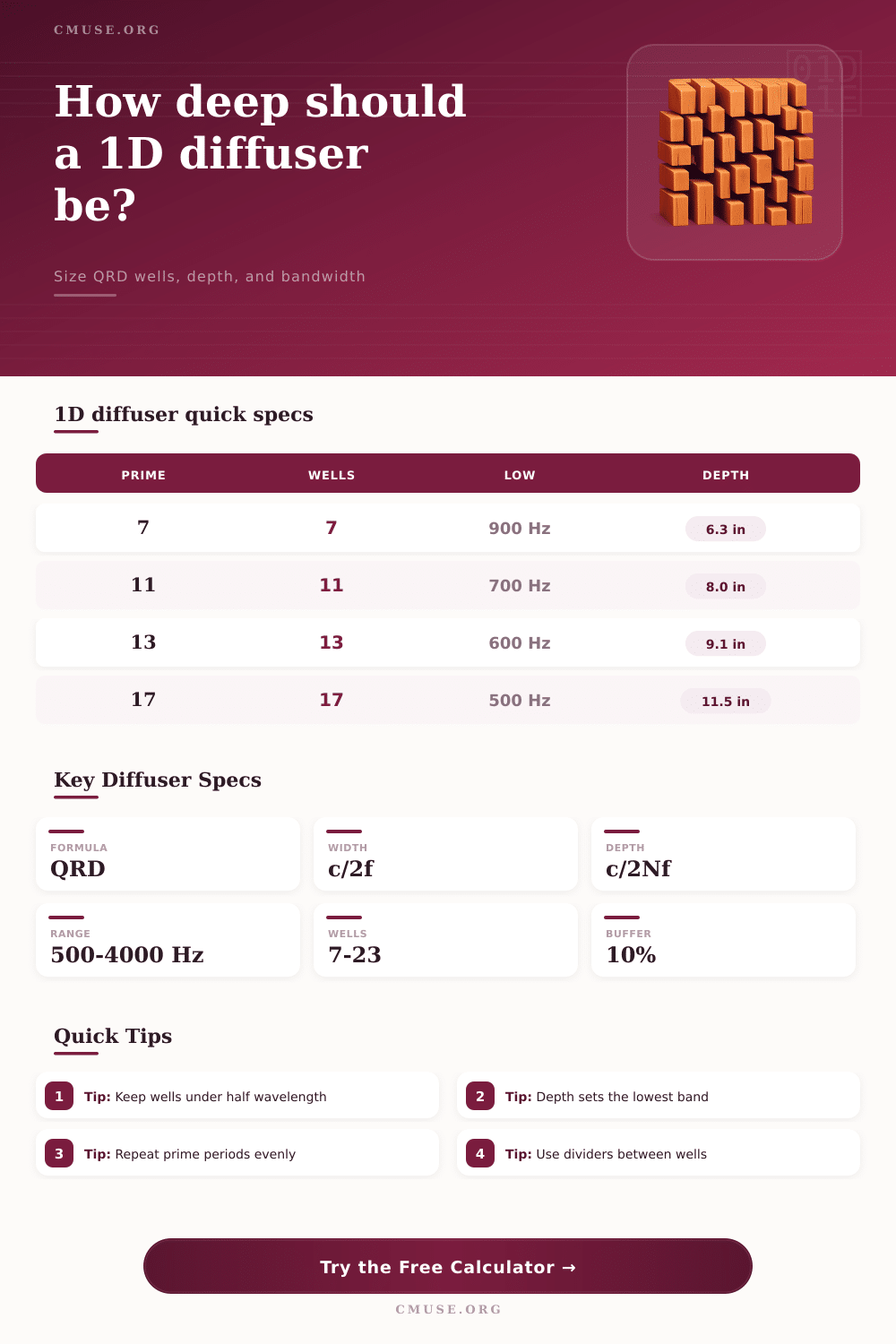
More specificaly, the lowest frequency that the one-dimensional diffuser is to be reflected by determines the depth of the deepest well within the one-dimensional diffuser. In addition, the highest frequency that the one-dimensional diffuser is to be reflected by determines the width of each well within the one-dimensional diffuser. If the wells within the one-dimensional diffuser is too wide, the high frequencies will reflect off of the front of the one-dimensional diffuser without reflecting off of any of the wells, and thus that high frequency will not be reflected by the one-dimensional diffuser.
In order to determine the dimensions of the wells of the one-dimensional diffuser, an individual can utilize a calculator. Such a calculator allows an individual to enter the frequencies that he or she desire to reflect off of the one-dimensional diffuser, as well as the available depth of the wall upon which the one-dimensional diffuser is to be constructed. Additionally, the calculator can also utilize the size of the wall to determine the exact width of each well within the one-dimensional diffuser, as well as the number of finished panel of the one-dimensional diffuser that will be required to construct the desired tool.
Each of the available calculators also allows an individual to choose between using either a quadratic residue pattern or a primitive-root pattern within the one-dimensional diffuser. Each of these mathematical sequences is utilized to create the depths of the wells within the one-dimensional diffuser. Each of these sequences are used for the same reason: to ensure that the one-dimensional diffuser does not focus the reflected sound towards specific area within the room, avoiding focusing the sound is essential to the functioning of the one-dimensional diffuser.
The shape of the room in which the one-dimensional diffuser will be constructed will impact the location at which the one-dimensional diffuser should be placed within that room. For instance, if the room is generally square in shape, a one-dimensional diffuser will be required along one of the rear walls of the room. In contrast, if the room is long and narrow, a one-dimensional diffuser will be required along each of the side walls of the room.
Thus, an individual must determine in which areas of the room the sound problem are present, for the calculator will allow an individual to determine the dimensions of the one-dimensional diffuser that is required, but the calculator will not be able to determine the specific problems with the sound within the room. The material from which the one-dimensional diffuser is to be constructed will impact both the performance of the one-dimensional diffuser and the weight of that one-dimensional diffuser. Dense sheet goods is often utilized as the material from which a one-dimensional diffuser is constructed, since such sheet goods will retain their dimensions and enable the sound waves to reflect off of hard surfaces within the one-dimensional diffuser.
In contrast, people often utilize lighter forms of composite material for one-dimensional diffusers that are to be constructed along ceilings, as the lighter the composite material, the less the one-dimensional diffuser will weigh. In addition to the type of materials that is utilized for constructing the one-dimensional diffuser, the thickness of the dividers that are used for creating the wells of the one-dimensional diffuser will also impact the total width of the one-dimensional diffuser. One of the most common mistake in the construction of a one-dimensional diffuser is attempting to create a one-dimensional diffuser that target some of the lower frequencies within the reflected sound.
If the depth of the one-dimensional diffuser is less than the depth that is mathematically calculated to reflect the lowest targeted frequency, the lowest frequency that is targeted will need to be increased. Thus, the one-dimensional diffuser will not reflect the lowest frequencies of the targeted range of frequencies; however, this is due to the physics of sound reflections, and is not a failure of the one-dimensional diffuser itself. Another of the most common mistakes is not accounting for the width of the wells within the one-dimensional diffuser.
If the wells within the one-dimensional diffuser are too wide, the high frequencies of sound will not be reflected by the one-dimensional diffuser. Thus, in order to reflect high frequencies of sound, the wells of the one-dimensional diffuser will have to be narrow. Consequently, an increase in the number of dividers will be required to narrow the wells to the required widths.
Thus, an increase in the number of dividers will lead to an increase in the total width of the one-dimensional diffuser panels that are constructed. In addition to the dimensions and construction of the one-dimensional diffuser, an individual must also make a decision regarding the placement of that one-dimensional diffuser within the room. An individual should place the one-dimensional diffuser in a manner that allows the sound waves to travel some distance within the room before they impact the one-dimensional diffuser panels.
If the sound waves are too close to the one-dimensional diffuser, the one-dimensional diffuser may reflect some of those sound waves before they have fully develop; thus, the diffuser should be mounted at a distance from the sound sources within the room. Finally, the gaps between each of the wells of the one-dimensional diffuser must be sealed. If the gaps between the wells are not sealed, some of the sound will pass through the one-dimensional diffuser without being reflected, and the one-dimensional diffuser will not perform in accordance with the calculations that were made to create such a tool.