Primitive Root Diffuser Calculator
Calculate prime/root residue order, well depths, panel dimensions, and usable diffusion band for a studio primitive-root diffuser.
🎯Studio Presets
🎚Diffuser Inputs
📊Calculated Spec Grid
🔢Residue Depth Schedule
| Well n | Residue r = gn mod p | Depth in inches | Depth in cm | Phase target |
|---|---|---|---|---|
| 1 | 1 | 0.88 | 2.23 | 2πr/p |
📐Frequency Window Checks
| Check | Formula | Current value | Design meaning |
|---|---|---|---|
| Design low | f0 | 700 Hz | First intended diffusion region |
| Well-width limit | c / 2w | 3376 Hz | Approximate upper scattering limit |
| Maximum depth | (p – 1)λ / 2p | 8.77 in | Deepest well before back and gap |
| Total build depth | dmax + back + gap | 9.52 in | Space needed from wall face |
🧮Prime and Root Reference
| Prime p | Valid roots to try | Cycle wells | Typical diffuser use |
|---|---|---|---|
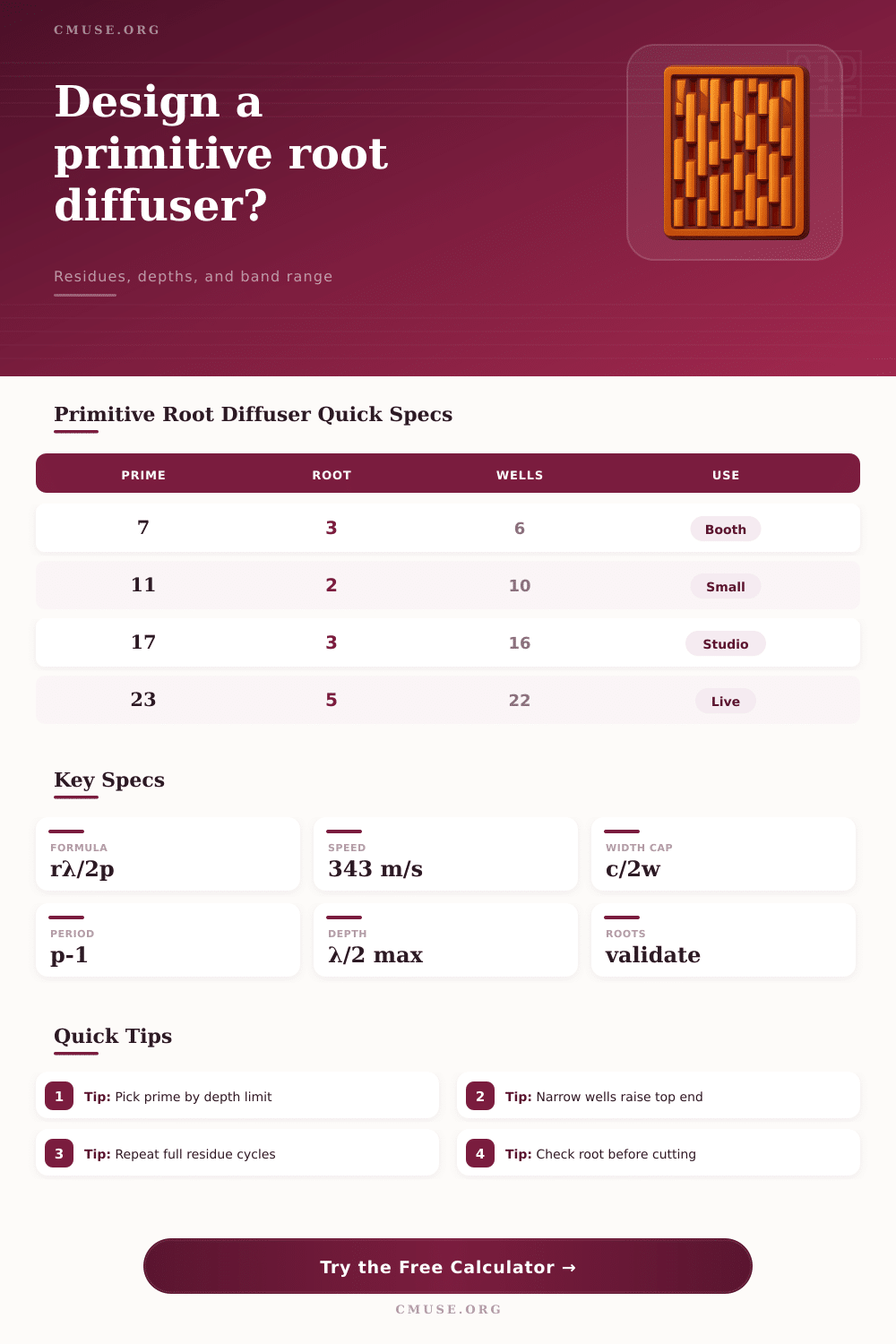
| 7 | 3, 5 | 6 | Narrow booth insert or quick prototype |
| 11 | 2, 6, 7, 8 | 10 | Small rear wall or practice room panel |
| 13 | 2, 6, 7, 11 | 12 | Balanced home studio panel width |
| 17 | 3, 5, 6, 7, 10, 11, 12, 14 | 16 | Mix room rear wall with finer sequence |
| 23 | 5, 7, 10, 11, 14, 15, 17, 19 | 22 | Large tracking space or stage diffuser |
🎶Common Project Sizes
| Scenario | Suggested p / g | Well width | Starting f0 |
|---|---|---|---|
| Recording booth 5×5 ft | 7 / 3 | 1.5 in | 900 Hz |
| Practice room 8×8 ft | 11 / 2 | 1.75 in | 800 Hz |
| Home studio 10×12 ft | 13 / 2 | 2.0 in | 700 Hz |
| Mastering rear wall | 17 / 3 | 1.5 in | 650 Hz |
| Stage or live room | 23 / 5 | 2.25 in | 550 Hz |
💡Calculation Tips
A primitive root diffuser is a device that is used to spread sounds across the different frequencies. A primitive root diffuser work by employing a mathematical sequence in creating wells of varying depths. The mathematical sequence is created with the use of a prime numbers and a primitive root of that prime number.
The prime number and primitive root together create a mathematical pattern that prevents the sequence from either early repetition of values within the sequence or skipping over any value within the sequence. The depths of the wells within the primitive root diffuser are established according to this mathematical sequence of residues, which ensure that the primitive root diffuser will avoid creating uneven sound level throughout the diffuser. To design a primitive root diffuser with a calculator, several different inputs has to be made.
How a Primitive Root Diffuser Works
The designer must make one of the initial choice that must be made by the designer; the prime number will determine the number of depths of the wells that will be created by the primitive root diffuser. A larger prime number will allow for the deepest well to extend more far away from the wall. In addition to the prime number, the designer has to choose the primitive root; only certain numbers will result in the design of the primitive root diffuser creating every non-zero residue that is generate by the prime number.
Should an invalid primitive root be chosen, the entire primitive root diffuser will collapse and the desired even scattering of the reflected sound will not occur. The frequency that will be utilized will determine the depth of the wells within the primitive root diffuser. More specific, low frequencies will require deep wells within the primitive root diffuser in comparison to high frequencies.
Additionally, the width of the wells will impact the frequencies that are reflected by the primitive root diffuser; if the wavelength of the sound is less than twice the well width, the sound will not perceive the wells within the primitive root diffuser as wells but as a flat panel of sound reflecting material. Each of the different parameter of the primitive root diffuser will impact each of the other parameters. For instance, lowering the design frequency of the primitive root diffuser will lead to each well being lengthened; longer wells will make it more difficult for the primitive root diffuser to be incorporated into the desired space.
Additionally, narrow wells will increase the limit of frequencies that is scattered by the primitive root diffuser, but will lead to an increase in the number of dividers for the wells; more dividers means more weight of the primitive root diffuser. The number of full repeats of the primitive root diffuser can be specified; each repeat will increase the total width of the primitive root diffuser, but will not impact the mathematical order of the residues within each well. This parameter can be used to allow for deeper primes to be employed in a space where there is more wall available.
Finally, the height of each panel and the density of the material to be used can be chosen; these two parameters will impact the total weight of the primitive root diffuser. In most case, the weight has to be taken into consideration when determining in what location the primitive root diffuser is to be hung. Many of the parameters that are established when building a primitive root diffuser will be complicated to solve with mathematics alone; there are several factor in most rooms that will impact the behavior of each primitive root diffuser.
For instance, corners and doors in the room will impact the way in which the boundary conditions are established and broken by the sound waves, thus altering the behavior of the primitive root diffuser if it is not covered in its full width by the primitive root diffuser. In addition to broken boundary conditions in relation to the walls, the depth of the wells can also be impacted by the depth of sound in the room; if the primitive root diffuser is not full width on the wall, the edge of the primitive root diffuser will impact the frequencies differently than the frequency of the high frequency sound reflections. Finally, the humidity and the temperature of the room will impact the behavior of the primitive root diffuser; the humidity and the temperature of the air will impact the speed of sound, and altering the speed of sound will alter the actual frequencies reflected by the primitive root diffuser.
Because of these potential alteration to the behavior of the primitive root diffuser, many designer of primitive root diffusers establish a safety margin around the calculated dimension of each well and each primitive root diffuser. A table of the available primes and their roots can help to indicate which primitive root diffuser will be effective within which size of room. For instance, a seven-well primitive root diffuser will work best for a vocal booth; because vocal sounds have a depth of less than a certain depth, such as 900 hertz.
An eleven-well or a thirteen-well primitive root diffuser will work best for a practice room; a practice room need to control the frequencies down to 700 hertz but does not want the primitive root diffuser to extend more than eight inches into the practice room. For the largest of rooms, larger prime can be utilized. However, rather than attempting to find the largest prime number, the designer simply needs to find the smallest prime number that will allow the desired frequencies to be scattered by the primitive root diffuser.
Many people into the design of primitive root diffusers can make a variety of different mistake in the process of creating their design. For instance, some individuals will determine the prime number and subsequently discover that the resulting depth of the deepest well will be too deep for the walls of the desired space. Additionally, others may determine the width of the wells according to their visual preference for the primitive root diffuser; however, utilizing narrow wells can lead to the frequency of sound that is reflected by the primitive root diffuser to be less than the frequencies that is desired to be reflected.
Both of these parameter can be viewed on the calculator prior to beginning to cut any wood for the primitive root diffuser. Furthermore, the parameter for the total build depth can be viewed with the calculator; any depth that is established will allow for the primitive root diffuser to avoid contact with the wall upon installation. When the primitive root diffuser is constructed, it should be listened to to ensure that it is functioning as desired.
For instance, when the primitive root diffuser is installed into the desired location, sound material of various frequency should be played while moving around the room that contains the primitive root diffuser. The primitive root diffuser should even out the reflections of sound within the space; it should not create the sensation of certain frequencies being emphasize over others. If the designed frequency or the well width are too narrow to reflect the sound that is desired, the design of the primitive root diffuser can be altered.
By modifying the parameter of the primitive root diffuser according to the initial design and calculations, it is possible to even overcome these identified issue. The same logic that relates to primitive root diffusers can be applied to the largest of rooms for sound scattering. For instance, a twenty-three-well primitive root diffuser can be established as multiple panel in the largest of rooms.
Each panel can be shifted one or two position in relation to each other; the order of the residues will remain the same, but multiple primitive root diffusers will act as one wide primitive root diffuser for the largest of rooms. This calculation can be performed by the calculator for each individual panel of the primitive root diffuser, after which the builder can decide how to best arrange the panels of the primitive root diffuser. Finally, a calculator cannot replace the judgment of the designer regarding the primitive root diffuser; the behavior of the primitive root diffuser is additionally impacted by the absorption of the remaining walls of the room, where the speaker are located within the room, and the height of the individual that is to listen to the sound that is create within the room.
These additional factor will impact the contribution of the primitive root diffuser to the sound that is reflected by the room; it will be easiest to hear its contribution to sound when the other factor of the room are under control. However, if the designer begins to construct the primitive root diffuser according to the desired parameter for frequency and size, there will be an even scattering of the sound that is reflected within the room.