Bonello Criteria Calculator
Check low-frequency room-mode distribution, band growth, coincidences, ratios, and modal density for studio and listening-room dimensions.
| Band | Range | Modes | Trend | Dominant Type |
|---|---|---|---|---|
| Calculate to list modal counts by band. | ||||
| Mode Type | Count | Share | Acoustic Meaning |
|---|---|---|---|
| Axial | 0 | 0% | One room dimension |
| Tangential | 0 | 0% | Two dimensions |
| Oblique | 0 | 0% | Three dimensions |
| Axis | 1st Mode | 2nd Mode | 3rd Mode | Spacing Note |
|---|---|---|---|---|
| Calculate to show length, width, and height axial spacing. | ||||
| Reference | Ratio H:W:L | Strength | Watch Point |
|---|---|---|---|
| Bonello trend | Rising bands | Even density | No downward steps |
| Sepmeyer A | 1:1.14:1.39 | Small rooms | Needs exact finish dims |
| Sepmeyer B | 1:1.28:1.54 | Control rooms | Check ceiling modes |
| IEC style | 1:1.4:1.9 | Listening tests | May need more volume |
| Cube risk | 1:1:1 | None | Stacked axial modes |
Room modes refer to the phenomenon whereby low-frequency sound waves bounce off the wall, the floor, and the ceiling of a rectangular room. These sound waves bouncing off the walls of a rectangular room cause some of these low-frequency sound waves to reinforcing themselves at certain frequencies and to cancel each other out at others. The physical dimensions of a rectangular room determine the pattern of the modes of that rectangle shaped room.
The physical dimensions of the room may cause some of the bass notes to sound more louder in certain areas of that rectangular room relative to other areas of that rectangular room. The Bonello criteria calculator can map out the pattern of the modes of a rectangular room prior to purchase acoustic treatment for that rectangular room. The method used by the Bonello criteria calculator require that the low-frequency spectrum be divided into bands of frequencies.
Room Modes and the Bonello Calculator
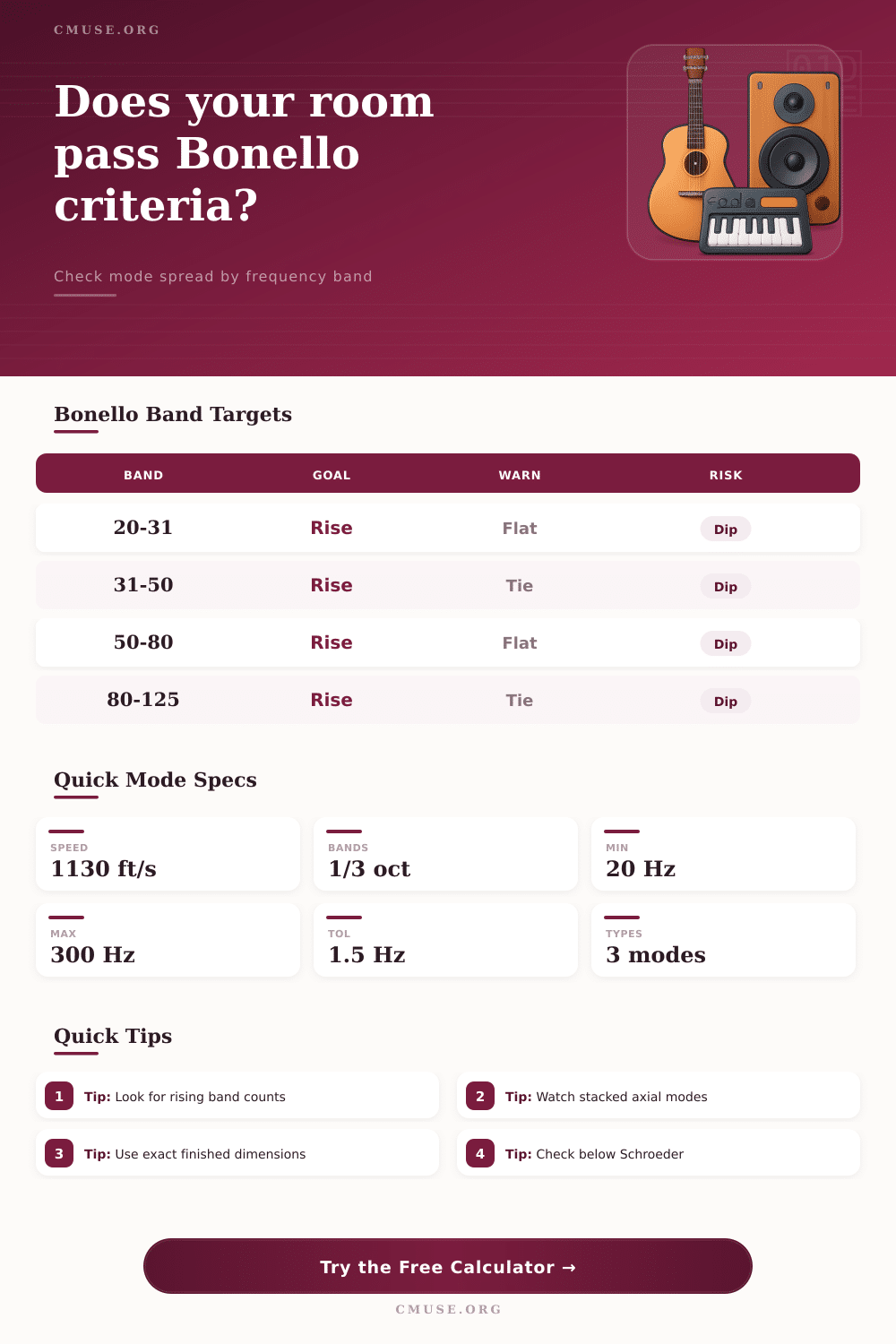
The calculator determines whether the number of modes increase as the frequency increases. In healthy rectangular rooms, the number of modes increase at higher frequencies. In problematic rectangular rooms, some bands of frequencies will contain flat stretches in the number of modes.
These flat stretches in the number of modes indicate that some bands of frequencies have too few reflections to even out the bass response of the rectangular room. To run the Bonello criteria calculator, you must enter the finished inside dimensions of the rectangular room into the calculator. Additionally, the user must select the speed of sound, and the frequency window over which the modes will be calculated must also be selected.
The finished inside dimensions of the rectangular room must be use in the calculator. The other dimensions of the rectangular room, such as the dimensions to the studs, are likely to lead to inaccurate calculations of the number of modes within the rectangular room. The speed of sound is used to account for the impact of the temperature within the rectangular room on the speed of sound.
The warmer the air within the rectangular room, the faster the sound travels through that space. Finally, a frequency window must be selected. Room modes below 80 Hz are sparse and powerful, while the modes between 200 and 400 Hz become dense enough that the individual mode do not matter as much as the density of modes in that rectangular room.
Thus, by entering a frequency window into the Bonello criteria calculator, users can control which portion of the spectrum of sound is calculated. The output of the Bonello criteria calculator will provide the total number of modes in the rectangular room, the modes will be clustered together in certain frequency bands and not others, and the Schroeder frequency for that rectangular room. The clustered modes are those modes that are located close to one another in relation to the tolerance set by the users for the calculator.
Clustering of the modes has a tendency to even out the sound within the rectangular room. Finally, the Schroeder frequency is the frequency at which the reverberation time begin to dominate the response of the rectangular room. For small rectangular rooms, the early Schroeder frequency will help to determine at which frequencies the modal problems will begin to manifest themselves.
This information will help to determine where to place the absorbers in the rectangular room, and whether the use of membrane trap will be beneficial to that rectangular room. Many rectangular rooms will not have the same dimension as those found in music textbooks. The Bonello criteria calculator includes common reference ratios for the dimensions of rectangular rooms.
However, it will also display the results of the dimensions of the rectangular room that is to be constructed. For instance, a rectangular room can be constructed according to the golden ratio and still have a cluster of modes at the ceiling height of that rectangular room. Additionally, a rectangular room with awkward dimensions can pass the Bonello criteria test if the number of modes increases as the frequency increase.
Thus, the success of the rectangular room is dependent upon whether the three axial fundamentals and their multiples fall away from one another within the tolerance chosen by the designer of the rectangular room. The tolerance for the Bonello criteria calculator is used to determine at what degree of closeness between modes will those modes be clustered together. Thus, a narrow tolerance will reveal only the clusters of modes that are strong and obvious.
However, a wider tolerance will reveal clusters of modes in the sound that are not nearly as strong in their clustering of modes. Thus, many rectangular rooms will be tested at the default setting for tolerance, and that tolerance will be modified based upon the sound that is heard within the rectangular room. Additionally, the reverb time can be input into the calculator.
The reverb time will impact the Schroeder frequency for the rectangular room. For example, if treatment is applied to the rectangular room, the reverb time will change, and that change in reverb time will impact the Schroeder frequency. The major limitation to the Bonello criteria calculator is that it cannot calculate the impact of furniture, equipment racks, or people in the rectangular room.
For instance, pieces of furniture within a rectangular room will change the effective volume of that rectangular room. Additionally, the items within that rectangular room will scatter the sound that enters the rectangular room. Thus, the Bonello criteria calculator will calculate the modes that exist in the empty rectangular room.
Based off these calculations, it will be possible to determine whether other treatment will be applied to the rectangular room, such as the placement of certain acoustic equipment or whether to construct membrane traps to that rectangular room to even out the sound that emanates from that rectangular room. The value of the Bonello criteria calculator is realized by testing different dimension for rectangular rooms prior to the construction of those rectangular rooms. For instance, as little as six inches can change the height of a rectangular room, which may even move a cluster of modes into a range that is inaudible to the human ear.
Additionally, shortening one of the walls of a rectangular room by one foot can change a flat band of frequencies to a rising band of modes. These changes are inexpensive to implement into the dimensions of a rectangular room prior to the construction of the walls of that rectangular room, but can be very costly once the walls of the rectangular room are constructed. The Bonello criteria calculator will also reveal the lowest axial mode that exists on each axis of the rectangular room.
The frequencies below this mode cannot be corrected by treatment to the rectangular room; they will be strong in certain areas of the rectangular room yet weak in others. Thus, when the calculator reveals this mode, it will provide a recommendation as to whether the rectangular room can be used for full-range monitoring or whether subwoofers will be required in the acoustic treatment of that rectangular room. The Bonello criteria calculator test is just one of several test that can be performed in determining the acoustic treatment that will be required of a rectangular room.
Thus, the Bonello criteria test will not replace listening tests of the rectangular room, nor will the Bonello criteria test replace the measurements of the rectangular room that are made with a microphone. However, the Bonello criteria test will indicate the acoustic benefits or the acoustic detriments of the rectangular room prior to the treatment of that rectangular room. For instance, if the calculated bands of frequencies have a rising number of modes and few cluster, the rectangular room is in a good position.
However, if the bands of frequencies have no rising number of modes, then it is also possible to understand which band of frequencies will require acoustic treatment prior to purchasing the acoustic treatment for that rectangular room.