Oblique Mode Calculator
Calculate room modes that involve length, width, and height at the same time, then scan nearby clusters across a practical low-frequency range.
🎚Room Presets
📏Room Dimensions and Mode Orders
Oblique modes require all three order fields to be above zero. The calculator uses f = c/2 x sqrt((p/L)^2 + (q/W)^2 + (r/H)^2) with temperature-adjusted sound speed.
Calculated Oblique Mode Results
📊Mode Family Grid
📝Reference Tables
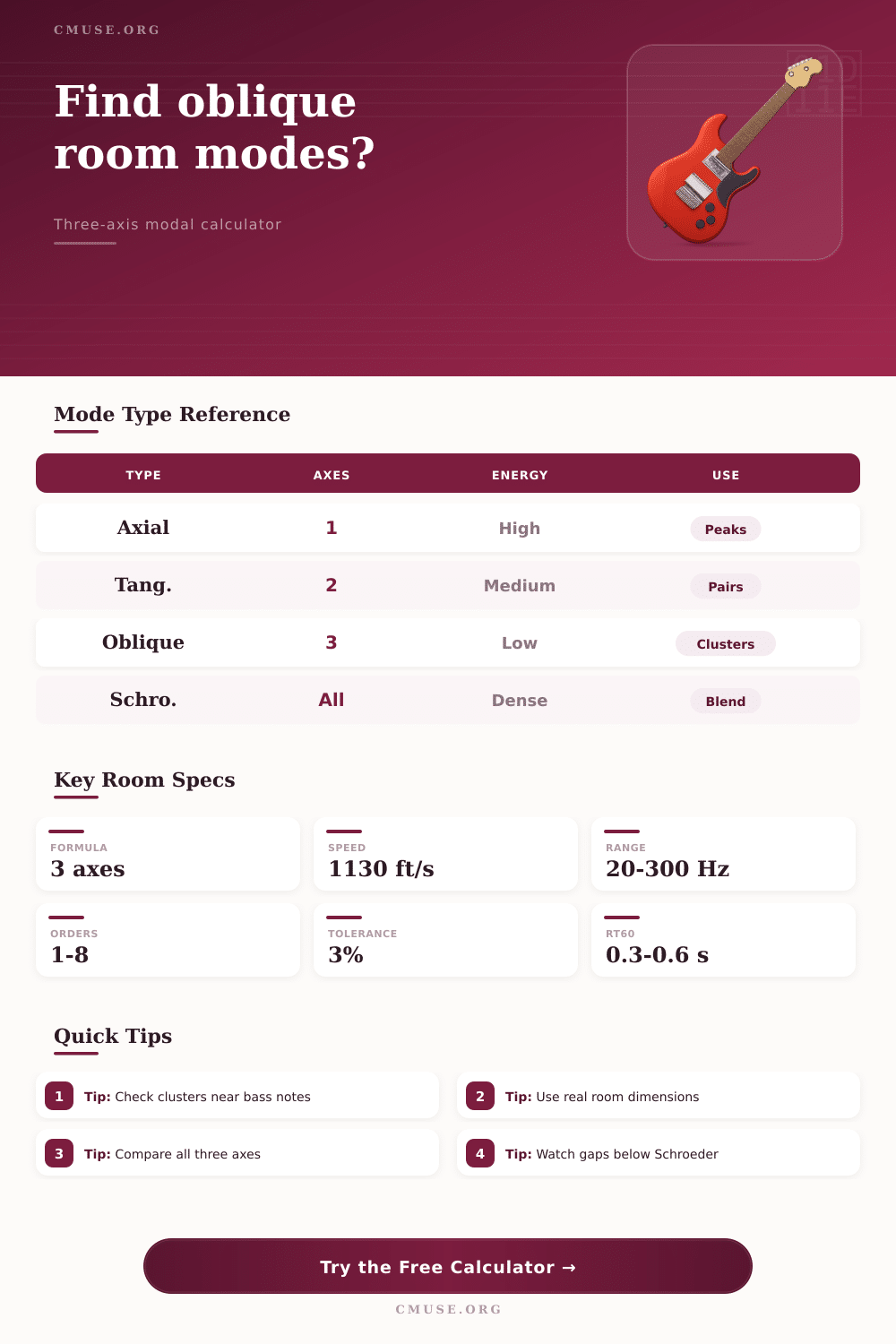
| Mode Class | Active Axes | Relative Energy | What It Reveals |
|---|---|---|---|
| Axial | One dimension | Highest single-axis pressure | Primary bass peaks and nulls |
| Tangential | Two dimensions | Usually lower than axial | Cross-axis modal reinforcement |
| Oblique | Length, width, and height | Spread across more surfaces | Dense clusters and uneven spacing |
| Schroeder region | Many overlapping modes | Room-dependent blend | Where individual modes become less isolated |
| Room Type | Typical Dimensions | Useful Scan Band | Watch Closely |
|---|---|---|---|
| Small booth | 5 x 6 x 7 ft | 70 to 300 Hz | Stacked high-order oblique modes |
| Bedroom studio | 10 x 12 x 8 ft | 35 to 250 Hz | Clusters near kick and bass fundamentals |
| Mix room | 14 x 18 x 9 ft | 25 to 220 Hz | Gaps between low modal groups |
| Live area | 20 x 16 x 12 ft | 20 to 180 Hz | Low-frequency build-up across corners |
| Temperature | Sound Speed ft/s | Sound Speed m/s | Modal Impact |
|---|---|---|---|
| 50 F / 10 C | 1107 | 337.3 | Slightly lower modal frequencies |
| 68 F / 20 C | 1125 | 343.2 | Common studio reference |
| 77 F / 25 C | 1134 | 346.1 | Slightly higher modal frequencies |
| 86 F / 30 C | 1143 | 349.0 | Useful for warm performance rooms |
| Mode Pattern | Example Orders | Meaning | Check |
|---|---|---|---|
| First oblique | 1, 1, 1 | Lowest three-axis interaction | Compare with first axial modes |
| Length-led | 2, 1, 1 | Extra variation along length | Check listening position depth |
| Width-led | 1, 2, 1 | Extra side-wall variation | Check left-right balance |
| Height-led | 1, 1, 2 | Extra floor-ceiling variation | Check ceiling cloud zone |
💡Practical Tips
Room mode refer to the pattern of sound that occur within enclosed space. These modes can alter the way that a person hear sound within a specific room. Oblique mode are a type of room mode that is often difficult to identify because they requires that you consider all three dimension of the room simultaneously.
Unlike axial modes, which only consider the sound reflecting off of two surface of a room, oblique modes tend to be quieter due to the sound reflecting off of more surfaces within the room. Oblique modes tend to cluster together at specific frequency, which can cause some sound to reinforce with others, while others may tend to cancel each other out. The calculator will provide mathematics results for room dimensions and temperature input into the calculator.
Oblique Room Modes and How to Check Them
The dimension that should be used are the finished dimensions of the room, which are the distances from one surface to the next in a room, such as from one plane of drywall to the next. The temperature must also be accounted for because change in the speed of sound will lead to changes in the modal frequencies of the sound waves. If the temperature is higher, the speed of sound will be higher and the modal frequencies will shift toward higher frequency.
The order value allow for the calculation of the specific frequency of each oblique mode. Using all order values of one will calculate the lowest possible frequency of oblique modes; higher order value will calculate higher frequencies. The results of the calculation can be analyzed to determine if any issue with room modes exist.
Often, there will not be any issue with the specific mode of oblique sound within a room. Issues can emerge, however, if there are cluster of oblique modes within the room. Using the tolerance setting for the calculator will determine if these cluster of modes create an issue for the listening within that space.
Additionally, the nearest-neighbor value will indicate how close the frequencies of the oblique modes are to each other. If they are close together, moving the listening position will help even out the oblique mode. The Schroeder frequency can help to determine the behavior of the modes within the room.
Modes will have distinct peak and troughs within frequencies below the Schroeder frequency; however, at frequencies above the Schroeder frequency, the modes will begin to behave similar to reverberation. The calculator can estimate the Schroeder frequency based off the size of the room and the RT60 value for that space. The RT60 value represents the time it take for the reverberations within the room to decay.
For a room with less reverb, the RT60 value will be lower; a lower RT60 value will result in a higher Schroeder frequency. This higher frequency will require treating more low frequency within a room before they begin to exhibit as mode problem. Many small recording studio experience issue with their rooms due to the fact that the frequencies of the first oblique mode of sound often fall within the frequency range of kick drum and bass guitar.
Often, the low-frequency scan limit is used to focus on the most important sound frequency within a room. This scan will begin at 20 Hz and end around 300 Hz. It is not necessary to catalog every mode within a room.
However, it is important to ensure that the important frequency are even with one another and not stacked on top of one another. Additionally, reference table provide a glimpse into the axial modes, tangential modes, and oblique modes of a room. Mathematical calculation cannot account for every variable that exist within a real room.
Variable include doors, windows, and furnitures. Each of these object will change the way that sound behave within a room. Sound wave that reflect off of surfaces of furniture will have their Q factor lowered because the object absorbs the sound.
This will change the strength of the mode. The temperature within a room will change during the recording session; the speed of sound will change. This will lead to changes in the modal frequency of the sound wave.
While the mathematical calculation of the modes can help to map out a room, utilizing a microphone and pink noise can help to catalog the actual mode within the room. Prior to placing the speaker within a room, or placing the listener within the best position for the speaker, the mode calculation should of been performed. If the first oblique mode and the neighbor to that mode fall within the frequencies of the most important musical note in a room, there will be issues at a variety of listening position.
If the cluster of oblique mode fall below the Schroeder frequency, treating the room for broadband trapping will be more effective than narrow notch filter. While the mathematical calculation is not the final answer in regard to room mode, the mathematical calculation will remove the guesswork within the treatment and placement of the speaker within a room.