Axial Mode Calculator
Calculate room length, width, and height axial modes from the c/2d formula, then check spacing, clusters, and low-frequency distribution for studio planning.
🎵 Quick Room Presets
📏 Room Dimensions
📊 Room Mode Summary Grid
🎼 Axial Mode Breakdown
Each row uses f = c / (2 × d) × n for one room axis. Oblique and tangential modes are intentionally excluded.
| Order | Length Axis | Width Axis | Height Axis | Notes |
|---|---|---|---|---|
| 1 | -- | -- | -- | Calculate to fill table |
🔎 Dimension Fundamentals
| Axis | Dimension | Formula | Fundamental | Common Issue |
|---|---|---|---|---|
| Length | 12 ft | c / 2d | 47.1 Hz | Front-back bass nulls |
| Width | 10 ft | c / 2d | 56.5 Hz | Side-to-side unevenness |
| Height | 8 ft | c / 2d | 70.6 Hz | Floor-ceiling buildup |
🧭 Spacing and Cluster Check
| Check | Result | Threshold | Interpretation |
|---|---|---|---|
| Closest Pair | -- | 3 Hz | Calculate to compare modal bunching |
| Largest Gap | -- | 20 Hz | Wide gaps can leave bass holes |
| Repeat Count | -- | 2 or more | Repeated modes raise risk |
| Modal Density | -- | Higher is smoother | Count inside selected range |
📝 Common Room Size Reference
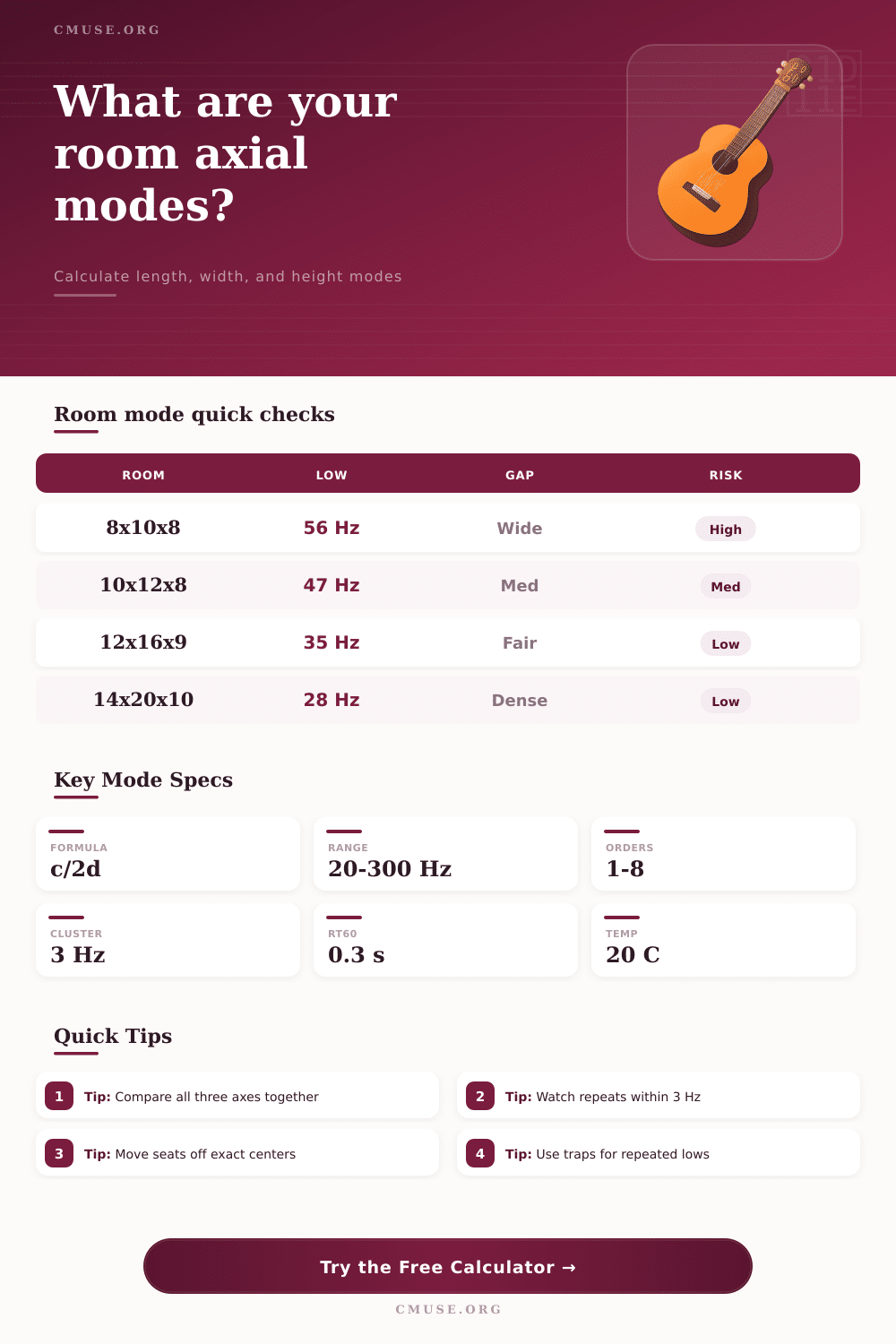
| Room Type | Dimensions | Lowest Mode | Main Concern |
|---|---|---|---|
| Recording Booth | 5 × 5 × 7.5 ft | 75 Hz | Repeated length and width |
| Bedroom Studio | 12 × 10 × 8 ft | 47 Hz | 70 Hz height buildup |
| Mix Room | 17 × 12 × 9 ft | 33 Hz | Front wall placement |
| Stage Rehearsal | 20 × 16 × 10 ft | 28 Hz | Low modal density |
| Small Cinema | 4.8 × 3.6 × 2.5 m | 36 Hz | Seat rows near nulls |
Understanding how sound move within a closed space requires an understanding of the standing waves that exists within each dimension of that closed space. These standing waves, known as axial mode, are those that travel in a direction that is parallel to each pair of walls within the room. When two or more of these axial modes exist within the same frequency, bass energy will either pile up within certain areas of the room or drop out of the room altogether.
Consequently, the frequency response of the listening room will be even. An uneven frequency response can make some chairs within that same room sound punchily while other chairs within that same space can sound hollow. A calculator can be used to apply the c over two-d formula to each dimension of the room.
How Sound Moves in a Room and How to Fix Bass Problems
Using such a calculator allow for the removal of guesswork regarding the frequency response of that room in advance of installing any acoustic treatment within the space. Relative to the size of the room, the ratios of the dimensions of the room are more important to understanding the relationship between sound and that room. Each ratio will determine whether the lowest axial modes within the room will even out amongst the area of the room or if those modes will end up bunching together within specific area.
For instance, if a room is in the shape of a cube, there will be a large number of axial modes of the first order and they will all be within the same frequency band. A rectangular room that is longer than it is wide and deep will have axial modes that are spread out over the room but there may be large gaps in the higher frequencies. Additionally, you can input the temperature and the reverberation time of the room into the calculation to allow for the calculation of the speed of sound within that room.
The use of this variable in the calculation allow for the estimation of the Schroeder frequency of the room. The Schroeder frequency is that frequency at which the axial modes coalesce into a field that is no longer defined by those standing waves. By changing the room temperature and reverberation time within the calculation, it is possible to determine how the colder or more dry the room is, the higher the Schroeder frequency will be.
Once you have calculated the frequencies of the axial modes within the room, the next step is to determine the spacing between each of those frequencies. If there are large gaps in the frequencies of the axial modes below approximately one hundred twenty hertz, there will be dead spots within the room at those frequencies. This is due to the fact that the sound wave does not exist at those frequencies within the space.
Conversely, if there are any tight clusters of axial modes within a range of three hertz, there will be reinforced peaks at those frequencies. These reinforced peaks will have a negative impact upon the sound system’s ability to accurately reflect sound in the room. Both dead spots and reinforced peaks can be flagged with the calculator so that the acoustic engineer can determine an appropriate response to each problem.
These responses may be shifting the position of the listener within the room, altering the dimension of the room during construction, or planning acoustic absorption to remove the problem frequencies. The placement of each listener in the room presents problems for the listener that are not defined in the numbers for the axial modes. For instance, if an individual is to sit in the center of the length or the width of the room, the listener will be positioned at a null for all odd orders of axial modes.
As a result, sound engineers typically move the listener a few feet from the center of the width and length of the room. The height at which the speakers are placed in relation to the axial modes that relate to the floor-to-ceiling dimension of the room can also have an impact upon the sound that is reflected in the room. By making these adjustments the engineers can make substantial difference to the sound in the room without adding any additional membrane traps to the speakers.
The same logic that is used to calculate the axial modes can also be used to determine the treatments that can be used within the room. If the axial modes are reasonably even within the room, broadband absorption treatments may be used. If the axial modes of a specific frequency band are within three hertz of each other, targeted Helmholtz resonator or membrane panels may be more efficient at treating that issue than other forms of acoustic treatment.
Additionally, these treatments will not deaden the low end of the speakers. While a calculator will not provide recommendations for acoustic treatments, the use of such a calculator will allow for an engineer to determine which frequencies require the most attention so that budget is applied to the frequencies that will make the most difference to the sound within that room. The axial mode analysis is a process that can change over time due to the effect that temperature and humidity has upon the sound environment within the room.
For instance, a recording studio may measure even with high accuracy during the winter months but experience new problems during the summer due to the increase in temperature within the room. Consequently, the measurement range for axial modes should be wide enough to account for axial modes within the range of up to three hundred hertz so that any seasonal change to the humidity or temperature of the room is accounted for. Additionally, while the input of the reverberation time of the room is an estimate, the reverberation time will still reveal at what point the room begins to transition into a more diffuse field.
Such a measurement can help to reveal how much control should be applied to the early reflections within the room in addition to bass traps. Axial mode analysis is not a process that allows engineers to determine the best numbers for the acoustic environment. A small room will always have some degree of bunching of axial modes.
The best solution, however, is to ensure that those axial modes are not placed in the most important octaves of sound. Additionally, the placement of listeners within the room should be considered so that they are not within any nulls for the axial modes. Before constructing the room or purchasing acoustic traps for that space, the dimensions of the room should be entered into a calculator that calculates axial modes.
By running the dimensions of the room through the calculator, the acoustic engineers will have a list of the specific frequency that will require treatment within the room.