Mean Free Path Acoustic Calculator
Estimate a room's geometric mean free path from the real Sabine room-acoustics relationship: path length equals four times volume divided by total boundary surface area.
🎵 Quick Room Presets
📏 Room Geometry Inputs
mean free path = 4V / S, where V = L × W × H and S = 2(LW + LH + WH) plus selected boundary additions. Reflection interval is MFP / c.
📊 Current Room Snapshot
🎧 Mean Free Path Reference Bands
| Room Type | Typical MFP | Reflection Interval | Acoustic Reading |
|---|---|---|---|
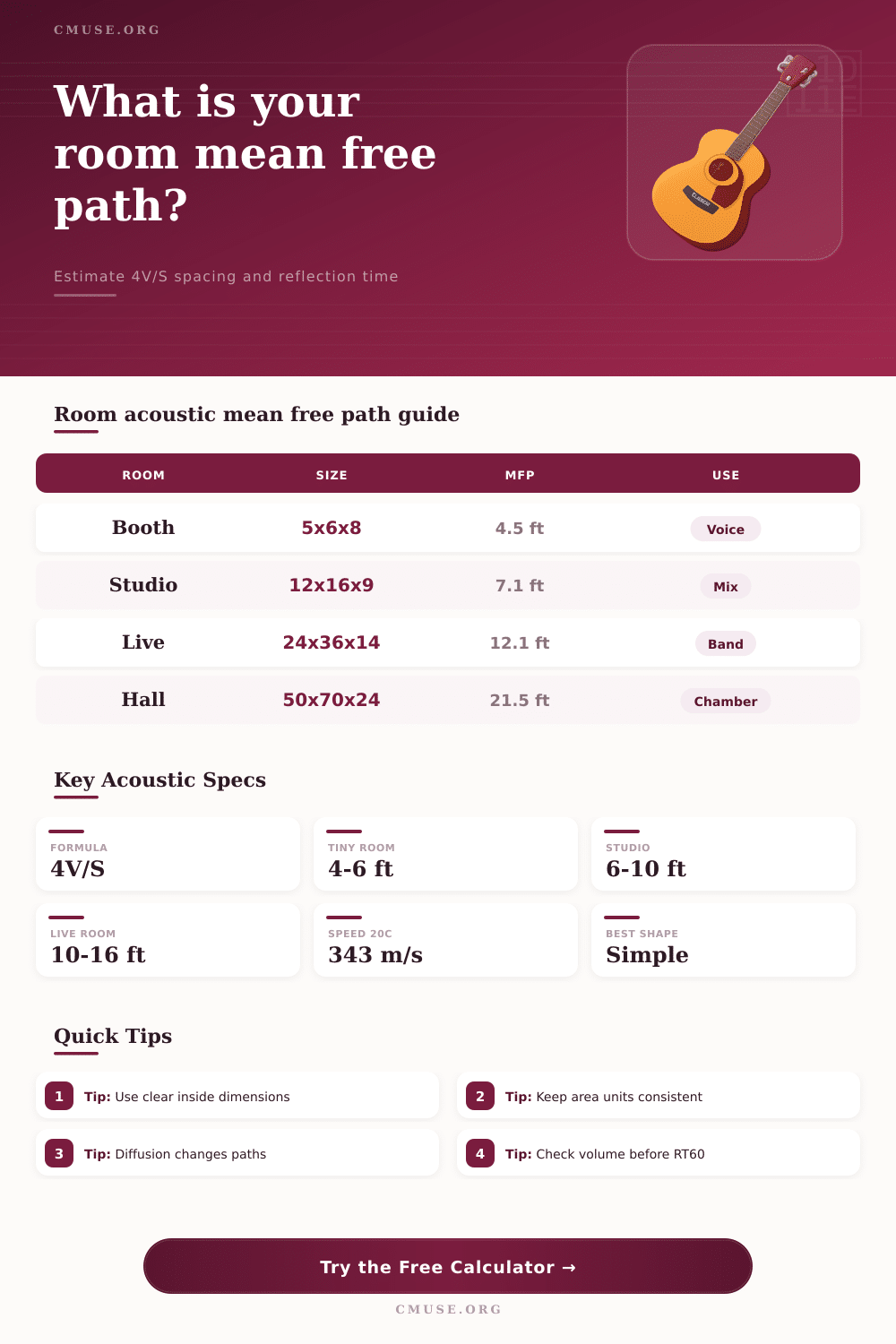
| Very small vocal booth | 3.5–5.5 ft / 1.1–1.7 m | 3.1–4.9 ms | Dense early reflections; treatment placement is critical. |
| Practice or podcast room | 5.0–7.0 ft / 1.5–2.1 m | 4.4–6.2 ms | Fast wall encounters; flutter paths need attention. |
| Mix room or project studio | 6.5–10 ft / 2.0–3.0 m | 5.8–8.9 ms | Balanced size for controlled early-reflection design. |
| Live room or scoring space | 10–18 ft / 3.0–5.5 m | 8.9–16 ms | More air between reflections; diffusion becomes useful. |
| Recital or chamber hall | 18–30 ft / 5.5–9.1 m | 16–27 ms | Longer acoustic paths support ensemble blend and spaciousness. |
🧮 Geometry Formula Table
| Step | Formula | Units | Why It Matters |
|---|---|---|---|
| Volume | V = L × W × H | ft³ or m³ | More volume lengthens the average distance between impacts. |
| Boundary surface | S = 2(LW + LH + WH) | ft² or m² | More surface gives sound rays more opportunities to strike a boundary. |
| Mean free path | MFP = 4V / S | ft or m | Core diffuse-field distance used in room acoustics. |
| Reflection interval | t = MFP / c | milliseconds | Converts distance into average time spacing between boundary hits. |
| Sabine context | RT60 = 0.161V / A | seconds | Uses metric volume and equivalent absorption area for decay context. |
🏛 Common Room Size Examples
| Scenario | Inside Dimensions | 4V/S Mean Path | Average Interval |
|---|---|---|---|
| DJ booth | 6 x 4 x 8 ft / 1.8 x 1.2 x 2.4 m | 3.4 ft / 1.0 m | 3.0 ms |
| Recording booth | 5 x 5 x 7.5 ft / 1.5 x 1.5 x 2.3 m | 4.0 ft / 1.2 m | 3.6 ms |
| Home studio | 10 x 12 x 8 ft / 3.0 x 3.7 x 2.4 m | 6.2 ft / 1.9 m | 5.5 ms |
| Mix room | 12 x 16 x 9 ft / 3.7 x 4.9 x 2.7 m | 7.5 ft / 2.3 m | 6.7 ms |
| Live room | 24 x 36 x 14 ft / 7.3 x 11.0 x 4.3 m | 13.0 ft / 4.0 m | 11.6 ms |
⚙ Surface Complexity Guide
| Boundary Condition | Surface Factor | Use When | Effect On MFP |
|---|---|---|---|
| Simple rectangular shell | 1.00 | Flat walls, flat ceiling, no major protrusions. | Pure textbook 4V/S result. |
| Small soffit or bay | 1.02 | One projection, shallow window bay, or small closet face. | Slightly shortens the path. |
| Typical studio details | 1.04 | Cloud edges, equipment racks, panels, and modest reveals. | Moderate surface increase. |
| Alcoves and risers | 1.08 | Broken rear wall, stage lip, multiple wall angles. | Noticeably shorter average path. |
| Highly broken boundary | 1.12 | Large diffusers, deep coffers, shelving, columns. | Shortest geometric estimate for same volume. |
Sound travels in a room by reflecting off of the walls, ceilings, and floors. The average distance that sound travels between reflections in a room is referred to as a mean free path. The mean free path is a specific measurement of the average distance that sound travels before it begin to reflect off of a surface within the room.
Furthermore, the mean free path allow individuals to understand how sound will behave within a specific room, whether the sound within that room will seem distant or crowded, and even how often that sound will reflect off of the surfaces within that given space. Should the mean free path be relatively short within that space, the reflections of sound will occur very frequent. However, should the mean free path be relatively long within that space, the reflections of sound will occur less frequently within that space.
Mean Free Path: How Far Sound Travels Before It Hits a Surface
In order to calculate the mean free path of a specific room, one must calculate the volume of that room and the total surface area of that room. The formula to calculate the mean free path is four times the volume of the room divided by the total surface area of the room. Such a calculation will provide the average distance that sound travels within that given space.
The measurement of this value is important for all types of rooms, ranging from rectangular rooms to those with angled ceilings or window bays. Any angled ceilings or window bays will increase the total surface area of the room without increasing the volume of the space. An increase in the total surface area of the space will decrease the mean free path of that space.
Thus, any rooms with complex surfaces will have shorter mean free path distances than those with more standard and simple surfaces. In order to calculate the mean free path of a given room using a calculator, the length, the width, and the height of the room must be determined. These three measurements determine the volume of the space, which is one of the variables required in calculating the mean free path of that specific area.
Small spaces, such as vocal booth, will have smaller distances for mean free path calculations than large areas, such as live rooms. Thus, calculating the mean free path using a calculator allows individuals to compare the size of their rooms. Furthermore, the calculator indicates the mean free path calculation for any difference in dimensions for that specific space.
Beyond calculating the mean free path, there are additional benefits to calculating the mean free path within a given space. For instance, the mean free path will determine how sound will reflect off of the surfaces within that room. Shorter mean free paths indicate that the sound will reflect more often off of the surfaces within that space.
Additionally, shorter mean free paths indicate that the sound will reflect more often off of the surfaces within that space, meaning that sound absorption will occur more often. A longer mean free path indicates that sound will travel for greater distance within the space before it reflects off of a given surface. Thus, there is more time for sound to travel through the air within that space.
Neither a short mean free path nor a long mean free path is inherently either good or bad; it entirely depends upon the goal of the individual who is utilizing the space. While many may focus upon adding acoustic treatment to their space, the geometry of the space will determine how well the acoustic treatment will work within that space. For instance, if the mean free path of the space is very short, even a small amount of acoustic treatment will have an impact upon the sound that is reflected.
However, if the mean free path of the space is very long, the same amount of acoustic treatment may have less of an impact upon the sound that is reflected from that space. Thus, individuals who wish to treat their spaces for specific sound reflections will benefit from understanding the mean free path of their space, as it can help them to understand how much acoustic treatment they may need to apply to achieve the desired outcome. Another additional factor that may impact the mean free path is the temperature of the space.
More specifically, temperature may have an impact upon the mean free path because temperature can change the speed at which sound travels through that space. Therefore, the calculator also include the temperature of the space as one of its variables. While a small change in the temperature of the space will not significantly impact the space, changes to the temperature will have an impact upon the mean free path when performing comparisons between different measurement of the same space.
Furthermore, the measurements of the timing of the reflections of sound within the space are measured in milliseconds, which are the units of time that the human ear use to differentiate between sounds. The calculated mean free path is just an estimated value for that space. For instance, adding object to a space will change the mean free path of that space.
Any additions to the space will change the total surface area of that space, which will change the mean free path. Furthermore, while the formula for calculating the geometric mean free path is correct, it does not account for the way in which sound may move through the space with the addition of object that create diffusion. Thus, in addition to calculating the mean free path, the calculator also provides an estimation of the impact of sound diffusion upon that space.
Beyond the dimensions of the space, the proportion of the space will also impact the mean free path. For instance, a space that is shaped like a cube will have a different mean free path than a space that is rectangular and long and narrow. Thus, any difference in the shape of the space will be reflected in the mean free path calculation.
Furthermore, if the calculated mean free path is not as expected for the space, it is possible that the dimension of the space are the issue. For instance, changing the height of the space will change both the volume and the surface area of the space. Thus, changing either of these value will lead to a change in the mean free path calculation for that space.
Finally, the mean free path of the space can be compared to the mean free paths of other space with similar purposes. For instance, vocal booths, mix rooms, and recital halls may have different mean free paths due to their different size and goals. Thus, individuals can use these reference ranges to determine if the mean free path of their space is appropriate for the task that the space is to be used for.
Overall, then, the mean free path is a number that enables individuals to determine the mean free path of their space, to understand how sound will reflect within that space, and to make better decisions regarding the design of that space.