Eyring Formula Calculator
Estimate RT60 with room volume, total surface area, frequency-band absorption, seating, audience absorption, treatment area, and high-frequency air loss.
🎶Descriptive Acoustic Presets
🎚Room, Surface, and Treatment Inputs
📊Spec Grid for the Current Calculation
📐Absorption Coefficient Reference
| Material | 125 Hz | 500 Hz | 1 kHz | 4 kHz |
|---|---|---|---|---|
| Painted gypsum board | 0.29 | 0.05 | 0.04 | 0.07 |
| Wood floor or paneling | 0.15 | 0.10 | 0.07 | 0.07 |
| Heavy carpet on pad | 0.08 | 0.57 | 0.69 | 0.71 |
| Acoustic ceiling tile | 0.45 | 0.80 | 0.75 | 0.70 |
| 2 inch broadband panel | 0.17 | 0.86 | 1.00 | 1.00 |
| 4 inch broadband panel | 0.84 | 1.14 | 1.07 | 1.02 |
⏱RT60 Target Ranges
| Use profile | Typical target | Useful band | Primary listening concern |
|---|---|---|---|
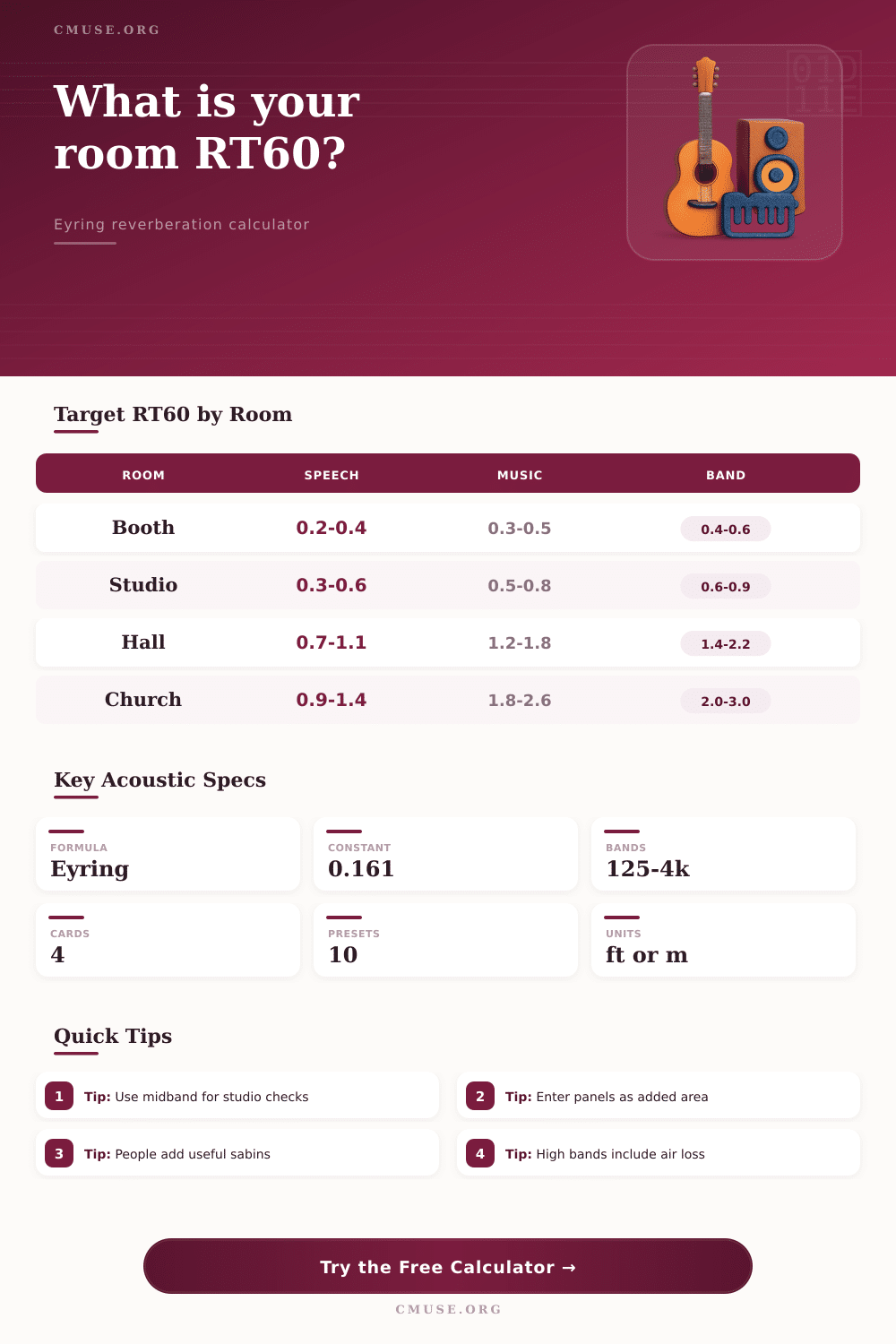
| Voiceover or vocal booth | 0.20 to 0.40 s | 500 Hz to 2 kHz | Dry articulation and low room tone |
| Control room or mixing | 0.30 to 0.60 s | 250 Hz to 4 kHz | Translation, imaging, and decay balance |
| Practice or ensemble room | 0.45 to 0.90 s | 500 Hz to 2 kHz | Musicians hear each other without harsh buildup |
| Music classroom | 0.50 to 0.80 s | 500 Hz to 1 kHz | Speech clarity with enough musical support |
| Small recital hall | 1.10 to 1.70 s | 500 Hz to 1 kHz | Natural sustain without losing detail |
| Choral or worship room | 1.60 to 2.40 s | 500 Hz to 1 kHz | Blend, warmth, and intelligible text |
🎧Common Room Size Examples
| Room example | Dimensions | Volume | Common target |
|---|---|---|---|
| Recording booth | 5 x 5 x 8 ft | 200 ft³ / 5.7 m³ | 0.20 to 0.40 s |
| Home mix room | 10 x 12 x 8.5 ft | 1,020 ft³ / 28.9 m³ | 0.30 to 0.60 s |
| Practice room | 8 x 8 x 8 ft | 512 ft³ / 14.5 m³ | 0.45 to 0.90 s |
| Small stage area | 20 x 16 x 12 ft | 3,840 ft³ / 108.7 m³ | 0.70 to 1.20 s |
| Recital hall | 48 x 32 x 20 ft | 30,720 ft³ / 870.0 m³ | 1.10 to 1.70 s |
🔢Eyring Formula Breakdown
| Quantity | Metric expression | Imperial note | How it is used |
|---|---|---|---|
| Room volume | V = L x W x H | ft³ converted to m³ | Higher volume lengthens reverberation |
| Boundary area | S = 2LW + 2LH + 2WH | sq ft converted to m² | Eyring uses total enclosing surface |
| Mean absorption | alpha = A / S | A is equivalent sabins | Bounded below 0.97 for log stability |
| RT60 | 0.161V / (-S ln(1-alpha) + 4mV) | Metric calculation reported in both units | Air loss matters mostly at high bands |
💡Acoustic Calculation Tips
RT60 is the measurement of the time it take for a sound to drop sixty decibels after a sound source stop making noise. RT60 is an important measurement in sound reinforcement and acoustic engineering in particular because RT60 will indicate to engineers how sound linger in a space or how quickly sound dies away in a space. For instance, in recording studios, an engineer will use the measurement of RT60 to determine if a vocal recording will sound clear or blurry due to reflections.
In classrooms, the measurement of RT60 will indicate to teachers and school administrators if students can hear the teacher or if the students has to strain to hear the teacher. Finally, people often use the Eyring formula as a means of calculating the value of the RT60 for a space prior to it’s construction. The Eyring formula utilizes several different values as the means of calculating the value of the RT60 for a space.
What RT60 Is and How to Use the Eyring Formula
The Eyring formula requires the measurements of the volume of the space to be built, the total surface area of the space to be built, and the average absorption of the surfaces of that space. Additionally, the Eyring formula does not use the assumption that a flat percentage of the sound within the space will disappear with each reflection of that sound within the space. Instead, the Eyring formula utilizes a logarithmic correction factor to its equation.
Calculations for spaces with high rates of sound absorption utilize this logarithmic correction factor. High rates of sound absorption are often common within small performance room and small recording studios with sound treatment panels installed within the studio. The materials used to construct the floors, ceilings, and walls of a space will impact the sound absorption within that space.
For instance, a wood floor will reflect more sound energy within the midrange frequencies than a carpet with a pad. Conversely, the carpet with a pad will absorb more sound energy than a wood floor. Ceiling tiles will absorb energy from sound within the upper frequencies of sound but will not absorb much of the lower frequencies of sound.
Painted gypsum ceilings will reflect the speech frequencies of sound but different types of treatment panels will reflect different frequencies. The presence of an audience in a space will also impact the absorption of sound within the space. Audiences will absorb sound within predictable manner and human beings will absorb sound within the speech range.
Additionally, upholstered seats will also absorb some of the sound created within the space. Calculators is available that can calculate the impact that audiences will have upon the absorption of sound within a space. Additionally, calculators are available to calculate the impact that upholstered seats will have upon the absorption of sound in a space.
Air will absorb some of the sound created in a space but this absorption mostly occurs for sound at higher frequencies. Humidity levels will impact the absorption of sound in air so adjustments to the humidity settings for a space will need to be made to calculate the impact of sound on sound absorption within that space. The outputs from the Eyring formula will provide a space with information regarding the sound reflection within the space.
One measurement from the calculation will be the RT60 for the space. Additionally, other measurements provided by the Eyring formula will include the equivalent absorption figure for the space and the average absorption coefficient of the space. The RT60 value will allow space engineers to determine if the space will meet the required target range for the RT60.
Additionally, the other measurements will provide additional information as to whether or not the space is achieving the target for the RT60. If the RT60 for the space is within the target range, then the balance of the space is likely within an acceptable range. However, if the calculated value of the RT60 is outside of the target range, then the engineers can utilize the information provided by the Eyring formula to determine which areas of the space may require additional treatment.
Engineers make many mistakes when attempting to calculate the RT60 of a space using the Eyring formula. One of the most common mistakes that engineers make is the assumption that each type of surface within a space is equally important in relation to sound reflection. In fact, the largest surfaces within a space have the most impact upon the calculation of the RT60 of that space.
For instance, changing the materials for the floor or ceiling will have a much more greater impact upon the calculated value of the RT60 than will changing the paint on the walls of the space. Additionally, engineers often only calculate the absorption of sound within a specific frequency band when using the Eyring formula. However, sound absorption change with the pitch of the sound that is played within the space.
An engineer should calculate the absorption of sound at several frequency bands to ensure that the space will meet the requirements for each specific frequency band. Although the Eyring formula can help engineers to calculate the expected value of the RT60 of a space, there are a variety of variables that the Eyring formula cannot capture. Such variables may include the placement of furniture within the space, the placement of doors within the space, and the way in which the individuals within the space will be sitting within that space.
Because the Eyring formula cannot capture these variables, it is important for the engineers to perform an impulse response test for the space once it has been built. The impulse response test will help to reveal whether the calculation of the RT60 using the Eyring formula was accurate in comparison to the actual sound that is reflected within the space when it is built. Furthermore, the impulse response test can reveal where adjustments may need to be made to the space to achieve the target calculations for the RT60.
There are also reference tables that provide engineers with information regarding the absorption of sound by different materials. These tables show the difference in absorption of sound by thin carpets vs. Heavy carpet pads, for instance. Additionally, the tables can also reveal the difference in sound absorption by two-inch sound absorption panels vs. Four-inch sound absorption panels.
Additionally, these tables can help to engineers to determine the cost of a sound absorption material versus the performance of that material. Consequently, these tables can help engineers to substitute one type of material for another in a space. The Eyring formula allows engineers to move from using intuition as to what materials should be used within a space to using a series of numbers to indicate what types of ceilings treatments will be required for a space.
Furthermore, these numbers will allow engineers to explain why certain types of treatment will be required for a space versus others. For instance, numbers will allow engineers to explain why certain counts of audience members will require adjustments to the target calculation for the RT60 of that space. Thus, the Eyring formula does not replace the engineers need to listen to spaces, but it will help to avoid surprises with the construction of a space.