Rest Value Calculator
Convert rest symbols, BPM, meter, dotted values, triplets, and repeated silence into exact durations for notation, arranging, and DAW editing.
🎼 Rest Presets
⏱ Rest Timing Inputs
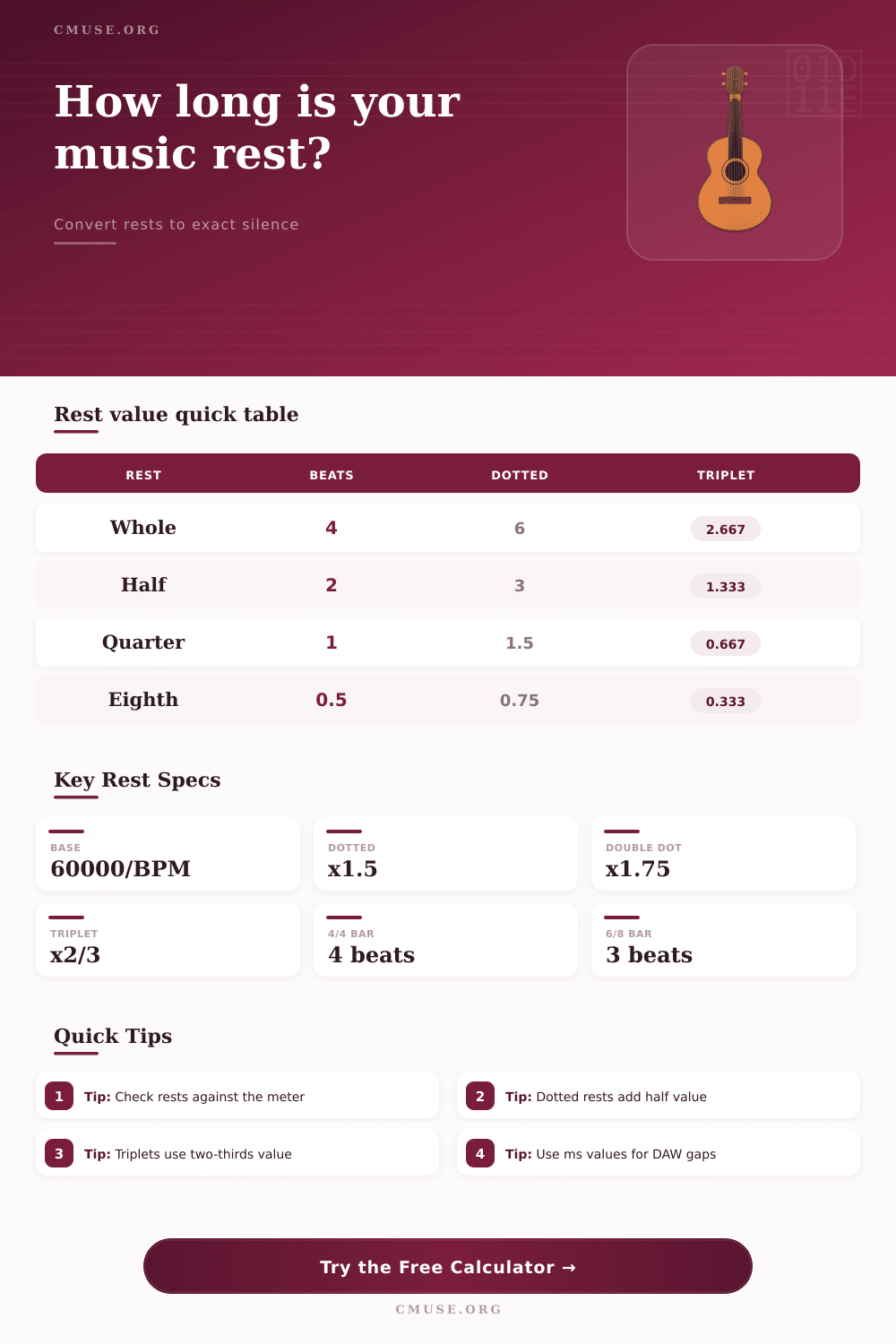
The calculator treats a quarter note as 60000 divided by BPM. Dotted rests multiply the base value by 1.5, double-dotted rests by 1.75, and triplet rests by 2/3.
📊 Rest Formula Grid
| Base Rest | Quarter-Note Beats | 120 BPM Straight | 120 BPM Dotted |
|---|---|---|---|
| Breve Rest | 8 beats | 4000 ms | 6000 ms |
| Whole Rest | 4 beats | 2000 ms | 3000 ms |
| Half Rest | 2 beats | 1000 ms | 1500 ms |
| Quarter Rest | 1 beat | 500 ms | 750 ms |
| Eighth Rest | 0.5 beat | 250 ms | 375 ms |
| Sixteenth Rest | 0.25 beat | 125 ms | 187.5 ms |
| Modifier | Formula | Quarter Rest at 120 | Use Case |
|---|---|---|---|
| Straight | base x 1 | 500 ms | Plain notation |
| Dotted | base x 1.5 | 750 ms | Long syncopation |
| Double Dotted | base x 1.75 | 875 ms | Compound figures |
| Triplet | base x 2/3 | 333.33 ms | Triplet spacing |
| Quintuplet | base x 4/5 | 400 ms | Five-note group |
| Septuplet | base x 4/7 | 285.71 ms | Seven-note group |
| Meter | Measure Beats | Whole Bar at 120 | Common Rest Fit |
|---|---|---|---|
| 2/4 | 2 quarter beats | 1000 ms | Half rest |
| 3/4 | 3 quarter beats | 1500 ms | Dotted half rest |
| 4/4 | 4 quarter beats | 2000 ms | Whole rest |
| 5/4 | 5 quarter beats | 2500 ms | Half plus dotted half |
| 6/8 | 3 quarter beats | 1500 ms | Dotted quarter pairs |
| 7/8 | 3.5 quarter beats | 1750 ms | Group as 2+2+3 |
| Scenario | BPM | Rest Value | Exact Silence |
|---|---|---|---|
| Pop Stop | 120 | Quarter | 500 ms |
| Ballad Breath | 72 | Dotted Half | 2500 ms |
| 6/8 Cadence | 84 | Dotted Quarter | 1071.43 ms |
| Triplet Pickup | 132 | Triplet Eighth | 151.52 ms |
| Dance Cut | 128 | Dotted Eighth | 351.56 ms |
| DnB Chop | 174 | 32nd x 8 | 344.83 ms |
A rest in music indicate a period of silence, and it is the decision regarding what musical element are not being played. A rest is a musical element that indicates a period of silence and is one of the component of music. Using a rest value calculator, the written rest symbol can be translated into amount of time the rest will take when played.
The tempo of the music are one of the variables that must be considered when calculating the time that a rest will take when played. The duration of the rest is dependent upon the tempo of the music. For example, at a tempo of 120 beats per minute, a quarter rest will take 500 milliseconds.
How to Calculate Rest Time in Music
However, at a tempo of 84 beats per minute, the same quarter rest will last 714 milliseconds. A rest value calculator takes care of these calculation so that the musicians do not have to perform these calculations in there heads each time they wish to alter the tempo of the music. Musical notation element, such as triplet rests or dotted rests, will alter the value of the rest in music.
A dotted rest will add half of the value of the rest to the base value of the rest. A double-dotted rest will add even more time to the rest then a dotted rest. A triplet will reduce the amount of time that the rest will take to play.
These notational elements is important to the musicians because they determine how the musicians intend for the musical phrases to ebb and flow within the piece of music. The notation and time signature field in a rest value calculator allow for musicians to account for these notational elements. Musicians may need to use multiple rest within a particular phrase of music.
For example, musicians may use three eighth rests or eight sixteenth rests in a row. The count and measure target field on a rest value calculator allow musicians to account for this and determine the effect that the rests will have on the musical phrase. In addition to tempo, musicians may also adjust the playback rate and groove offset of the music.
Using a half speed playback rate will double the duration of rest in the music. Musicians may forget this when editing music. The groove offset allow musicians to modify the release of rests in the music by a few milliseconds.
This allow musicians to fine-tune the music to ensure that the silence in the music is either intentional or empty to convey the message that the musicians wish to convey. The meter of the music will also change the meaning of the rests in music. For instance, in 4/4 time, a whole rest will last for four beats and fill the measure.
In 3/4 time, a whole rest will last for a full measure of silence in the music, even though a full measure of 3/4 time contains only three beats. The rest value calculator indicate the length of a rest relative to the length of the measure of the music so that musicians do not use four beat for a whole rest as if it were in 4/4 time. The reference table on the page allow musicians to view the relationship of the different types of rests in music.
The tables show the length of a dotted quarter rest relative to a triplet eighth rest at a specific tempo. These tables also show how different meters, such as 6/8 time, will impact the rests in music. The musicians do not need to memorize these tables, but they do help the musicians to understand how rests will play out in music relative to the different type of rests that may be written in the musical score.
The rest value calculator is of the most practical use to musicians when sequencing music or performing live. The ability to understand the length of rests in milliseconds will allow musicians to accurately place edit point within their digital audio workstation. The length of rests in milliseconds will also allow musicians to program gate effect.
Without the rest value calculator, musicians may find that rests that appear correct on the musical score can be too short when the music is played with a click track. Musical rests contain as much information as the musical notes that surround them. By neglecting rests in music, musicians may create musical phrases that are either too tight or too loose with the music.
By using a rest value calculator that account for tempo, musical notation modifier, meter, and the number of rests in a musical phrase, musicians will have a better understanding of the silence that they will include in their musical performance.