Beats Per Measure Calculator
Decode time signatures, additive groupings, compound pulse, pickup measures, and section timing from one clean meter calculator.
🎼 Meter Presets
⏱ Time Signature Inputs
📊 Current Meter Grid
🎶 Common Meter Reference
| Time Signature | Typical Beat Count | Common Grouping | Practical Feel |
|---|---|---|---|
| 2/4 | 2 quarter-note beats | 2 | March, polka, direct two-count pulse |
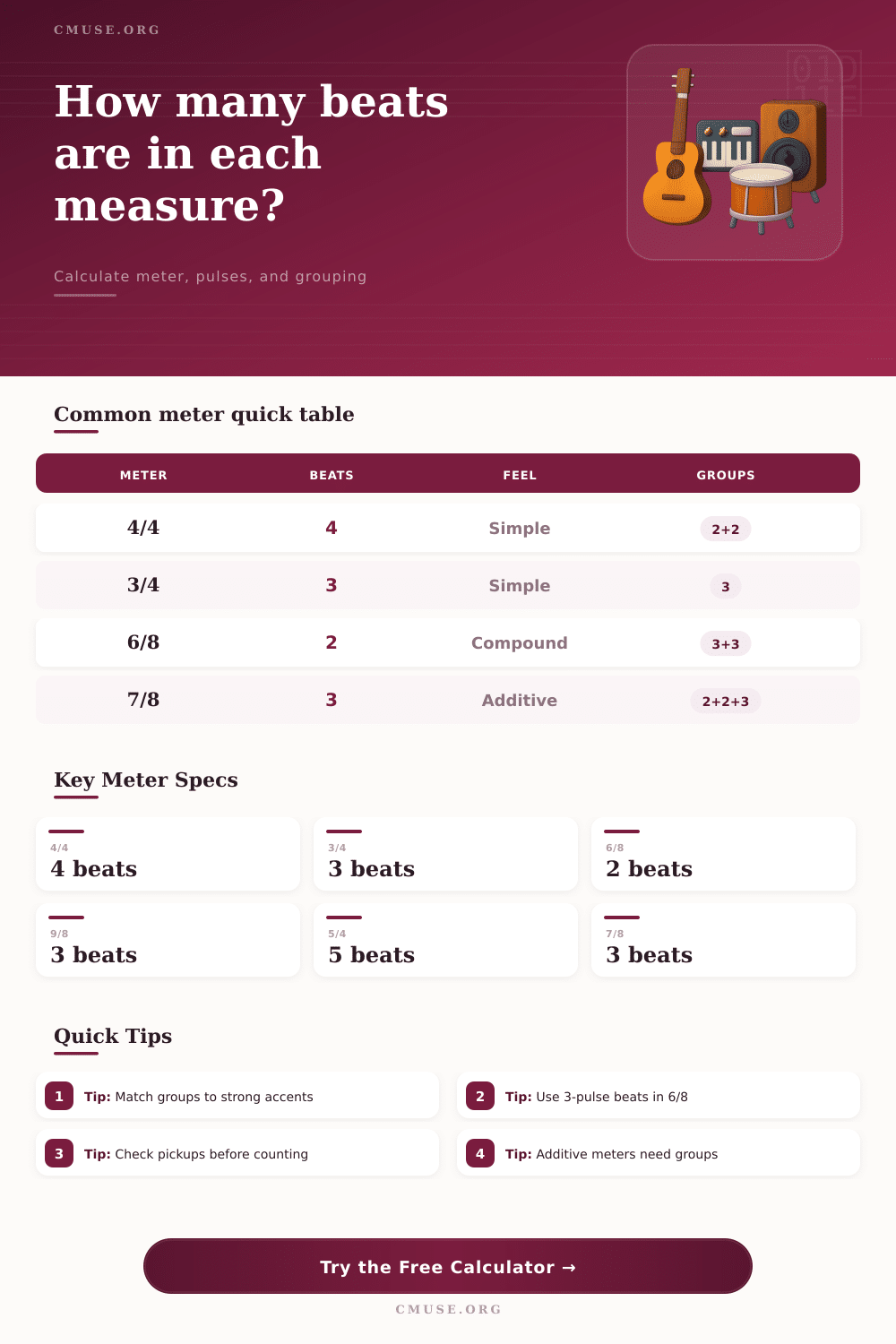
| 3/4 | 3 quarter-note beats | 3 | Waltz, minuet, strong-weak-weak motion |
| 4/4 | 4 quarter-note beats | 2+2 or 4 | Common time, backbeat, pop and rock default |
| 2/2 | 2 half-note beats | 2 | Cut time, fast music read in two |
| 5/4 | 5 quarter-note beats | 3+2 or 2+3 | Asymmetrical simple meter |
| 7/4 | 7 quarter-note beats | 4+3, 3+4, or 2+2+3 | Long additive bar with shifting phrase weight |
🎚 Compound and Additive Grouping
| Meter | Written Counts | Primary Beats | Grouping Formula |
|---|---|---|---|
| 6/8 | 6 eighth notes | 2 dotted-quarter beats | 6 counts / 3 counts per beat = 2 |
| 9/8 | 9 eighth notes | 3 dotted-quarter beats | 9 counts / 3 counts per beat = 3 |
| 12/8 | 12 eighth notes | 4 dotted-quarter beats | 12 counts / 3 counts per beat = 4 |
| 5/8 | 5 eighth notes | 2 grouped beats | 2+3 or 3+2 makes two uneven beats |
| 7/8 | 7 eighth notes | 3 grouped beats | 2+2+3 or 3+2+2 makes three beats |
| 11/8 | 11 eighth notes | 4 grouped beats | 3+3+3+2 creates four uneven beats |
📐 Beat Unit Timing Table
| Beat Unit | Quarter Ratio | Duration at 120 BPM | Use Case |
|---|---|---|---|
| Half note | 2.00 quarter notes | 1000 ms | Cut time and broad conducting patterns |
| Quarter note | 1.00 quarter notes | 500 ms | Most simple meters and DAW grid counting |
| Dotted quarter | 1.50 quarter notes | 750 ms | Compound 6/8, 9/8, and 12/8 pulse |
| Eighth note | 0.50 quarter notes | 250 ms | Fast asymmetrical meters such as 7/8 |
| Dotted eighth | 0.75 quarter notes | 375 ms | Fine compound subdivision or syncopated counting |
| Sixteenth note | 0.25 quarter notes | 125 ms | Detailed grid, tuplets, and rhythmic programming |
📋 Section Examples
| Scenario | Meter | Measures | Total Primary Beats |
|---|---|---|---|
| Pop verse grid | 4/4 | 8 | 32 quarter-note beats |
| Waltz phrase | 3/4 | 16 | 48 quarter-note beats |
| Blues shuffle feel | 12/8 | 12 | 48 dotted-quarter beats |
| Prog riff cycle | 7/8 | 14 | 42 grouped eighth-note beats |
| Slow compound intro | 6/8 | 8 | 16 dotted-quarter beats |
| Odd-meter turnaround | 11/8 | 6 | 24 grouped eighth-note beats |
A time signature consist of two numbers that tell the musician specific informations about the music in that piece, but the time signature does not always contain information that tells a musician the number of primary beat in each measure. The number on the top of the time signature tell the musician the number of counts in each measure, while the bottom number of a time signature indicate the value of the note that represent one count. Even if a musician understands the time signature of a song and know the number of counts in each measure, they may not understand how many primary beats is contained within each measure due to the fact that the grouping pattern of the musical note within each measure determine the number of primary beats.
A musician must understand the difference between written counts and primary beats in order to understand the meter in which the music is written. The grouping pattern within music can change the number of primary beats within each measure, even with the same number of written counts. For instance, music written in 6/8 time contain six eighth notes within each measure.
Written Counts and Main Beats
However, the musician may feel as if there are only two large pulses within each measure. In this case, each pulse contain three eighth notes and there are only two primary beats within the measure. However, if the musician feels as if there are six individual eighth note pulses within the measure, then there are six primary beats within that measure.
Thus, the same number of written counts are used, but the number of primary beat changed as a result of the change in grouping pattern of the musical notes within that measure. Many musical meter that contain additivity also use the concept of grouping patterns to indicate the number of primary beats that should be used within each measure. For instance, a meter of 7/8 time indicate that there are seven eighth notes within each measure.
However, musicians may not feel seven individual beats within that measure. Instead, the musician may feel three uneven beats within each measure, such as when the musician sets the grouping pattern within the music as 2+2+3 rather than individual eighth note. In this case, each grouping of three beats have a primary beat for that measure, resulting in three primary beats within each measure.
Thus, the same number of written counts are used, but the grouping pattern indicate to musicians the number of primary beats that should be used within each measure. While the tempo and subdivisions within a piece of music can affect the perception of the number of primary beats within each measure, the tempo and subdivisions does not change the number of beats within each measure. For instance, if the tempo increase within a section of music, that section will contain fewer beats within that section.
However, the total number of beats that will pass within that section of music will be the same. Similarly, if the musicians change the subdivisions from straight notes to triplets, the musicians may feel as if the music change within that section of music. However, there will still be the same number of beats within that measure.
Thus, while musicians may argue about the tempo of music, they are actualy arguing about the subdivisions of the beats rather than the number of beats within each measure. Finally, pickup measures and phrase accent can have an impact upon how musicians and listeners perceive the number of primary beats within a section of music. Pickup measures often contain fewer musical note than the other measures within the song.
As such, the accent within pickup measures may be felt differently from the remaining measure of the song. However, pickup measures do not change the number of beats contained within the complete measures that follow the pickup measures. Additionally, while the accents that occur every few measures will create a larger pulse that exists within the music in addition to the beats that occur from bar to bar, these accent will not change the number of beats contained within each measure.
However, they will change how the musicians breathes within the music, as well as the dynamics of each section of music. Understanding the difference between written counts and primary beats in music allow musicians to make decision regarding the arrangement of the music. For instance, if a section of music is in 9/8 time, it may contain three primary beats within each measure rather than nine primary beats.
Thus, the musicians may know that six beats may contain three pulses rather than six individual pulses within the section of music. As such, if musicians counted the number of small pulses rather than the large pulses that contain three eighth notes, the music may fight against the groove that musicians intend to create within the section of music. However, if musicians counted the number of large, three-beat pulses rather than the number of small eighth notes, the music will sit within the groove that is program into the section of music.
Thus, musicians could of used a calculator to separate written counts of music from the primary beats that will guide musicians in their creation of music.